(Steps to a Happy Life - 6)
Protect Complete Health.
Enjoy Prosperity at all times.
Dr. Manthena Satyanarayana Raju
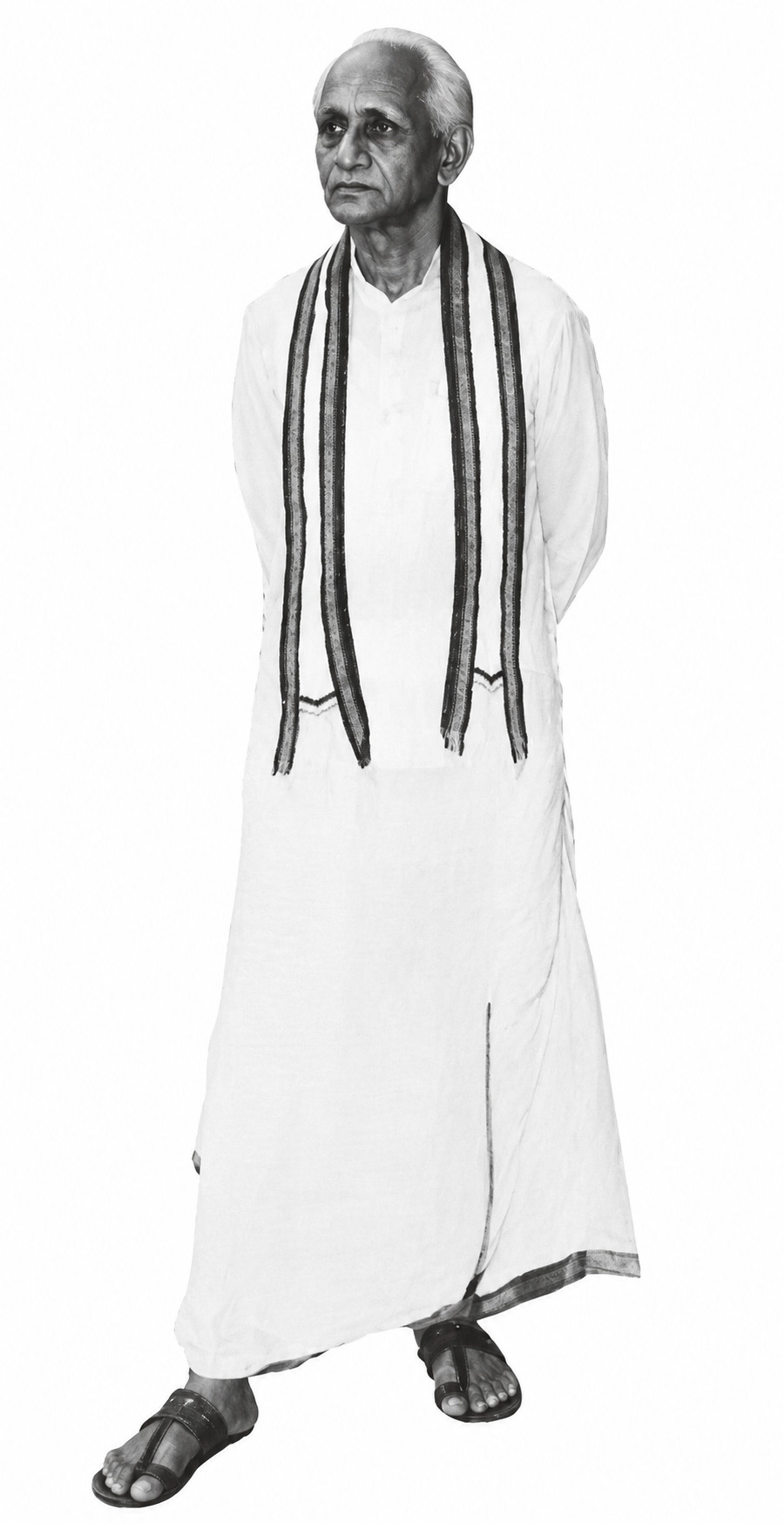
With deep humility, I dedicate this book, Asanas — The Golden Rules of Health, to my revered teacher, Dr. V. V. Ramaraju, who blessed me with the wealth of good health, taught me the profound principles of Prakriti Chikitsa (Nature Cure), and, with kindness and affection, shaped the course of my life in a way that enabled me to serve society.
- Dr. Manthena Satyanarayana Raju
Dr. Vegiraju Venkata Ramaraju was born on July 2, 1913, in the village of Marripudi, located in Bapatla Taluk of Guntur District. The village was well known as a sacred place because of the many Yajnas (Vedic sacrificial rituals) and Yagas (elaborate Vedic fire rituals) performed there.
He was the youngest son of Sri Vegiraju Kotamraju and Smt. Adeyamma, who were deeply devoted to the constant remembrance of the Divine Name (Anavata Namasmarana — uninterrupted chanting of God's name).
Just as the sun spreads its light the moment it rises, Ramaraju's noble qualities became evident from an early age. At the age of just eight, he became convinced that meat was not meant to be human food and that all living beings deserved compassion. He gave up eating meat himself and, despite opposition from his elders, courageously stood by his conviction. In time, he even persuaded them to give up meat, revealing his deep sense of humanity and compassion.
His love for learning was immense. However, given the circumstances of those times, he completed his School Final education, underwent teacher training in a British-run school, and took up the teaching profession. While working as a teacher, he made significant efforts for the development of many schools in the surrounding areas.
Later, at the request of his elder brother, the renowned physician Sri Vegiraju Krishnamraju, he gave up his teaching career and dedicated himself to the practice of Nature Cure (Prakriti Chikitsa). At that time, Ramaraju was only 21 years old.
Sri Krishnamraju was an extraordinary personality. He trained many young men in Karra Saamu (traditional stick fighting) and Katti Saamu (traditional sword fighting), shaping them into skilled practitioners of physical training and martial arts.
He was also an unmatched expert in Nature Cure. During his visits to Delhi, he delivered lectures in Sanskrit that attracted not only the general public but also eminent personalities such as Mahatma Gandhi, Vinoba Bhave, Purushottam Das Tandon, and Jamnalal Bajaj. Inspired by his teachings, he led a rural Nature Cure movement and successfully treated many unusual and stubborn illnesses through natural methods.
On one occasion, a village headman was on the verge of death. Following his elder brother's instructions, Ramaraju went to examine him. The man had already been moved to a shed outside the house because everyone believed that his death was imminent. Ramaraju examined him by pressing and massaging his abdomen. Realizing that there was still hope, he had the man brought back inside the house. He then administered an enema, cleansed his large intestine, and gave him a bath. Within about an hour, the man began speaking and was even able to drink milk.
The villagers, who had been certain that the village headman would die, were astonished to see him recover. They began spreading stories among themselves: "A young yogi has come! They say he eats nothing except raw food and fruits. He simply rubbed the patient's stomach and brought him back to life with a mantra!"
Curious people came to see Ramaraju. With great simplicity and humility, he would explain, "My dear friends, this is neither a mantra nor a miracle. I follow an uncooked natural diet, and I simply treated him through Nature Cure by cleansing his large intestine. That is all."
Such was the simple and unassuming life of Dr. Ramaraju.
In those days, whenever cholera broke out, entire villages would be abandoned. People fled in fear, leaving even the bodies of their loved ones behind. At such times, Ramaraju encouraged groups of young men to come forward. Every day, they would dig large pits and respectfully bury those who had died. Even the British officials who witnessed these scenes were amazed by their courage and spirit of service.
Living entirely on an uncooked natural diet — consisting only of raw vegetables and ripe fruits — Ramaraju undertook an extraordinary bicycle journey of about 3,800 miles (over 6,000 kilometers). During this journey, he met many distinguished personalities. One of the most memorable moments was his meeting with Mahatma Gandhi.
On the day he went to see Gandhi, the public visiting hours had already ended. The attendants firmly told him that no more visitors would be allowed. Ramaraju then sent in a small note. After reading it, Gandhi invited him inside.
Looking at the young man, Gandhi asked, "Why do you eat only raw vegetables?"
Ramaraju replied, "It is my elder brother's instruction. This is an experiment to demonstrate the strength and benefits of a natural diet."
On hearing this, Gandhi encouraged him, saying, "Beta, tum achchha kaam kar rahe ho. Mat chhodo." ("My son, you are doing a good work. Do not give it up.") He then recited a Sanskrit verse.
Ramaraju possessed an exceptional memory and could retain whatever he heard after a single reading or hearing. The verse became deeply engraved in his mind:
Na tvaham kāmaye rājyam,
Na svargam nā punarbhavam;
Kāmaye duḥkha-taptānām,
Prāṇinām ārti-nāśanam.
Meaning: "I do not desire a kingdom. I do not desire heaven, nor even freedom from rebirth. What I truly desire is the power to remove the suffering of living beings who are tormented by sorrow."
Ramaraju never forgot these words. They became the guiding ideal of his life. He devoted himself to providing free medical treatment and food to the poor, considering it his life's mission.
He followed this uncooked natural diet continuously for seven years, from 1936 to 1942, and through his own life demonstrated its remarkable benefits to the world.
For some time, Dr. Ramaraju's elder brother, Sri Krishnamraju, established Nature Cure ashrams in Bapatla and later in the forests near Nakrekal. The experiences they gained while running these ashrams were truly remarkable.
From those experiences, Sri Krishnamraju often emphasized two important principles: "Hunger is a falsehood.", "Weakness is a complete falsehood."
He would say that these were conclusions he had arrived at over fifty years earlier through practical experience.
On one occasion, a tribal man suffering from severe vomiting and diarrhea was brought to the ashram by his relatives, who left him there for treatment. He was unable to speak, his body was completely dehydrated, and he could not even move. Treatment was started immediately.
One night, loud noises suddenly came from the patient's hut. Hearing the commotion, the doctor and the watchman rushed there. Their first thought was that a bear might have dragged the helpless patient away.
However, when they lit brighter lamps and looked inside, they found the patient still lying on his bed. They asked him what had happened, but he was too weak to speak and could only move his eyes.
The next morning, they discovered a seven-foot cobra lying dead inside the hut. Even then, the patient was too weak to explain what had happened. About seven or eight days later, after he had fully recovered, he told them that he himself had killed the snake, after which he had collapsed again from exhaustion.
Reflecting deeply on this incident, Ramaraju came to the conclusion that what people call hunger and weakness are, to a great extent, mental states. This was one of many experiences that shaped his understanding.
Between 1936 and 1946, amidst many such experiences, he traveled from village to village throughout Bapatla Taluk, spreading awareness about Nature Cure.
In 1946, his elder brother, Sri Krishnamraju, established a Nature Cure hospital in Bhimavaram, in West Godavari District, and invited Ramaraju to join as a physician. Ramaraju accepted the responsibility of managing the institution. There, he gained extensive practical experience in Nature Cure, learning both its strengths and its limitations, and began sharing those valuable experiences with others.
Many distinguished people received treatment under his care. His patients included well-known film personality L. V. Prasad, as well as members of the Bajaj family, among many others.
Ramaraju named his younger son after his elder brother, Krishnamraju. He personally trained him in Nature Cure for five and a half years, and in 1987 entrusted him with the responsibility of managing the hospital.
Even at the age of 89, Dr. Ramaraju continued to lead an extraordinarily active life. He conducted yoga camps, taught yoga to 1,200 revenue department employees and 140 Physical Education Teachers (P.E.T.s) in the district, and provided treatment to patients who came not only from Andhra Pradesh but also from neighboring states such as Tamil Nadu, Karnataka, and Odisha. He also organized numerous yoga and Nature Cure camps.
To remain so active and dedicated to public service at the age of eighty-nine was an exceptional achievement. It is no exaggeration to say that such a feat was possible only for Dr. Ramaraju.
Many people urged Dr. Ramaraju to record his experiences in the form of books. However, he would always say, "A book can serve as a guide, but it cannot take a person to the destination. If someone practices treatment merely by reading a book and suffers harmful consequences, it is the science itself that will be blamed."
Nevertheless, when his friends and family persistently insisted, he agreed to write a few books. Along with sharing his own experiences, he explained the fundamental principles on which Nature Cure is based and how those principles should be understood and applied in daily life.
He was completely opposed to self-publicity. Whenever newspaper reporters, television channels, or radio stations approached him for interviews or publicity, he would humbly reply, "The acceptance of the people is enough for me. I do not want publicity."
The humility of Dr. Ramaraju, despite his profound mastery of Nature Cure, is best reflected in one of his own statements. He once said:
"During the first five or six years after I began practicing Nature Cure, I thought there was no one equal to me in this field. I believed I had understood everything and that whatever I said was the final truth."
"After another fifteen years, I began to feel that perhaps there was still a little more to learn about Nature Cure."
"Twenty years later, I realized that there was still a great deal left for me to learn."
"Finally, after sixty years of medical practice, I felt that I really knew nothing about Nature Cure."
These words reveal the extraordinary depth of his character and his remarkable humility. The more he learned, the more aware he became of the vastness of knowledge that still remained beyond his grasp.
In 1987, Dr. Ramaraju was honored with the title "Yogacharya" at the Erpedu Ashram in Chittoor District by Malayala Swami. On that occasion, the Swami's words spoke volumes about Ramaraju's wisdom.
He said:
"We believed that we understood religion and yoga correctly. But only after learning yoga from Dr. Ramaraju and listening to his discourses did we realize how little we actually knew. His insight is extraordinary. His understanding of how medical science is deeply woven into religion is truly unparalleled."
It is said that Dr. Ramaraju's deep interest in Nature Cure began in 1936. At that time, a Telugu translation of Louis Kuhne's famous work on hydrotherapy (Jala Chikitsa — water therapy), translated by Sri Dronamraju Satyanarayana, was in a deteriorated condition. Ramaraju painstakingly rewrote the entire work as a 1,000-page manuscript and presented it to his elder brother. This effort is regarded as the turning point that drew him wholeheartedly toward Nature Cure.
Even to this day, his daily life reflects the principles he practiced and preached. Besides attending to all the responsibilities of the ashram, he washed his own clothes, cleaned his own utensils, and carried his own luggage while traveling. Such simple habits demonstrated his understanding that daily work itself is a form of natural exercise.
The remarkable recoveries achieved through his treatments are too numerous to recount. With thorough scientific knowledge, he carefully examined patients, made accurate diagnoses, and successfully treated many who had been declared beyond hope by others. Some patients, who were thought to have no chance of recovery, went on to live another twenty or even thirty years under his care.
Recognizing the value of his work, the Government of India awarded him research grants of one lakh rupees per year during the periods 1980–1983, 1985–1990, and 1992–1995 to conduct research on various diseases. With these grants, he appointed an M.B.B.S. doctor, established a laboratory, and carried out systematic scientific research. Thus, Dr. Vegiraju Ramaraju was a physician who successfully combined the wisdom of traditional Nature Cure with the methods of modern scientific investigation.
No matter who approached him, or at what time, he would patiently offer medical advice without the slightest sign of irritation or fatigue. His usual place of consultation was never the special ward reserved for privileged patients. Instead, he would be found sitting under a tree, surrounded by poor patients. In his eyes, whether a person was rich or poor, influential or ordinary, everyone was equal before disease.
Dr. Ramaraju relieved thousands of people from illness and explained the principles of Nature Cure with such clarity that they became as easy to understand as peeling a banana. His thoughts, words, and actions were always in perfect harmony, and he dedicated his entire life to spreading the knowledge of Nature Cure.
When I myself was admitted to his hospital in poor health, he showered me with selfless affection. He gave me a thorough understanding of Nature Cure, restored me to complete health, and breathed new purpose into my life by shaping me into a physician whose work would serve society. He nurtured the spirit of service within me and guided it onto a noble path. The love, affection, and guidance he gave me are unforgettable.
It is therefore my great fortune to humbly dedicate this book at the sacred feet of my revered teacher — Yogacharya Dr. V. V. Ramaraju, a physician worthy of comparison with Dhanvantari, the divine physician. On this occasion, I offer him my heartfelt salutations and deepest reverence.
- Manthena Satyanarayana Raju
Whenever God wishes to bring welfare to humanity, He raises up a few individuals to serve as guides for mankind. Whenever I think of Satyanarayana Raju, I feel he is one such person. Dr. Raju is very dear to me. I have the affection of a father toward him because he lives with perfect harmony between his thoughts, words, and actions, and dedicates himself day and night to the service of others.
Having studied and understood Nature Cure for several decades, I have watched Satyanarayana Raju restore the health of thousands of people through this system. I have also realized that, along with proper food and lifestyle, asanas (yogic postures) make an invaluable contribution to good health.
About two years ago, I requested Satyanarayana Raju to write a book that would give the general public a complete understanding of asanas. The reason I specifically asked him was that I had personally observed his method of teaching asanas. It is comprehensive, scientific, and highly effective. I felt that if this knowledge could reach everyone, people would be able to achieve both physical and mental well-being in their own homes.
Today, after seeing this book, Asanas — The Golden Rules of Health, that long-cherished wish of mine has finally been fulfilled.
After reading the manuscript of this book, I was deeply impressed by the way Satyanarayana Raju has explained the asanas. His discussions on topics such as the proper performance of each asana, why one should take rest between asanas, the difference between physical exercises and yogic asanas, and many other related subjects are based on rich practical experience and presented in a thoroughly scientific manner.
This book will be immensely useful to everyone who values good health. It is no exaggeration to say that anyone who reads it even once will feel inspired to begin practicing the asanas immediately.
Modern man may be surrounded by material comforts, yet he is constantly troubled by numerous mental stresses. As a result, he unknowingly invites ill health and inner unrest into his life. This book, Asanas — The Golden Rules of Health, provides the right answer to all these problems. It is my sincere hope that everyone who desires good health will make the best use of this opportunity.
I offer my heartfelt congratulations to Satyanarayana Raju, who has dedicated his life as a sacred offering (Yajna — a selfless act performed for the welfare of others), considering selfless service for public health to be his noble mission and working tirelessly without any expectation of personal reward.
I also sincerely hope that many more books on health will come from his pen in the years to come.
Ch.V.P.Murthy Raju
Freedom Fighter
Gandhian
My heartfelt greetings to all lovers of good health.
From my childhood, I had a feeling of tightness in my chest, and my heart appeared enlarged, much like that of a person suffering from heart disease. Even by the time I reached the age of eighteen, my height had not grown beyond five feet. Noticing these physical conditions, my father sent me in 1985 to Dr. V. V. Ramaraju at Kakinada for Nature Cure treatment.
Dr. Ramaraju taught me asanas and guided me in following proper dietary discipline. I practiced them sincerely for five to six months. As a result, not only did I grow five inches taller, but my chest also became broader and better developed.
From that time onward, I developed a deep interest in asanas and dietary discipline. I began thinking seriously about them, studying them in greater depth, and striving to understand their underlying principles. Whenever anyone asked, or whenever I found people interested, I would teach them the asanas I had learned.
In 1994, I began conducting regular asana classes and training programs. Along with prescribing dietary discipline for patients who followed the principles of Nature Cure, I also taught them asanas. In this way, over the years, I gained considerable practical experience in the teaching and practice of asanas.
In recent years, I have observed that the way asanas are being taught has become very similar to physical exercise. People are made to perform one posture after another — sometimes twenty or thirty different poses in succession. However, they are rarely taught the fundamental differences between asanas and ordinary exercises. They are not given a proper understanding of how long an asana should be held, what should be done after completing an asana, or what the state of the mind should be while practicing it.
Most books on asanas are filled with illustrations of numerous postures, Sanskrit verses, and scholarly language that is difficult for the average reader to understand. A beginner, who knows nothing about asanas, sees these countless complicated postures and immediately thinks, "How could I ever do all these? My body will never bend like that." Such thoughts create fear even before they begin practicing, and they develop a negative attitude toward asanas. They become firmly convinced that their bodies are not suited for yoga.
As a result, many people stay away from asanas altogether.
It was to bridge this gap that I decided to write this book, Asanas — The Golden Rules of Health. I have explained every subject thoroughly, using simple language that anyone can understand. Instead of describing a large number of postures, I have focused only on the fifteen most important asanas that are essential for everyone.
I have also explained how even people who are overweight or whose legs and waist are stiff can practice these asanas with ease. This book has been written to answer the many questions and doubts that arise in the minds of those who practice asanas and to provide them with a clear and complete understanding of the subject.
I have paid special attention to those who believe that they are too overweight to practice asanas. In fact, I have clearly explained that people who are overweight often benefit the most from asana practice. I have included a special method of performing the postures for them and explained why they begin to experience the benefits even if they can bend only up to a certain point in an asana.
Similarly, I have provided specific asanas for people suffering from neck pain, back pain, leg pain, and other common physical problems.
I have also explained how asanas provide unique benefits that cannot be obtained through ordinary exercises, walking, or physical labor. Through asanas alone, a person can gain these benefits while sitting still, without movement, and without experiencing fatigue.
I sincerely believe that after reading this book, you will gain a complete understanding of asanas. More importantly, I hope you will develop a strong desire to practice them and make them a part of your daily routine.
With the heartfelt hope that you will not let this expectation of mine go unfulfilled...
Yours sincerely,
Mantena Satyanarayana Raju
Writing a book is like performing a Yajna — a sacred undertaking. Writing a book on health is an even greater Maha Yajna (great sacred undertaking). Such an effort requires not only dedication and ability but also the support and cooperation of many people.
Moreover, I resolved to write four health books within a single month — from May 1, 2001, to May 31, 2001. The successful completion of that resolve would not have been possible without the wholehearted support and tireless efforts of several kind-hearted people. I can never forget their invaluable help.
My heartfelt gratitude goes first to Sri Gokaraju Gangaraju (Managing Director, Laila Group of Companies, Vijayawada). Sharing my desire to bring this healthy way of living to the people, he stood by me with complete generosity. On the banks of the Krishna River in Vijayawada, amidst beautiful gardens and a peaceful atmosphere, he arranged a comfortable cottage for us. He personally ensured that every necessary facility was provided so that the intense summer heat of the Rohini Karthe (the traditionally hottest period of summer) would not interrupt our work. He took special care that we faced no obstacles during that entire month, enabling this great undertaking to proceed smoothly. For all his thoughtful support, I offer him my heartfelt thanks.
I also express my sincere gratitude to the distinguished freedom fighter and Gandhian, Sri Ch.V.P. Murthy Raju, who constantly guided me with valuable advice throughout my life's journey, encouraged me to write a book on asanas, and graciously wrote the foreword for this book.
My thanks are due to Sri Turumella Koteswara Rao, who, out of his own affection and goodwill, meticulously proofread these books, and to Sri Vakada Durgaprasad, who stayed with me during the writing process and prepared the fair copies of the manuscripts.
I also extend my sincere appreciation to the management and staff of the printing press, and especially to Sri Shivaji Raju, who treated the publication of these books as their own responsibility and completed the printing within a very short time.
Finally, I offer my heartfelt gratitude and congratulations to all the lovers of health who adopted this way of life, regained their health, and promptly shared their experiences with me through letters and telephone calls whenever I sought their feedback.
Mantena Satyanarayana Raju
An asana is a posture in which the body remains steady, still, and comfortable. Many people think that practicing asanas is simply another form of physical exercise. Just as exercise affects the body, asanas also have a profound effect on the body. However, asanas are not practiced with the body alone.
Every human being is a combination of body, mind, and consciousness. Together, these three constitute the complete human personality. The primary purpose of asanas is to bring these three into harmony and thereby establish balance.
If asanas were merely physical movements, we could perform them while thinking about household matters, office work, or anything else. But that is not the case. While practicing an asana, the entire attention of the mind should remain on the body. No other thoughts should be allowed to enter the mind.
One should remain fully aware of the state of the mind during the asana, the flow of the breath, and the way the muscles are functioning. The mind should be completely absorbed in observing these aspects. Only then can it be said that the asana has been practiced correctly.
Physical exercise, on the other hand, does not require this kind of mental involvement. Therefore, its benefits are limited mainly to the body, whereas the benefits of asanas extend much further.
When a person is physically and mentally unhealthy, they cannot perform any task in life with enthusiasm. Nor can they achieve what they set out to accomplish. Only when a person enjoys both physical and mental health can they work with energy and efficiency. It is only then that they can experience true happiness and progress toward spiritual growth.
Our ancestors realized this truth thousands of years ago. That is why they developed the system of asanas, practiced it themselves, and experienced its profound benefits. In those days, medicines as we know them today did not exist. Therefore, people sought ways to prevent illness by making the best use of the body's own natural strength. As a result, they discovered methods by which the body could be maintained in good health. These methods have stood the test of time and continue to produce excellent results even today.
Modern systems of medicine are comparatively recent and are based on relatively limited experience. Asanas, on the other hand, have been studied, refined, and practiced over thousands of years. They have evolved into a well-established system for promoting physical health, mental well-being, and spiritual development.
Although there are great differences between the way people lived in ancient times and the way we live today, the need for asanas remains exactly the same. Asanas not only promote physical health but also help a person attain a higher level of consciousness.
For those of us who live with illness, pain, suffering, and mental distress, such an elevated state may seem beyond imagination. Our first responsibility is to free ourselves from physical and mental suffering. Attaining higher states of consciousness comes later. The primary purpose of practicing asanas is to overcome these forms of suffering.
Asanas keep every joint in the body flexible and free from stiffness. They strengthen the muscles and promote healthy blood circulation to every organ. They help remove toxins and harmful waste products that accumulate in different parts of the body. They gently massage all the internal organs and improve their functioning.
Most importantly, asanas create harmony between the body and the mind, bringing deep mental relaxation. The body and the mind are inseparable. When the body becomes truly healthy, positive changes naturally begin to take place in the mind as well.
Mental stress and physical weakness are two major causes of many illnesses.
The human body possesses an extraordinary ability to heal itself. By using its own natural strength, it can protect itself from disease. This natural defense is what we call the immune system or immunity. The practice of asanas helps strengthen the body's natural resistance to disease.
When waste materials accumulate within the body, they create conditions in which disease-causing bacteria and harmful toxins can thrive. Asanas help remove these accumulated impurities, thereby promoting a cleaner and healthier internal environment.
Many diseases arise when vital organs such as the heart, lungs, and kidneys do not function properly. The practice of asanas helps these organs work efficiently and with greater strength.
Similarly, many health problems occur when the nervous system does not function correctly. Asanas strengthen the nerves, relieve pressure on them, and ensure that nerve signals are transmitted properly to every part of the body.
Asanas also protect us from excessive mental stress, which is one of the root causes of many diseases.
The human body contains endocrine glands, which produce hormones. These hormones regulate the functioning of the body's various organs. Some hormones also influence the mind. Likewise, the functioning of these glands is affected by our mental state.
For example, when a person experiences anger, fear, or anxiety, a hormone called adrenaline is released into the bloodstream in larger amounts. As a result, the heart beats faster, breathing becomes more rapid, and the muscles tighten, causing the body to enter a state of tension.
At the same time, when the body needs to protect itself from danger, adrenaline is released in greater quantities to prepare us to respond quickly. For instance, if we are absent-mindedly walking along a road and a truck suddenly comes speeding toward us, we instinctively jump aside without consciously thinking. It is adrenaline that enables the body to react so swiftly in such situations.
Similarly, during childhood and adolescence, increased secretion of thyroid hormones supports normal growth and development. In women, hormones are essential for every stage of reproduction, including the release of eggs, conception, and pregnancy.
The functions of hormones are so numerous and varied that it is impossible to describe them as having only a single role. They regulate countless processes throughout the body. Even the speed at which an organ should function — whether it should work faster or slower at a given time — is determined by hormones.
For the body to remain healthy and function properly, each endocrine gland must release exactly the right amount of hormones into the bloodstream at the right time. When this delicate balance is disturbed, it causes not only physical changes but also changes in a person's mental and emotional state.
One of the major benefits of practicing asanas is that they help regulate the functioning of the endocrine glands, keeping their activity balanced and stable.
The endocrine glands often fail to function properly because of excessive physical strain, improper use of the body, and mental stress. These factors interfere with the proper transmission of nerve signals to the glands and reduce the supply of oxygen-rich blood that they receive. As a result, their functioning becomes impaired.
Asanas gradually correct these problems. They restore proper nerve communication, improve blood circulation, and gently help the endocrine glands return to their normal, healthy functioning.
True health is possible only when every organ in the body works in harmony with all the others. When this coordination is disturbed, the body's efficiency declines, and illness develops. The regular practice of asanas helps restore this harmony among all the organs, enabling the body to function as a well-coordinated whole.
According to yogic science, the human body is surrounded by an invisible field of energy. This may also be called an energy sheath. In yoga, it is known as the Pranamaya Kosha (the vital energy sheath).
The existence of this energy field, described in yogic texts thousands of years ago, was later explored by some scientists in Russia using a technique known as Kirlian photography, through which they claimed to photograph this energy field. This drew attention to the idea that the body is surrounded by a subtle field of energy.
This vital energy flows both within and around the body through certain channels. In yogic science, these channels are called Nadis (subtle energy pathways). It is believed that when these pathways become blocked, or when excessive energy accumulates in one area, various physical and mental disorders can arise.
The practice of asanas helps this Prana (vital life energy) flow freely and smoothly through the Nadis, without obstruction. As a result, the body and mind are better able to maintain good health.
Asanas also bring about important changes in the way we breathe. Rapid, irregular breathing is often a sign of physical or mental stress. Through the practice of asanas, breathing gradually becomes slower, deeper, and more even.
Asanas reduce the rate of breathing and encourage long, steady breaths. This, in turn, brings about a state of mental calmness and inner peace.
While practicing asanas, the mind remains alert and aware. The mind is usually restless, constantly running from one thought to another. During an asana, however, it should become steady and remain focused on the body. If an asana is performed without awareness — allowing the mind to wander instead of keeping it on the body — it can hardly be considered true asana practice.
No matter how perfectly an asana is performed physically, it will not yield its full benefits if the mind is not engaged with the body and its organs. While practicing asanas, focusing the mind on the breath keeps worries and anxieties from entering the mind, at least for that period of practice. Although this may seem to be only a temporary benefit, regular practice gradually brings about a profound and lasting transformation in one's mental state.
The body often reflects what is happening in the mind. For example, when we are angry, we instinctively raise our chest and shoulders. When we are sad, we sigh deeply. When we are anxious, our breathing becomes rapid, and our voice begins to tremble. On the other hand, when we are happy, the entire body feels light, relaxed, and free from tension.
In this way, the condition of the body often reveals the condition of the mind.
There is no doubt that the regular practice of asanas strengthens both the body and the mind, promotes good health, frees us from pain and suffering, and gradually prevents these negative physical and mental reactions from arising. In doing so, asanas help shape both the body and the mind into their healthiest and most harmonious state.
An asana is the practice of placing the body in a particular posture and then remaining still in that position. Every asana consists of three distinct stages. Only when all three stages are completed can it truly be said that an asana has been practiced. These stages are:
Let us understand each of these in detail.
1. The First Stage — The Entry Stage (How to Perform the Asana):
Every asana should be performed according to a proper method. Following the prescribed sequence of movements to enter an asana is called the Entry Stage. In other words, when you perform the posture correctly and prepare the body to remain in the final position, the first stage is complete.
However, if you perform the movements correctly but immediately return to the starting position without allowing the body to remain in the second stage, the practice will not produce any real benefit.
Simply moving into an asana and immediately coming out of it cannot truly be called practicing an asana. Even if you perform many different postures every day in this manner — assuming each posture only briefly before releasing it immediately — you will gain little or no benefit.
For the Entry Stage to bear fruit, it must be followed by remaining steadily in the Asana Stage.
2. The Second Stage — The Asana Stage (Remaining Still and Steady): This is the most important stage of an asana.
The Asana Stage is the period during which the body remains completely still in the final posture for as long as one can comfortably maintain it. Most of the benefits of an asana depend on how long you remain in this stage and the state of your mind while you are in it. If this stage is practiced correctly, it accounts for 60–70% of the total benefit of the asana.
If you merely place the body in a posture during the first stage and then immediately come out of it without entering the second stage, it cannot be called an asana. Likewise, completing only one of the three stages does not constitute practicing an asana. In such a case, it is simply exercise.
Take Surya Namaskara (Sun Salutation) as an example. It consists of twelve postures. Although all twelve postures are performed in one round of Surya Namaskara, this does not mean that twelve asanas have been practiced. The reason is that, in Surya Namaskara, one moves continuously from one posture to the next, performing only the first stage of each posture. There is no Asana Stage, in which the posture is held steadily, nor is there a Relaxation Stage after each posture.
Since these two stages — which are responsible for producing the major benefits — are absent, Surya Namaskara and asanas produce different results. This is why Surya Namaskara is regarded as a form of exercise rather than a series of asanas.
Many people perform the Entry Stage correctly, but because they are eager to finish quickly, they remain in the Asana Stage for only a short time before coming out of the posture. Others treat the posture itself like an exercise, moving the body back and forth while counting "one, two, three," instead of remaining steady.
Whether a person leaves the posture too soon or keeps moving while in it, the practice cannot be considered a true asana. As a result, the full benefits are not obtained. Instead of receiving 60–70% of the benefits, they gain only about 20–30%.
If the Asana Stage, which is the heart of asana practice, is neglected, then asanas become no different from ordinary exercises. The essential distinction between the two is completely lost.
3. The Third Stage — The Relaxation Stage (Allowing the Body to Rest Completely):
After remaining motionless in the Asana Stage for as long as the body can comfortably maintain the posture, the practice moves into the Relaxation Stage. The longer and more steadily the posture is held, the greater the benefits the body receives during this stage.
The Relaxation Stage is not merely a period of rest. In fact, 30–40% of the total benefit of an asana is obtained during this stage.
During this stage, one should either sit or lie down quietly for one or two minutes, allowing the body's fatigue to subside and the breathing to return to its normal rhythm. During this time, the body, mind, muscles, nerves, and the entire system become completely relaxed and peaceful.
If another asana is begun without giving the body sufficient time to complete this Relaxation Stage, the full benefits of the previous asana will not be obtained.
Many people practice asanas without fully understanding the proper method. They simply perform forty or more different postures one after another, giving little importance to either the Asana Stage or the Relaxation Stage. Later, they feel that asanas do not produce results. In reality, no one can obtain the full benefits by practicing in this way.
Because people do not experience the expected results, they gradually lose interest in asanas and discontinue their practice. Not knowing the true secret of asanas, many turn instead to walking, physical exercises, aerobics, gyms, and other forms of fitness, moving away from asana practice altogether.
To help overcome this misunderstanding and provide a clear understanding of asanas, I will explain these three stages in detail and emphasize their importance while describing the fifteen most important asanas.
I have deliberately limited this book to these few asanas because, when practiced correctly according to this method, these fifteen asanas alone are sufficient to provide the body with complete benefits.
To receive the full physical and mental benefits of asanas, all three stages must be practiced properly. From now on, try practicing in this manner for some time. You will then understand for yourself what an asana truly is.
In the chapters that follow, I have explained each of these three stages in greater detail. I sincerely hope that you will read them carefully, understand them thoroughly, and then begin practicing asanas with the right attitude and an open mind.
For every organ in our body to function properly, it must receive an adequate and continuous supply of blood. Only then can the various organs carry out their functions efficiently without a decline in performance.
Before we understand how asanas influence blood circulation, let us first learn how blood serves the body, what its functions are, and how much blood the heart pumps through the body each day.
Functions of Blood in the Human Body
1. Blood carries oxygen from the lungs to every cell in the body. It also transports the carbon dioxide produced by the cells back to the lungs, where it is expelled from the body during exhalation.
2. Blood transports digested nutrients throughout the body. After digestion in the small intestine, food is broken down into simple forms such as monosaccharides, amino acids, fatty acids, glycerol, vitamins, and minerals. These nutrients are absorbed into the bloodstream, which then carries them to all the organs and tissues of the body.
3. Blood carries waste products from the cells to the organs of excretion. Some waste products are first transported to the liver, where they are processed before being prepared for elimination. For example, urea, uric acid, and creatinine, which are produced during protein metabolism, are carried by the blood to the kidneys and are ultimately excreted from the body through urine.
4. Blood transports enzymes and hormones from the places where they are produced to the organs and tissues where they are needed.
5. Blood protects the body against disease. White blood cells present in the blood destroy harmful microorganisms that enter the body. When disease-causing microbes invade, the body also produces antibodies and antitoxins to fight them, thereby maintaining the body's natural immunity.
6. Blood helps prevent excessive blood loss after an injury. Its ability to clot seals damaged blood vessels and stops excessive bleeding.
7. Blood helps regulate the body's temperature. When the body becomes too warm, blood carries heat to the skin, where it is released through sweating and evaporation. On the other hand, when the outside temperature is very low, the blood vessels near the skin constrict, helping to retain heat within the body and prevent excessive heat loss.
The heart is responsible for supplying blood to every part of the body. It can be compared to a hand-operated water pump. Just as each stroke of a hand pump brings out a certain amount of water, each heartbeat pumps a certain amount of blood into the blood vessels.
In an average person, the heart beats about 70 to 72 times per minute. With every heartbeat, it pumps approximately 60 to 70 milliliters of blood out into the circulation. Thus, the heart supplies about 4.5 to 5 liters of blood every minute. Even when we are completely at rest and doing no work, the heart continues to pump this much blood through the body every minute.
However, when we engage in strenuous physical activity, perform exercises, or are involved in intense mental work, the normal supply of about 5 liters of blood per minute is no longer sufficient.
Whenever a part of the body works harder, it consumes more energy. As energy is used, that part of the body requires a greater supply of oxygen. To meet this increased demand, both the lungs and the heart have to work harder. At such times, the heart beats faster and more forcefully, enabling it to pump a larger volume of blood to the parts of the body that need it most.
In this way, the blood pumped by the heart is distributed according to the body's needs. Organs and tissues that are working harder receive a greater share of the blood supply, while those that are relatively inactive receive only the amount they require.
In addition, vital organs such as the heart muscles, lungs, brain, kidneys, and liver receive a comparatively large share of the blood supply because of their essential functions. Among all the tissues of the body, the muscles attached to the bones (skeletal muscles) receive the least blood when they are at rest.
People who perform physical labor naturally use almost all the muscles in their bodies. In contrast, those who spend most of their time sitting in offices, or those who lead a sedentary lifestyle with little physical activity, do not use all their muscles regularly.
It is only when muscles are used that they receive proper blood circulation. The reason is that when muscles are at rest, many of their capillaries (tiny blood vessels) remain closed, while only some remain open and carry blood. These capillaries take turns functioning — some open while others close. They do not all remain open continuously.
When a muscle is at rest, only about 1 to 3 milliliters of blood flow through every 100 grams of muscle tissue. However, during vigorous activity, this blood flow can increase to about 30 milliliters. Since working muscles require a much greater supply of blood, the capillaries open automatically to meet this increased demand.
Proper blood circulation is essential for the efficient removal of waste products from the body's cells. For example, the carbon dioxide produced by the cells is carried by the blood to the lungs, where it is exhaled. Thus, muscles remain healthy and function efficiently only when they are regularly put to work.
Now let us see how the practice of asanas influences blood circulation in the muscles.
When an asana is performed, only certain groups of muscles work for a period of time, after which they return to their normal relaxed state. In this way, each asana activates a different set of muscles. Let us now understand how these working muscles receive an increased supply of blood during the practice of asanas.
To understand this more clearly, let us consider a simple example.
When you clench your fist, you will notice that the muscles of the forearm tighten. As they contract, the forearm appears slightly smaller, as though it has been compressed. This happens because the veins — the blood vessels that carry blood from the hand back to the heart — are squeezed by the contracting muscles. As a result, the blood within these veins is pushed more rapidly toward the heart.
Now, if you continue to keep your fist tightly clenched for a short time, you will notice that the forearm gradually appears larger or slightly swollen. Let us understand why this happens.
Although the blood vessels within the muscles are compressed for the first few seconds of contraction, they gradually begin to expand again. This is because blood flowing from the heart toward the hand continues to arrive, causing pressure to build up within the blood vessels. As this pressure increases, the capillaries — the tiny, hair - like blood vessels within the muscles—begin to open.
Since the muscles are expending energy while they remain contracted, their demand for blood also increases. Consequently, a greater volume of blood is directed toward that part of the body.
Now imagine that you suddenly open your clenched fist. The blood that has been flowing from above rushes rapidly into the blood vessels of the muscles. This sudden increase in blood flow makes the forearm appear fuller and slightly larger. At this moment, the amount of blood flowing through these blood vessels is much greater than under normal conditions.
As the capillaries open, the exchange of oxygen and carbon dioxide within the cells becomes more efficient. Cellular respiration improves, and carbon dioxide is removed more effectively.
In this way, by alternately contracting and relaxing the muscles, a much greater supply of blood reaches them.
When practicing asanas, it is not only the muscles that are affected. In each asana, pressure is also applied to the internal organs in different parts of the body. As long as an organ remains compressed during a posture, the blood flow to that area is temporarily reduced. This is why you may experience some discomfort or a mild aching sensation while holding the asana.
However, as soon as the posture is released, a much greater volume of blood flows to that area than it normally receives. In this way, asanas enable us to redirect the blood pumped by the heart, increasing its flow to different parts of the body as needed.
When every organ receives this increased blood supply at least once each day through regular practice, its strength and efficiency improve. Waste products produced within the cells are removed promptly instead of being allowed to accumulate.
Just as asanas increase the supply of fresh blood to every part of the body, they also help ensure that deoxygenated blood returns freely from all parts of the body to the heart without obstruction. As a result, the heart is able to function more efficiently and does not have to work under unnecessary strain.
Thus, by practicing asanas every day, we can keep the heart healthy and enable it to supply blood efficiently to every organ of the body without placing excessive stress on it.
In today's society, many people are far more familiar with physical exercise than they are with asanas. One reason asanas have not become as popular as exercise is the shortage of qualified teachers. Another is that, even among those who have learned them, relatively few are willing to teach and share their knowledge with others.
The influence of Western lifestyles is evident in many aspects of our lives. Since Western countries place greater emphasis on physical exercise, many people assume that following the same approach is the best choice. Doctors, too, often recommend exercise for maintaining good health. Added to this is the large number of fitness centers and training facilities that teach various forms of exercise. For these and many other reasons, most people show greater interest in physical exercise than in asanas.
Even those who know something about asanas often think, "What is so special about them? They simply involve bending the body into different positions without much physical effort. Exercise, on the other hand, moves the entire body. It causes fatigue and makes you sweat, so it must be more beneficial." This is a common misconception.
In reality, the body benefits far more from the practice of asanas than from ordinary physical exercise. Along with improving physical health, asanas also bring a deep sense of calm and peace to the mind.
To understand the difference between the two, we must first examine the changes that take place in the body during physical exercise and compare them with the changes that occur during the practice of asanas. Only then can we clearly understand which approach is truly more beneficial.
Changes in Breathing During Physical Exercise:
The respiratory system and the circulatory system work together to meet the body's oxygen requirements. Their activity changes according to how much oxygen the body needs.
When the body is at rest, breathing is slow and deep. As physical activity increases, the rate of breathing also increases. The harder we work, the faster we breathe.
Under normal resting conditions, the lungs take in about 6 to 8 liters of air per minute. During strenuous physical activity, however, this can increase to 50 to 100 liters per minute.
At rest, the body uses approximately 250 to 350 milliliters of oxygen per minute. During exercise, the body's oxygen requirement may rise to 4,500 to 5,000 milliliters per minute. Since physical exercise requires a large amount of energy, the body's demand for oxygen increases accordingly.
Normally, while the body is at rest, it extracts about 60 to 80 milliliters of oxygen from every liter of blood. During exercise, this may increase to about 120 milliliters per liter.
During vigorous exercise, the oxygen level in the cells decreases while the amount of carbon dioxide increases. As a result, a greater amount of oxygen carried by the blood is released into the cells to meet their increased demand.
Another reason the lungs work harder during exercise is the production of lactic acid in the cells. During strenuous activity, the muscles are required to work beyond their normal level. To provide the necessary energy, they begin using the glucose stored within the muscle cells. As energy is released from glucose, lactic acid is produced and enters the bloodstream.
Under normal conditions, the blood contains about 10 to 20 milligrams of lactic acid per 100 milliliters of blood. During strenuous exercise, this may increase to 100 to 200 milligrams per 100 milliliters.
The increased concentration of lactic acid in the blood leads to the production of larger amounts of carbon dioxide. As the level of carbon dioxide rises, the lungs must work harder to remove it from the body. To accomplish this, breathing becomes much faster, allowing more oxygen to be taken in and delivered to the cells.
However, much of the extra oxygen supplied by the lungs is used simply to eliminate the excess carbon dioxide produced during exercise. It is often not sufficient to fully meet the metabolic needs of the cells themselves.
As a result, the heavy energy expenditure in the muscles during exercise leads to fatigue and exhaustion in the body.
Changes in Breathing During the Practice of Asanas:
Unlike physical exercise, the practice of asanas does not cause the breathing rate to increase, nor does it require the lungs to work harder to supply large amounts of oxygen.
This is because, unlike exercise—where the muscles are often made to work beyond their normal capacity—asanas do not demand excessive physical effort. The muscles do expend energy while holding an asana, but they do not undergo the same changes described earlier, such as the excessive production of lactic acid and the resulting increase in carbon dioxide.
While an asana is being held, breathing remains slow, steady, and gentle. As soon as the posture is released, a few deep breaths are taken naturally. These deep breaths supply a greater amount of oxygen to the body's cells.
This pattern of deep breathing continues during the interval between one asana and the next.
Under normal conditions, each breath brings in about 300 to 500 milliliters of air. However, after releasing an asana, each deep breath can draw in 1,000 to 1,100 milliliters of air.
As a result, the body is able to take in a much larger amount of oxygen through deep breathing without placing any extra strain on the lungs.
During physical exercise, much of the additional oxygen taken into the body is used merely to remove the excess carbon dioxide produced by the working muscles. In contrast, the oxygen taken in during the practice of asanas is available primarily to meet the actual needs of the body's cells, enabling them to function more efficiently.
Changes in Blood Circulation During Physical Exercise:
As we have already seen, the body's need for oxygen increases during physical exercise. Under normal conditions, each liter of blood carries about 200 milliliters of oxygen. During strenuous exercise, however, the body may require 4 to 5 liters of oxygen per minute.
To transport such a large amount of oxygen, a much greater volume of blood must circulate through the body. This means that the heart has to work much harder. As a result, the heart rate, which is normally about 70 beats per minute, may increase to 150 beats per minute or even more during exercise.
In addition, the amount of blood pumped out with each heartbeat increases from about 70 milliliters to as much as 200 milliliters. In other words, while the heart normally pumps about 4.5 to 5 liters of blood per minute, during vigorous exercise it may have to pump up to ten times that amount.
As the body's oxygen consumption rises, the volume of circulating blood also increases. If the body uses about 100 milliliters more oxygen per minute than normal, the circulating blood volume may increase by approximately 800 to 1,000 milliliters.
To meet this increased demand, the body releases additional red blood cells from its storage sites into the bloodstream. At the same time, because a considerable amount of water is lost through sweating, the water content of the blood decreases, making the blood somewhat more concentrated.
Only after all these changes occur is the blood able to carry the increased amount of oxygen needed by the body's cells.
This clearly shows the great difference between the workload of the heart at rest and its workload during physical exercise.
After vigorous exercise, it may take 20 to 30 minutes for the heart and lungs to return to their normal resting state. The same is true for people who play strenuous sports or run. We have all experienced how, after running fast and then suddenly stopping, the heart continues to beat rapidly, breathing remains heavy and fast, and the body takes time to recover.
Changes in Blood Circulation During the Practice of Asanas:
During physical exercise, the heart works harder in order to supply more blood to the muscles. In the practice of asanas, however, the muscles and internal organs receive an increased blood supply without placing extra strain on the heart.
As we have already seen, physical exercise increases the body's demand for oxygen. As breathing becomes faster to meet this demand, the workload of the heart also increases. During asanas, this increased demand does not arise, and therefore the heart does not have to work harder.
While an asana is being held, blood flow to certain muscles and internal organs is temporarily reduced. As soon as the posture is released, however, these areas receive a much greater supply of blood than they normally do.
Thus, the same blood that is already circulating through the body is redirected by different asanas to provide an increased blood supply to different organs and tissues, after which the circulation gradually returns to its normal pattern.
This kind of selective increase in blood flow to different organs and muscles does not occur during ordinary physical exercise in the same way that it does during the practice of asanas.
Because the oxygen carried by the blood is made fully available to the parts of the body that were engaged in the Asana Stage, those muscles and organs are able to utilize it efficiently. As a result, they regain their strength, function more effectively, and become healthier.
Changes in the Mental State:
Physical exercise certainly keeps the body active and energetic. It may also give the mind a temporary feeling of freshness while we are exercising. However, it does not produce a state of deep mental calm.
When we first learn a new exercise, we consciously pay attention to the body's movements. Once it becomes familiar, however, we perform it almost automatically, without much awareness. The body continues to move, but the mind is no longer actively engaged with it.
Moreover, breathing becomes faster during exercise. Whenever the breath becomes rapid, the mind also becomes restless, making it difficult to experience true mental peace.
The practice of asanas benefits the mind just as much as it benefits the body.
While performing an asana, the mind is focused on the part of the body involved in the posture. During the Relaxation Stage, attention is directed toward the breath. This keeps the mind steady, calm, and free from unnecessary thoughts.
Asanas are accompanied by deep, slow breathing. These deep breaths supply a greater amount of oxygen to the brain, helping to maintain the proper flow of Prana (vital life energy). As a result, the mind naturally becomes calm and peaceful.
After completing all the asanas, one rests in Shavasana. During this Relaxation Stage, all the muscles of the body become completely relaxed. Since the muscles no longer require active control, the brain is relieved of its continuous effort and is able to rest completely.
When the brain receives complete rest, the mind also experiences deep peace.
This is why, after completing the practice of yoga asanas, one feels as though both the body and the mind have been filled with a new source of energy. Such a profound sense of physical and mental rejuvenation cannot be obtained through any form of ordinary physical exercise.
Many people are left with doubts about how to breathe while practicing asanas — when to inhale, when to exhale, and whether they are breathing correctly. Most practitioners never receive a clear explanation of this subject. As a result, they continue practicing with many unanswered questions.
Some are taught to inhale before entering an asana, while others are told to exhale first. They are instructed to hold the breath (Kumbhaka) while remaining in the posture, and then to inhale or exhale again while coming out of it. This is how most people are taught to practice asanas.
When this method is followed, however, the Asana Stage lasts only as long as one can comfortably hold the breath. For most people, this is only 20 to 30 seconds. After that, the need to breathe forces them to release the posture.
The benefits of an asana depend largely on how long the posture can be maintained without movement. The effects of an asana do not appear immediately. They begin gradually, usually 10 to 20 seconds after the posture is assumed, and continue to increase steadily as long as the posture is maintained. These benefits keep accumulating until the point where the body naturally feels that it can no longer remain in the posture and it is time to release it.
If the breath is held throughout the asana, the need for air arises just when the posture is beginning to produce its greatest benefits. As a result, the practitioner is forced to come out of the posture too early and is unable to receive its full effect.
There are one or two specific asanas in which holding the breath, inhaling, or exhaling in a particular way is necessary. However, if this method is applied to every asana, no one will be able to obtain the complete benefits that asanas are capable of providing.
Teachers often instruct students to inhale while lifting the chest, exhale while bending the chest or waist forward, or take a deep breath and hold it while lifting the legs or the body. Such instructions are commonly given during asana practice.
However, if we perform an asana with proper attention and in the correct manner, the body itself knows how much air it needs, how much it should release, when to inhale, when to exhale, and when the breath should naturally be held. It regulates the breathing on its own.
For example, even if we make no conscious effort to inhale, we naturally breathe in whenever we lift the waist or raise the chest. Likewise, when we bend the waist or lower the body forward, the body naturally exhales.
Similarly, while holding an asana, the muscles of the abdomen, the muscles of the chest, the lungs, and other structures are compressed to varying degrees. Depending on the posture, they may be compressed by about 50 to 90 percent. While remaining in such a posture, we cannot simply inhale or exhale whenever we wish. The position of the body itself determines how much air can enter or leave the lungs.
The amount of air that reaches the body during an asana is naturally regulated according to the posture being practiced. Therefore, it is best to leave the breathing entirely to the body while practicing asanas. The body will take care of it automatically.
Our responsibility is simply to maintain the posture steadily and without movement, and to remain in it comfortably for as long as possible. This is the approach that produces the greatest benefit.
Let us now examine a few examples to understand what happens when we deliberately hold the breath during an asana, and what happens when we simply allow the body to regulate the breathing naturally.
Let us take Paschimottanasana as an example. In this asana, one sits with the legs stretched out straight and bends forward without bending the knees, bringing the face down to the knees.
Many people are taught to exhale completely while bending forward from the seated position and then bring the face to the knees. After reaching the posture, they remain with the head resting against the knees for 10 to 20 seconds.
Within 5 to 10 seconds of reaching the posture, the practitioner begins to feel the effects of the asana. The muscles and nerves in the legs are stretched, the abdominal muscles are compressed, and the spine is bent deeply. At this point, the benefits of the posture are just beginning to develop.
However, because the breath has been held or completely expelled, the need for air soon becomes unavoidable. As a result, the posture has to be released before its full benefits can be experienced.
The practitioner then repeats the same asana once or twice more. Each time, the benefits begin to develop, but the posture is interrupted before they can fully unfold. Thus, the process is repeatedly started and stopped, and the complete benefit of the asana is never obtained.
If this method is practiced every day, progress reaches the same point each time and goes no further. The practitioner continues to repeat the practice, but the benefits do not increase beyond that stage.
Now let us consider the same Paschimottanasana without consciously controlling the breath.
After bringing the head to the knees, simply remain in the posture. Because the chest is deeply bent forward, the lungs are naturally compressed by about 80–90%. Even so, the remaining 10–20% of their capacity is enough to allow the body to receive the small amount of air it needs. This enables the body's immediate needs to be met without discomfort and allows the practitioner to remain in the posture without interruption.
Continue holding the posture until the nerves and muscles of the legs have been stretched to their fullest comfortable extent, the abdominal muscles have been fully compressed, and the body naturally signals that it can remain no longer. Stay in the posture for as long as you can comfortably maintain it without movement.
Only by remaining in this way do the muscles and nerves stretch fully and gradually become free from stiffness. Depending on the individual, this may be 20 to 30 seconds, or it may extend to 1 or 2 minutes.
As soon as the posture is released, the lungs naturally take in deep breaths without any conscious effort on our part. If an asana has been held for as long as the body is able to maintain it properly, there is no need to repeat it a second time.
As one becomes accustomed to practicing asanas, the duration of the Asana Stage should gradually increase. Only then will the benefits continue to grow. On the other hand, if one always focuses on the breath and comes out of the posture as soon as breathing becomes difficult, the benefits will always remain limited to the same level, no matter how long the practice is continued.
Therefore, whenever we practice an asana, our attention should be on the correct method and the posture itself—not on the breath. While holding the posture, the mind should not be occupied with thoughts such as, "I am running out of breath," or "I cannot breathe anymore; I must come out now."
The longer an asana can be maintained steadily and without movement, the greater its benefits. Therefore, do not lose the true benefits of asanas by becoming preoccupied with controlling the breath. This is a principle that every practitioner should understand and remember if they wish to receive the full benefits of asana practice.
When beginners learn asanas in a class, twenty or thirty people usually practice together under the guidance of a teacher. During these sessions, everyone enters the posture together and comes out of it together.
This is a good approach while learning. Until the body becomes familiar with the postures, it is beneficial to hold each asana only for a short time before releasing it.
However, even after practicing regularly for ten or twenty days, many people continue the same habit. They enter an asana and come out of it simply because the people around them do so. Everyone remains in the posture for the same length of time and continues practicing in this manner.
After learning for one or two months, they follow the same routine at home. They remember the number of seconds or minutes their teacher instructed them to hold each posture and continue practicing according to that fixed timing.
Some yoga teachers even provide a list specifying exactly how long each asana should be held. Many books on asanas do the same, stating that a particular posture should be practiced for a certain number of seconds or minutes, or repeated a specific number of times.
If we simply follow a fixed time for every asana in this way, we cannot receive its fullest benefits.
When we ask, "How long should an asana be held?", the answer should not be determined by the teacher, by the author of a book, or by anyone else. Each practitioner must determine it for themselves.
On what basis?
It depends on the condition of the body, the particular asana being practiced, and the practitioner's level of experience. The body itself determines how long it can remain comfortably in a posture and when it is time to come out of it.
The body's decision should become our decision.
Remaining in an asana for as long as the body willingly allows is the best way to obtain its complete benefits.
Let us now examine in detail the factors that determine how long an asana should be held.
1. The Condition of the Body:
Every person's physical condition is different.
Someone who has been accustomed to regular physical labor will be able to remain in an asana differently from someone who has lived a comfortable, sedentary life with very little physical activity. Likewise, a person who is overweight will respond to an asana differently from someone who is very lean.
When people with such different physical conditions practice the same asana, their bodies do not respond in the same way.
For some, the body experiences discomfort almost immediately after entering the posture and signals that it should be released. For others, the body may be too stiff to bend properly into the posture at all. Still others may be able to remain in the asana for one or two minutes without any pain or discomfort, allowing them to hold the posture comfortably.
If the same time limit is prescribed for all these people, one person may experience considerable discomfort during that period, another only moderate discomfort, while a third may not even have begun to feel the effects of the asana.
Releasing an asana before the body has even begun to respond to it is of little benefit. Therefore, it is a good practice for each person to remain in the posture for as long as their own body comfortably allows, and not to come out of it prematurely.
2. The Nature of the Asana:
Every asana affects people differently. One person may be able to perform a particular posture with ease, another may be able to do it only partially, while someone else may achieve only half the posture.
If everyone is asked to hold the same asana for exactly the same length of time, their bodies will not respond in the same way. Since their responses differ, the benefits they receive will also differ.
For everyone to experience a similar response and receive the fullest benefit from an asana, each person must remain in the posture for as long as they are individually able to maintain it.
The correct approach is to observe how much your own body is able to cooperate in a particular asana and then make an effort to remain in the posture for that length of time.
3. The Level of Practice:
The length of time you can remain in an asana changes as your practice develops.
During the first one or two months of learning, you will be able to hold each posture only for a relatively short time. However, with regular daily practice, the time you can comfortably remain in an asana gradually increases.
For example, when you first learn Paschimottanasana (the forward bend in which the head is brought to the knees), even remaining in the posture for 10 to 15 seconds may feel very difficult. After about four months of regular practice, however, staying in the same posture for one or two minutes will no longer seem so difficult. If you continue practicing for seven or eight months, you may be able to remain motionless in the posture for two or three minutes without discomfort, as your body gradually becomes accustomed to it.
In this way, the body adapts over time, allowing the duration of the Asana Stage to increase naturally. The length of time you remain in a posture should therefore depend on what your body is prepared to accept at its present level of practice.
Suppose you become accustomed to holding Paschimottanasana for 30 seconds, and then continue practicing it for exactly 30 seconds every day. In that case, your progress will eventually come to a standstill. As your body adapts, the time spent in each asana should also increase. A fixed duration for every practice—or the same duration for everyone—is neither effective nor the correct approach.
So, how long should an asana be held?
When beginners first start learning, they should not remain in any asana for more than 5 to 10 seconds. If the body is pushed too hard at the very beginning, it may become so sore during the first week that even walking or moving about becomes difficult.
If you experience that much discomfort, you may lose interest in practicing asanas altogether.
Therefore, during the first week, the purpose is simply to enter each posture and come out of it, gently preparing all the muscles, nerves, and internal organs for asana practice.
From the second week onward, such soreness usually disappears. From then on, the decision of how long to remain in an asana and when to come out of it should be guided by the body's own response. Pay attention to the changes taking place within the body, and release the posture only when your body indicates that it is time to do so.
After assuming an asana correctly, remain completely still in that posture. While you are holding it, various changes begin to take place within the body. Depending on the asana, certain muscles are stretched, certain areas experience pressure, the breath naturally becomes restricted to some extent, and the intended effects of the posture begin to develop.
As you continue to hold the posture, you may gradually feel pain, fatigue, heaviness, a strong stretching sensation, compression, or pressure in different parts of the body. Wherever these sensations arise, they indicate that the asana is working on that particular part of the body.
Remain in the posture for as long as your body can comfortably tolerate these sensations. As time passes, the discomfort gradually increases until you begin to feel that you can no longer endure it. A natural feeling arises that it would be better to release the posture. Stay in the Asana Stage until your body clearly tells you, "I cannot remain any longer. That is enough. I need to rest." Then, and only then, gently come out of the posture.
Some people may feel the need to release an asana after only 5 or 10 seconds when they first begin. In that case, they should do exactly that. Do not become discouraged by thinking, "The person next to me held the posture for 30 seconds, while I managed only 10." Never compare your practice with that of others.
Likewise, if someone else comes out of the posture while your body is still comfortable remaining in it, do not release the asana simply because they have done so.
Each practitioner should close their eyes, observe the changes taking place within the body, and determine the duration of the asana based on those inner responses.
The most important thing is not how long you remain in an asana, but how steadily you can remain in it without movement. The time spent in a posture should be determined by your own body's response, not by how long someone else remains in it or by a fixed time prescribed by another person.
Consider cooking vegetables. Once they are placed on the stove, not all vegetables cook in the same amount of time. Each one requires a different cooking time. In the same way, no two people can remain in an asana for exactly the same length of time or experience it in exactly the same way.
Depending on your physical condition, your health, and your level of practice, your body will naturally determine how long you should remain in each asana. By allowing your body to guide you in this way, you can receive the full benefit of every posture.
This is one of the great secrets of asana practice.
The most important aspect of asanas is not entering and leaving the posture. The real importance lies in remaining in the posture. Nor is it important to perform a large number of asanas. What truly matters is how correctly and steadily you can maintain each asana that you practice.
If you wish to obtain greater benefits from a smaller number of asanas, the key is to remain in each posture for as long as your body can comfortably sustain it.
I hope you will observe these principles carefully, practice your asanas correctly, and experience their full benefits.
Before practicing an asana, if no particular organ or part of the body draws our attention, it means that the body is comfortable and functioning without any noticeable discomfort.
For example, after eating a heavy meal rich in oil, ghee, and spices, we become aware of the stomach because it feels uncomfortable. Our attention is naturally drawn to it. Whenever the mind becomes focused on a particular organ, it is because something is happening there.
Similarly, when bowel movements are not smooth, we experience abdominal pain. At such times, the mind is repeatedly drawn to the large intestine, where the discomfort is felt.
Before beginning an asana, no particular organ in the body usually occupies our attention. However, once we enter the posture, our awareness naturally shifts to the body.
While remaining in the Asana Stage, many changes take place within the body. Some areas are compressed, others are stretched, blood flow decreases in certain parts, while it increases in others. As these changes occur, the mind becomes aware of them in different ways — through pain, tingling, a feeling of heaviness, increased pressure, or other forms of discomfort.
The part of the body where these sensations are experienced tells us which muscles or organs the asana is acting upon.
As we continue to remain in the Asana Stage, these sensations gradually become more noticeable. If, while holding a particular asana, one part of the body experiences greater discomfort or pain than the others, it indicates that the asana is especially beneficial for that area.
An increase in pain during the Asana Stage is a sign that the asana is producing its intended effect. We should remain in the posture for as long as we can comfortably tolerate that sensation.
Throughout the Asana Stage, keep the mind focused on the areas where the sensations arise and carefully observe the changes taking place there. Notice how the discomfort first appears, then gradually increases, becomes more intense, and finally reaches the point where the body says, "I can no longer tolerate this — I need to rest."
When that stage is reached, gently come out of the Asana Stage and allow the body to enter the Relaxation Stage.
As soon as the body enters the Relaxation Stage, the parts that were previously painful or uncomfortable no longer occupy the mind's attention. Within a few seconds, the body begins to return to its natural, comfortable state.
This is the normal sequence of events that takes place from the moment an asana is assumed until it is released.
When you first begin learning asanas, the pain experienced during the first week is of a different kind. Just as you may feel soreness when you walk a long distance without prior practice, run for the first time, or begin a new exercise routine, similar soreness is natural when you start practicing asanas. Such initial aches should not be given undue importance.
The pain that arises while entering an asana, the discomfort that makes you want to come out of the posture, or the feeling that you cannot continue — all these usually occur before you have reached the full Asana Stage. Such discomfort does not indicate that the asana has begun producing its real benefits in that part of the body.
Once you become well accustomed to practicing asanas, it takes much longer for the pain that cannot be comfortably tolerated to arise after entering the Asana Stage. This allows you to remain in the posture for a longer period. The longer you can remain steadily in the Asana Stage, the greater the benefit.
After practicing certain asanas for some time, you may notice that it takes much longer for the pain in the Asana Stage to increase. When this happens, you should gradually move toward a deeper or more complete form of the posture.
Let us again take Paschimottanasana as an example.
During the first month, you may find it difficult even to hold your feet with your hands while keeping your knees straight. At that stage, bend forward only as far as your body comfortably allows, and remain there in the Asana Stage.
By the second month, you may be able to hold your feet comfortably with your fingers and remain in that position without the discomfort increasing significantly. At that point, bend a little farther forward, attempting to bring your face closer to your knees. You will once again notice the appropriate stretch and discomfort developing.
After practicing this for some time, that position too becomes easier. When the discomfort is no longer sufficient, place your head against your knees and continue practicing at that level for several more days.
When the body becomes fully accustomed even to this position and you no longer experience any meaningful discomfort, try bringing the chest, as well as the head, into full contact with the thighs. This deeper position will remain beneficial for several months.
After practicing for several years, if even this position becomes so easy that you can remain in it for three or four minutes without experiencing the characteristic discomfort, then you may progress to an even more complete form of the asana, if one exists. Otherwise, you may stop practicing that particular asana and begin learning another one.
There are only two or three relatively simple asanas that may eventually reach this stage. In most other asanas, even if you practice them throughout your life, the characteristic discomfort that indicates the posture is working will usually develop fully within one or two minutes.
A circus performer, for example, may be able to place the head and chest completely against the thighs and remain there for ten minutes. Such a person often feels little or no discomfort in forward - or backward - bending postures because the body has already developed extraordinary flexibility. Once the body becomes that flexible, only a limited number of asanas continue to provide further benefit.
If no discomfort arises at all, it indicates that no significant changes are taking place within the body. When no internal changes occur, that particular asana is no longer producing meaningful benefits for you.
Therefore, it is wise to use these sensations as a guide and progress step by step toward the complete form of each asana.
However, do not misunderstand this principle. Simply because greater discomfort can indicate that an asana is working does not mean that you should stubbornly force your body into a posture or push beyond its natural limits. Doing so can cause injury and create problems within the body. You may strain muscles, ligaments, or joints.
Never force an asana. Progress patiently, allowing the body to open naturally over time.
Many people practice asanas in such a way that they never experience the characteristic discomfort of the Asana Stage. If this response does not arise, the asana cannot produce its full benefit.
Whenever an asana produces no such sensation, it usually means one of two things: either the posture has not been performed correctly, or the part of the body that should have been properly stretched or compressed has been left relaxed, allowing the practitioner to remain in the posture too comfortably.
Some people perform thirty or forty different asanas every day, yet they never remain in any one posture long enough for the characteristic discomfort to develop fully. As a result, they do not receive even half of the benefits the asanas can provide.
Others enter an asana but, instead of remaining completely still in the Asana Stage, they continue moving the body — rocking forward, backward, or sideways as though they were doing an exercise routine while counting, "one, two, three."
When this is done, the blood flow, vital energy, and the effects of the asana are not allowed to become concentrated in the specific part of the body on which the posture is meant to act. Such a practice may produce the effects of ordinary physical exercise, but it does not produce the benefits of an asana.
Some practitioners repeat the same asana three or four times in succession. Each time, they enter the posture, come out of it before the discomfort has properly developed, and then repeat the process. They continue performing the asana in rounds, never remaining in the Asana Stage long enough for its full effects to unfold.
Some teachers even recommend practicing Vakrasana three times, Gomukhasana four times, or Paschimottanasana seven or eight times in succession.
In reality, there is no need to repeat an asana so many times. If it is practiced correctly, one well-performed repetition is enough to produce its full benefit.
If, for any reason, a practitioner wishes to repeat an asana, they should first allow the body to complete the Relaxation Stage. Only then should they perform the posture again, remain motionless in the Asana Stage for as long as they comfortably can, and once again follow it with an adequate period of relaxation.
If, instead, asanas are performed continuously in quick succession like physical exercises, the practice may produce the effects of exercise — but the unique benefits of asanas will be almost entirely lost.
In modern life, many people have become accustomed to a routine that involves very little physical effort or discomfort. They often expect the same comfort while practicing asanas. However, if you remain in an asana without experiencing the characteristic sensations of the Asana Stage, you should not expect to receive its full benefits.
The pain that results from overexertion during physical exercise is harmful to the body. In contrast, the discomfort experienced while holding an asana is beneficial, as it indicates that the posture is producing its intended effect.
Whenever you practice an asana, pay close attention to the sensations that arise. If you do not experience any discomfort in any part of the body, it is likely that something in the posture has not been performed correctly. In that case, review your technique carefully and make the necessary corrections.
In some asanas, instead of pain, you may experience tingling, heaviness, pressure, or some other form of discomfort. Whatever form these sensations take, observe them carefully during the Asana Stage and remain in the posture for as long as your body can comfortably tolerate them.
What matters is not how many asanas you practice each day, but how completely you experience and sustain the working stage of each asana.
Note: Asanas such as Vajrasana, Padmasana, Sukhasana, and Gomukhasana are commonly used for meditation, prayer, and sitting comfortably for extended periods with a steady and focused mind. Therefore, the principles discussed above regarding pain should not be applied to these postures.
You may remain in these asanas for as long as you wish. Their primary purpose is to benefit the mind rather than the body. Therefore, do not assume that they are ineffective simply because they do not produce physical discomfort. Their value lies in promoting mental steadiness, concentration, and inner calm.
After entering an asana and until you come out of it, the period during which you remain completely still is called the Asana Stage.
The benefits you receive from any asana depend primarily on how you remain during this stage. Simply entering the posture is not enough. The real effects of the asana develop while you continue to hold it steadily.
The benefits you receive from each asana also depend on your state of mind during the Asana Stage. If you remain calm, relaxed, and free from unnecessary thoughts, you will receive the full benefit of the practice.
On the other hand, if the mind keeps wandering from one thought to another while you are holding the posture, the benefits of the asana are greatly reduced—often to less than half of what they could be.
Let us now understand how to remain in the Asana Stage so that we can receive the maximum benefit from every asana.
While practicing asanas, many people spend the Asana Stage watching those around them—observing how far others can bend, how they perform the posture, or how long they are able to remain in it. Instead of paying attention to themselves, they keep comparing their practice with that of others and spend the entire Asana Stage thinking about them.
Others keep their eyes open, looking around at various objects while allowing their minds to wander from one thought to another.
Some people practice at home while listening to conversations, songs, or other forms of entertainment.
Many also spend the Asana Stage talking with those around them, chatting, laughing, or engaging in casual conversation while practicing. In fact, some even say, "If we don't look around or talk while doing asanas, we get bored."
If the mind is occupied with such distractions — thinking about unrelated matters, watching things around you, or engaging in conversation — you can be certain that you will not receive even half of the benefits of the asanas.
The real secret of asana practice is to prevent the mind from wandering and keep it resting quietly within the body.
When asanas are practiced correctly, the mind remains calm and firmly anchored within the "cage" of the body for one or two hours even after the practice is over. If this state is not experienced, it indicates that the Asana Stage has not been practiced correctly.
To experience this state, we must first understand our role during the Asana Stage and then put it into practice.
1. Keep Your Eyes Closed:
As soon as you enter an asana, close your eyes completely. No matter how many asanas you practice, make it a rule to close your eyes immediately after assuming each posture and keep them closed throughout the Asana Stage.
When you are ready to come out of the posture, you may open your eyes briefly if needed, and then, as soon as you enter the Relaxation Stage, close them again.
With regular practice, this becomes natural. Experienced practitioners can keep their eyes closed continuously — from the moment they enter the Asana Stage, through releasing the posture, and into the Relaxation Stage — opening them only after the period of relaxation is complete.
If the mind is to turn inward, the eyes must be closed.
Practicing asanas is a sacred discipline. Any sacred practice can be performed successfully only with concentration and sincerity. Closing the eyes helps the mind become focused and prevents unnecessary thoughts from arising.
When your eyes are closed, you become aware of your own mistakes. When they are open, you are more likely to notice the mistakes of others.
If you can keep your eyes closed, your mouth will also naturally remain closed. When both the eyes and the mouth are at rest, you become aware of what is happening within your own body.
To understand the internal changes taking place during the Asana Stage, the eyes should not be occupied with looking around, and the mouth should not be occupied with speaking.
These two rules — keeping the eyes closed and remaining silent — should be followed by everyone throughout the practice of asanas.
2. Keep the Mind Focused:
When you perform any activity with your full attention on what you are doing, it is called meditation. When the mind is elsewhere while the body is engaged in a task, it is simply distraction.
Practicing asanas is, in essence, a form of meditation on the body. When you learn to meditate on the body, meditation of the mind follows naturally.
It is through this meditative approach to asanas that we gain greater vitality, receive their full benefits, and undergo inner mental transformation. Gradually, the mind learns to remain in a meditative state throughout the day. This is the true meaning of Yoga.
To attain such a higher state through asana practice, the role of the mind during the Asana Stage is of great importance. Let us understand how the mind should be directed.
As soon as you enter the Asana Stage, close your eyes and focus your mind on the part of the body where the posture produces the greatest sensation — whether it is pain, pressure, stretching, heaviness, or any other form of discomfort.
The asana is bringing about changes in that particular area. By keeping your attention there and quietly observing, you begin to understand what is taking place within your body.
When the mind is absorbed in that part of the body, other thoughts naturally fade away. As a result, the mind becomes calm and gathers strength.
The author also explains that when the mind is concentrated on a particular area, more of the body's energy is directed there, supporting the work that the asana is doing. By maintaining your awareness in that region, you also become more sensitive to your body's signals and can recognize the right moment to come out of the posture.
The length of time you are able to remain in the Asana Stage depends largely on how steadily you can keep your mind focused.
When you practice in this way, you begin to discover for yourself which parts of the body each asana affects and what benefits it produces. No one else needs to tell you — you experience it directly.
By observing the Asana Stage with full attention and gradually increasing the time you remain in it day by day, you can steadily increase the benefits of your practice. Your body also progresses toward mastery of the asanas more quickly.
When you practice with complete attention, even an hour or an hour and a half of asana practice does not feel tiring or tedious. The time passes almost unnoticed.
As this way of practicing becomes a habit, you begin to look forward to the next day's practice. You find yourself wondering, "When will it be time to practice my asanas again?"
When asanas are practiced with a meditative mind, you never feel like giving them up. If circumstances prevent you from practicing on a particular day, you feel as though you have missed something valuable.
With such regular and attentive practice, you eventually stop thinking of asanas as something done merely for physical health. You realize that asanas are far more than physical exercises.
Until this method is understood, it is easy to think, "What is the difference between asanas and ordinary exercise? Aren't they both just forms of physical activity?" Whenever such a thought arises, it simply means that the true nature of asanas has not yet been understood.
The real secret of asana practice lies in practicing with complete attention. Only then does the deeper purpose of the asanas reveal itself.
Some people may wonder, "Even if I try to focus my mind during the Asana Stage, will it really stop wandering?"
The answer lies in what happens within the body. As soon as you enter the Asana Stage, physical changes begin to occur. The nerves carry information about these changes to the brain, naturally drawing the mind's attention to them.
However, if you open your eyes at this time, fresh distractions arise. The mind begins to wander from one thought to another, constantly shifting its attention.
When the eyes remain closed, the mind has far fewer distractions and naturally stays with the sensations arising within the body, quietly observing the internal changes.
Even if the mind occasionally wanders, do not become discouraged. As soon as you notice it, gently bring your attention back to the Asana Stage and once again observe the sensations within the body.
I hope everyone will practice each asana in this way — with the eyes closed, the mind fully attentive, and complete awareness of the body's inner responses — so that they may experience the full physical and mental benefits that asanas have to offer.
Many people wonder whether it is really necessary to rest between one asana and the next. Is such a pause truly essential?
Some believe that if they rest between asanas, they will not feel tired, will sweat less, and the practice will seem too easy because the body remains relaxed and still. As a result, they come out of one posture and immediately move into the next.
By practicing asanas continuously in this way, they feel that a little sweating, physical exertion, and a sense of effort mean they have had a good workout. They move quickly from one posture to another without pause.
In the course of an hour, some people practice thirty or forty asanas. Apart from being able to say, "I practice thirty or forty asanas every day," this approach serves little purpose.
Focusing only on the idea that the more asanas you perform, the better, they try to fit as many postures as possible into the available time.
As a result, most practitioners do not give the body adequate rest between one asana and the next.
Let us now understand how much is lost when rest is omitted, why this interval is so important, and how much rest should be given between asanas. Let us examine the reasons for including this period of relaxation in our practice.
First Reason:
When you practice an asana, the areas of the body where you feel pressure, pain, discomfort, or compression of the muscles are the very areas where the posture is working. During the time you remain in the Asana Stage, blood circulation in these regions is either significantly reduced or, in some cases, increased, depending on the nature of the posture.
The blood that is temporarily prevented from reaching these areas does not disappear. Instead, it accumulates in the surrounding muscles and nearby tissues while you continue to hold the asana. This process continues throughout the Asana Stage.
The moment you release the posture, the blood that has accumulated in the surrounding areas rushes rapidly into the regions where circulation had previously been restricted.
This change is essential. Only when this process occurs in the organs or tissues that the asana is intended to influence can we say that the posture has produced its desired effect. This is one of the principal benefits of asana practice.
For this benefit to occur fully, it is important to rest after releasing the asana. During the Relaxation Stage, the previously restricted areas receive a fresh and abundant supply of blood, often much greater than they were receiving before.
If, instead, you immediately begin another asana without resting, the muscles and nerves are once again placed under tension before normal circulation has been restored. As a result, the blood does not have sufficient time to reach the affected areas completely.
Consequently, the asana cannot produce its full benefit.
No matter how many asanas you perform, if this process is repeatedly interrupted, the results will always remain incomplete.
While you are holding an asana, its effects are produced in one way. After you release the posture, another important phase of its effects begins. This second phase can take place only during the Relaxation Stage.
Therefore, if you wish to receive the full benefit of an asana, you must allow the body to rest completely after coming out of the posture.
Without this period of relaxation, you are unlikely to receive more than 50 to 60 percent of the benefits that the asana can provide.
This is the first reason why adequate rest should always be given after every asana.
Second Reason:
While holding an asana, the normal pattern of breathing is altered to some extent. During certain asanas, the breathing becomes faster, while in others it becomes shallow. As a result, you may experience a feeling of exertion or breathlessness.
Some asanas require the muscles to remain under considerable tension. Maintaining this tension naturally leads to fatigue.
In certain postures, the movement of the breath is restricted more noticeably, and in others, the body expends a significant amount of energy. All of these factors contribute to the physical effort experienced during the Asana Stage.
It is only after these various changes have developed that we come out of the posture.
Once the asana has been released, the body needs time to recover fully from this fatigue and exertion. The breathing rate should gradually return to normal, deep and relaxed breathing should resume, and the body should regain its natural, comfortable state.
Only after this recovery has taken place should you begin the next asana. When you do so, you will be able to remain in the Asana Stage for a longer period and receive greater benefit from the posture.
If, however, you begin another asana before the body has recovered from the previous one, you will not be able to perform it fully. As a result, you will be able to remain in each posture for only a short time, and the benefits of your practice will be reduced.
Therefore, after releasing an asana, allow the body to rest until it has completely returned to its natural state.
This is the second reason why rest between asanas is essential.
Third Reason:
Immediately after releasing every asana, the body naturally begins to take deep breaths. During this period of deep breathing, a greater amount of oxygen reaches the body.
As the supply of oxygen increases, the mind gradually becomes calm and settled. Just as a heavy weight presses down and keeps something from moving, this increased supply of oxygen helps quiet the restless activity of the mind.
In this state, thoughts naturally become fewer, and the mind experiences a level of peace that is rarely present at other times.
These are the mental changes that begin to occur immediately after an asana is released.
In our daily lives, the mind is almost constantly occupied with one thought after another. As a result, most people go through the day without experiencing true peace or mental rest.
Asana practice offers us a precious opportunity to spend at least one hour each day free from this constant mental agitation—to experience comfort, joy, and inner relaxation.
This benefit of asana practice is received during the Relaxation Stage.
If, instead of resting, you immediately begin another asana, these important mental changes cannot take place. Such practitioners miss one of the greatest gifts of asanas—the deep sense of mental peace and well-being.
They may spend an hour practicing, yet finish feeling unsatisfied rather than refreshed.
While you are holding an asana, you naturally become aware of sensations such as stretching, pressure, or discomfort. The feeling of ease and comfort that the asana is meant to produce is experienced only after the posture has been released and the body is allowed to rest.
Indeed, the primary purpose of asana practice is to bring relaxation and well-being to both the body and the mind.
When you rest for a few seconds after every asana, you can continue practicing many postures without becoming exhausted. In fact, rather than feeling drained, you will feel as though your energy is increasing with every asana you practice.
Keeping the above three reasons in mind, you should decide how much rest to take between one asana and the next. The same amount of rest is not appropriate for every asana.
After releasing a posture, remain in the Relaxation Stage until the fatigue, exertion, discomfort, and other sensations produced by that asana have completely subsided, and your breathing has returned to its normal, natural rhythm.
It is during this period that you experience mental peace and tranquility.
As a general rule, the Relaxation Stage after each asana should last at least one minute. Depending on the posture and your body's needs, it may be extended to two or three minutes. In fact, some asanas require two or three minutes of rest before you proceed to the next posture.
If you have sufficient time, allowing yourself an even longer period of relaxation can only be beneficial.
When you practice asanas in this way—giving proper relaxation after every posture—the entire practice itself becomes a form of meditation. The Relaxation Stage that follows each asana can bring about profound experiences of mental calm and inner well-being.
The important question is not, "How many asanas did I practice today?" Rather, it is "How peacefully did I practice them?"
Likewise, instead of asking, "How much did I sweat?", ask yourself, "How completely did my body relax?" That is the true measure of successful asana practice.
The interval between one asana and the next is known as the Relaxation Stage.
Many practitioners make mistakes during this period. As soon as they come out of an asana, they begin looking at others, talking to them, asking the teacher questions, or engaging in casual conversation.
Some people even practice asanas at home while listening to songs or other forms of entertainment.
If you occupy yourself with such activities immediately after releasing an asana, neither the body nor the mind is able to relax completely.
When the body and mind do not receive complete relaxation, the benefits of the asana are significantly reduced.
Let us now understand what should be done immediately after releasing an asana in order to receive its full benefits.
1. Keep Your Eyes Closed:
As soon as you finish an asana, keep your eyes closed. Do not open them immediately.
The moment you open your eyes, you begin to notice the people or objects around you, and new thoughts naturally arise. If you wish to experience complete relaxation, the first requirement is to keep your eyes closed throughout the Relaxation Stage.
Whatever the duration of your rest period, keep your eyes completely closed for the entire time.
2. Assume a Relaxation Posture:
While holding an asana, many parts of the body remain under tension. Therefore, as soon as you come out of the posture, release all tension—from the feet to the head—and assume a relaxation posture, either sitting or lying down.
After sitting asanas, rest in a comfortable sitting position. After lying-down asanas, remain lying down for the Relaxation Stage.
While resting, allow every part of the body to become completely loose and relaxed. Let the body feel as though it is effortlessly supported, without holding or tightening any muscles.
When the body is relaxed in this way, blood circulation improves significantly. The nerves are freed from tension and are able to regain their energy more effectively.
Giving the body this period of relaxation between one asana and the next is extremely important. It greatly enhances the benefits of your asana practice.
3. Focus the Mind on the Breath:
After assuming the relaxation posture and allowing the body to become completely relaxed, turn your attention to your breathing.
Focus your awareness on the small area just below the nostrils and above the upper lip, where you can naturally feel the breath flowing in and out. Rest your attention gently on this point.
When the mind is focused on the breath, new thoughts are less likely to arise, and old memories are less likely to return.
As long as the mind remains occupied with thoughts, neither the body nor the mind can experience complete relaxation or fully regain its energy.
If you wish to receive the maximum benefit from your asana practice, both the body and the mind must remain under your conscious guidance during the Relaxation Stage. This is the purpose of focusing on the breath.
As you quietly observe each inhalation and exhalation, the mind naturally becomes absorbed in the process of breathing. As a result, it gradually grows calm and peaceful.
Therefore, throughout the rest period between one asana and the next, remain completely relaxed and keep your attention gently fixed on the natural flow of your breath.
4. Experience Complete Mental Peace:
If an asana has been practiced correctly, with full attention and held for the appropriate length of time, the body naturally begins to take deep breaths as soon as the posture is released.
These deep breaths supply the body with a greater amount of oxygen, helping to meet its needs more completely. At the same time, the mind experiences a profound sense of peace.
After just two or three deep breaths, the mind naturally becomes steady and stops wandering from one thought to another.
It is during the interval between one asana and the next that we can directly experience a mind free from thoughts. This state arises naturally after the asana is completed—we do not have to force it or deliberately create it.
To experience this state fully, we should first follow the three practices described above: keep the eyes closed, assume a proper relaxation posture, and focus the mind on the breath. When these are observed, the peaceful state continues throughout the entire Relaxation Stage.
Many people fail to practice asanas correctly simply because they have never experienced this deep inner peace. As a result, they practice for a few days and then give up.
If, without any effort on our part, such profound peace arises immediately after an asana, it would indeed be unfortunate not to spend a few moments experiencing and enjoying it.
The mind is almost never completely still. Even during sleep, it continues to dream and think. Yet after an asana has been properly completed, the mind naturally enters a state in which thoughts subside.
The longer the mind remains free from thoughts, the more energy and strength the body receives. This enables us to go through the entire day with greater vitality.
This is what it truly means to gain energy through asana practice.
This is also one of the fundamental differences between physical exercise and asanas.
No other form of physical work or exercise can provide this depth of mental peace and inner joy. Therefore, let us make full use of the Relaxation Stage between asanas to experience this remarkable state of mental tranquility.
The calm, clear state of mind that naturally arises immediately after releasing an asana is equivalent to meditation.
Meditation develops inner strength, mental clarity, better judgment, joy, and good health. Remarkably, even if a person is unable to practice any other form of meditation, these benefits can still be attained through the meditative practice of asanas.
Such is the value of asana practice.
I hope that everyone will follow these four principles during the interval between one asana and the next and, through this method, receive the full benefits of asana practice every day.
Just as the right time and the right place are important for any worthwhile activity, they are equally important for the practice of asanas. A suitable environment and proper surroundings play a significant role in helping you receive the full benefits of your practice.
If asanas are practiced at any time and in any place, not only will you fail to receive their complete benefits, but you may even experience undesirable effects.
Let us now understand when and where asanas should be practiced in order to obtain the greatest possible benefit from them.
When Should Asanas Be Practiced?:
Asanas do much more than promote physical health. They also bring about profound mental transformation. Through regular practice, the mind gradually learns to remain wherever the body is, instead of constantly wandering elsewhere.
To receive these mental benefits fully, the early hours before dawn are the most suitable time for practicing asanas.
If the surrounding environment is not conducive, you may still receive the physical benefits of the practice, but the deeper mental changes are less likely to occur.
Before sunrise, the atmosphere is exceptionally calm and peaceful. It is also the time of day when the air is at its purest and least polluted. Likewise, the mind is naturally quieter at this hour than at any other time during the day.
The author also notes that the air at this time contains abundant Prana (vital life energy) and that the atmosphere is filled with beneficial, uplifting vibrations.
As people wake up and begin their daily activities, their minds become occupied with countless thoughts, worries, and anxieties. According to the author, these mental disturbances influence the surrounding environment and gradually diminish the calm and harmonious atmosphere that exists before dawn.
For this reason, Brahma Muhurta — the period between 4:00 a.m. and 6:00 a.m. — is considered the ideal time for practicing asanas.
Developing the habit of waking up during these early hours can positively influence the course of one's life. At this time, the home is also generally quiet, with few interruptions or distractions.
From the moment you begin your practice until you complete it, the mind should remain free from external distractions. This is much easier to achieve when practicing during these peaceful hours. If the mind is to turn inward, the support of a calm environment is extremely important.
Those who are unable to wake up before dawn may practice later in the morning, preferably before 7:00 or 8:00 a.m. However, at that time there are usually more interruptions—telephone calls, conversations, visitors, and other distractions. All of these reduce the benefits of asana practice.
Do not drink beverages such as bed coffee before practicing. Asanas should always be practiced on an empty stomach.
Those who practice certain asanas in the evening should also do so with an empty stomach. The author recommends practicing between about 5:00 p.m. and 6:30 p.m., provided that sufficient time has passed since the last meal.
Whenever possible, everyone should make an effort to practice before dawn, as this helps one remain calm, peaceful, and mentally refreshed throughout the day.
Where Should Asanas Be Practiced?:
The best place to practice asanas is outdoors during the early morning hours. Even in winter, or when there is a light mist or dew, it is perfectly suitable to practice outside.
Since the body is first warmed up through pranayama, you will generally not feel cold while practicing. Moreover, the practice of asanas itself generates considerable warmth within the body.
Those living in towns or cities may practice on the terrace or rooftop, if one is available. If that is not possible, a veranda is a good alternative.
If neither of these is available, you may practice in a bedroom. However, keep the doors and windows fully open to allow fresh air to circulate. Avoid using fans during practice.
Do not practice in the kitchen or near storerooms.
The important thing is to practice in a place where the air you exhale can flow out freely and where fresh, clean air, rich in Prana (vital life energy), can enter continuously from outside.
When you practice every morning in a peaceful environment, with a calm mind, free from interruptions, and in a place with good ventilation, the benefits of that practice stay with you throughout the day.
If possible, it is also very beneficial to set aside some time in the evening for practice.
1. The First Round of Water:
As soon as you wake up, if you feel the urge to urinate, empty your bladder first.
Some people naturally have a bowel movement immediately after waking, along with urination. If this happens, it is perfectly fine. Otherwise, after returning from the toilet, rinse your mouth thoroughly and then drink water.
Those who suffer from frequent colds, cough, breathlessness, excess phlegm, acidity, or similar conditions should drink lukewarm water. Everyone else may drink water at room temperature. Avoid drinking refrigerated water.
It is best to drink the water in one or two rounds over about five or six minutes, consuming approximately one to one and a half litres, if comfortable. In general, the more water you can comfortably drink until the stomach feels full, the better.
Drinking a larger quantity of water at one time creates gentle pressure within the stomach. When this pressure is sufficient, it naturally stimulates the bowels, making the first bowel movement of the day easier and more complete.
If, however, you sip the water little by little over a long period, this pressure does not develop adequately, and the bowels are less likely to be stimulated effectively.
2. The First Bowel Movement:
When you drink water in the manner described above, the pressure created in the stomach stimulates the nerves in the digestive tract. As a result, the intestines begin to move through what is known as the gastrocolic reflex.
The weight of the water in the stomach also creates gentle pressure on the lower part of the bowel. This encourages the stool in the large intestine to move forward.
After drinking the water, do not immediately begin any other activity. Instead, spend five to ten minutes walking slowly around the house while keeping your attention on the bowels. Quietly observe the sensations and movements taking place within the large intestine.
Focusing the mind in this way helps the muscles and nerves that are holding the stool to relax. As they relax, a larger portion of the stool moves forward and becomes ready for elimination.
Do not go to the toilet as soon as you drink the water. Wait until the movements in the bowels become stronger and you feel a clear, natural urge to have a bowel movement. Until then, remain outside the toilet and allow the urge to develop naturally.
When you respond to this fully developed urge, the bowels usually empty comfortably and completely, often taking less than half a minute.
Make it a habit to complete this comfortable bowel movement before beginning any other activity of the day. It should become a regular part of your daily routine.
Afterward, brush your teeth and complete your morning hygiene.
Then wear loose, comfortable clothing that allows the waist and abdomen to move freely during asana practice and other forms of physical activity.
About 20 to 25 minutes after drinking the water, you may begin your asana practice or any other physical exercise.
3. What Should Be Done Before Beginning Asanas?
About 20 to 25 minutes after drinking water, you may begin your practice. Before starting the asanas, it is beneficial to complete pranayama and, if you practice them, Surya Namaskaras.
It is especially good to practice pranayama before asanas. It generally takes about 25 to 30 minutes. Practicing pranayama first greatly enhances the benefits of asanas and enables you to remain in the Asana Stage for a longer time. Therefore, it is highly beneficial for everyone to practice pranayama every day.
I have written a separate book explaining pranayama in detail. It is advisable to study it thoroughly and practice pranayama before beginning asanas.
Those who are accustomed to practicing Surya Namaskaras, or those who wish to include even a few rounds (four or five), may certainly do so.
In that case, after completing your morning routine, practice Surya Namaskaras first. After that, practice pranayama, and only then begin your asana practice.
By this time, both the body and the breathing will be well prepared for the asanas, and the results will be much better.
Those who wish to practice only asanas may begin them immediately after completing their morning routine.
Pranayama and asanas are inseparably connected. They are like husband and wife. If either one is missing, the practice cannot produce its full benefits.
Therefore, everyone should practice pranayama for 25 to 30 minutes before beginning the asanas. This enables the body to receive complete benefit.
The combination of pranayama and asanas provides every kind of benefit to the body. Every practitioner should understand this important principle and put it into practice.
4. Things You Will Need
1. Keep a hand towel nearby.
It will be useful for wiping away any mucus that may be released or any perspiration that develops during the practice of asanas.
2. Use a soft mat or folded blanket.
It is best to practice on a soft asana mat. If one is not available, fold one or two soft blankets lengthwise so that they are long enough to support your entire body.
When the surface beneath you is soft, you can remain in an asana comfortably for a longer time. Foam or sponge mats are not suitable, as they do not provide a firm, stable base for sitting. A thick, well-padded blanket is a better choice.
If you practice on a thin blanket, it becomes difficult to remain in the Asana Stage for long, and discomfort or pain may develop more quickly. Therefore, make the surface as comfortable and well-cushioned as possible.
5. What Should Be Done After Completing Asanas?
About five to ten minutes after completing your asana practice, drink one to one and a half litres of water once again. Then keep your attention on the bowels and allow the urge for a bowel movement to develop naturally. This helps the second bowel movement to take place comfortably and with ease.
Asana practice stimulates the movement of the bowels, allowing the stool to move forward more effectively. As a result, the second bowel movement is usually smoother and more complete.
After this, it is beneficial to wash the head with cool water. Pranayama and asana practice generate considerable heat within the body, and the head also becomes warm. Washing the head with cool water helps cool it down and promotes healthy blood circulation.
After completing your bath, it is good to begin the day by taking a natural, uncooked diet.
Waking up before dawn, drinking plenty of water, ensuring a comfortable bowel movement, practicing pranayama first, and then preparing the body for asana practice is beneficial in every way.
The very mention of asanas makes many people feel intimidated. When they see the body twisting, bending, and assuming various postures, they often become discouraged, thinking, "How could I ever do all that?"
There are hundreds of asanas, each designed to produce different effects on the body and to develop different abilities. Today, many people stay away from asanas simply because they are unaware of the tremendous health benefits they offer.
With the intention of first helping people understand the health benefits that can be gained through asana practice, this chapter presents a selection of the most important asanas. It has been written to explain in detail those asanas that are easy for almost everyone to practice and that effectively address many of the common health problems people face today.
Keeping in mind the modern person's lifestyle and limited time, I have selected 15 important asanas that provide maximum benefit with minimum time and effort.
These 15 asanas have been chosen to give the entire body — from the feet to the head — healthy movement and to exert a beneficial effect on all the organs. They help improve the health of the muscles, nerves, bones, cells, blood vessels, and other tissues throughout the body.
These asanas have been selected so thoughtfully that, even if you are unable to practice any others, these 15 alone are sufficient to promote complete health.
A person can comfortably complete all 15 asanas in about 45 to 60 minutes each day.
First, practice these asanas for a few months and experience their benefits. If you later have the interest and the time, you may gradually learn and practice the remaining asanas as well.
The asanas described in the following pages are arranged in the order in which they should be practiced each day.
Before beginning, read this entire chapter carefully two or three times. This will help you understand which asana affects which parts of the body and what changes it brings about.
Only after fully understanding the instructions should you begin practicing them.
Practice them every day without interruption, and experience the remarkable physical and mental benefits that asanas have to offer.
Make your life joyful, and make your human birth truly meaningful.
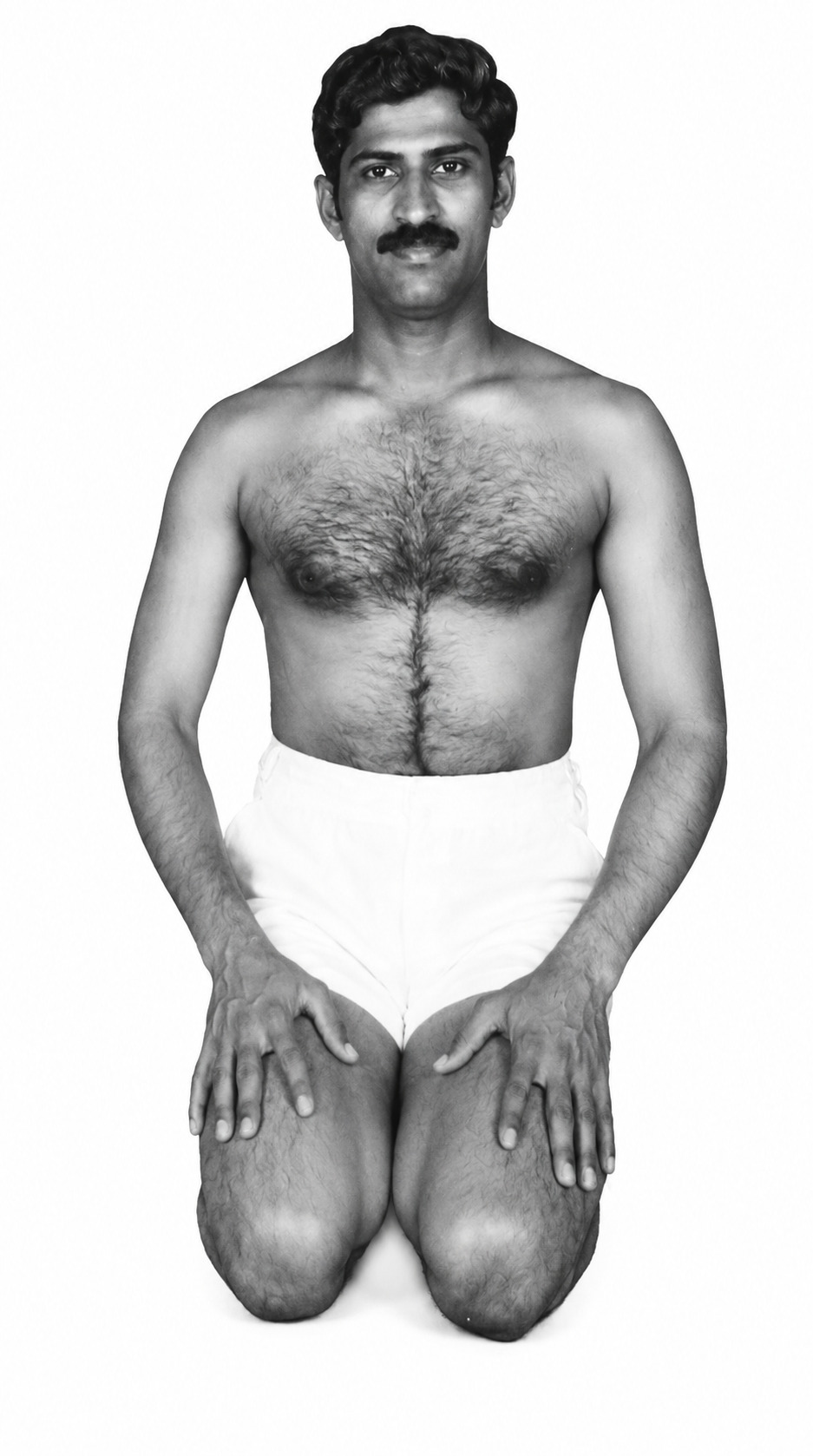
This asana is called Vajrasana because, among all the asanas, it is considered as valuable and steadfast as a vajra (diamond). It provides maximum benefit with very little effort and in a relatively short time.
Method of Practice:
When sitting in Vajrasana, the front of the legs—from the knees down to the feet—should rest on the floor. In this position, it is mainly the shin bones, with very little muscle cushioning them, that come into contact with the ground.
If Vajrasana is practiced on a hard floor, it can become quite painful, making it difficult to remain in the posture for long. Therefore, it is best to arrange your practice so that you can sit comfortably and without movement in Vajrasana for 20 to 30 minutes.
Use a soft asana mat, a thick padded blanket, or a folded soft blanket on the floor, and practice Vajrasana on that surface.
1. Kneel on the floor with both knees placed side by side. Stretch both feet straight back behind you, and place a thin folded blanket beneath the ankles.
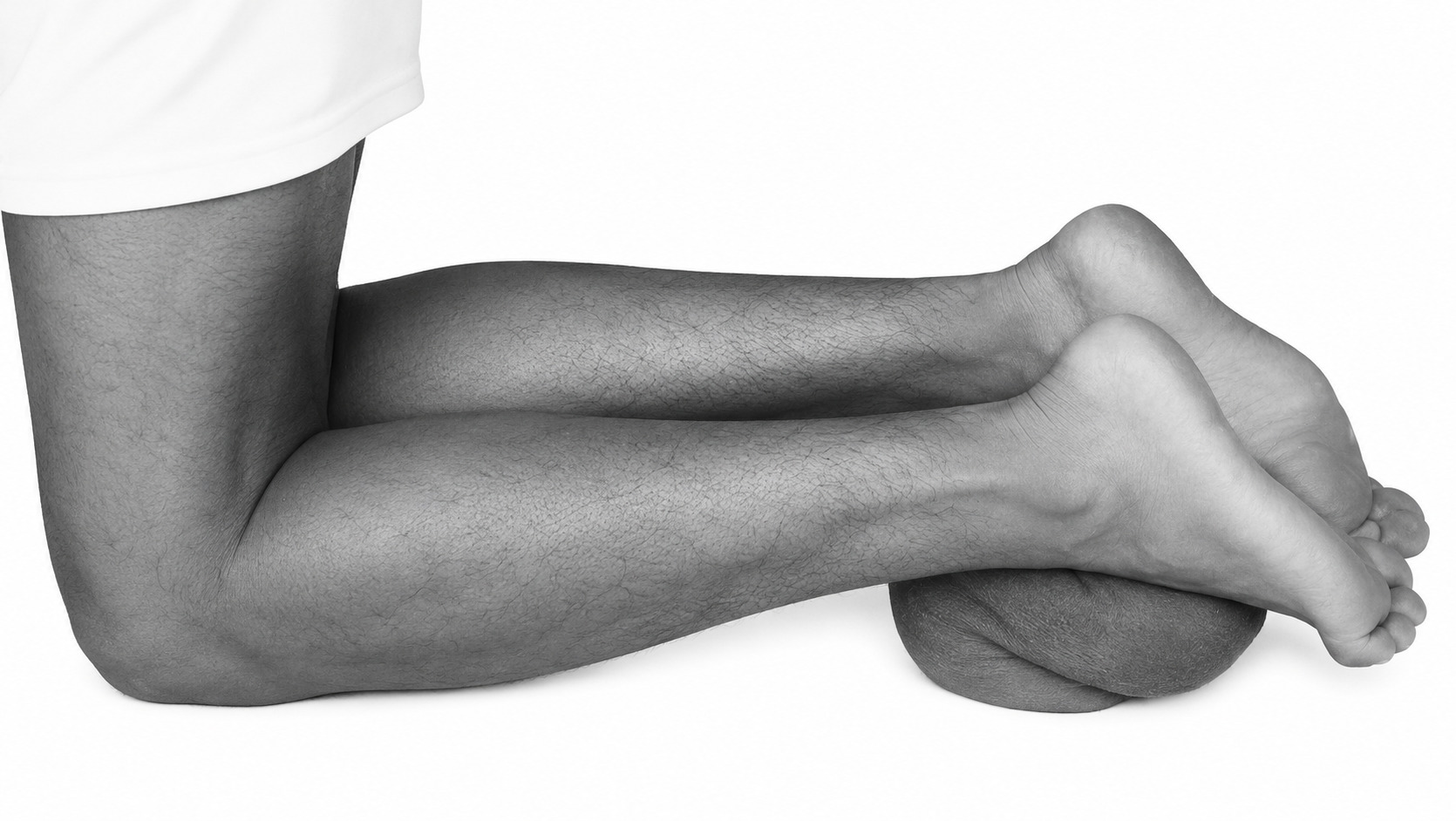
2. Keep the big toes close together, side by side, and separate the heels so that there is about a hand's breadth of space between them. Then slowly lower yourself to sit on your feet, with each buttock resting on its corresponding heel.
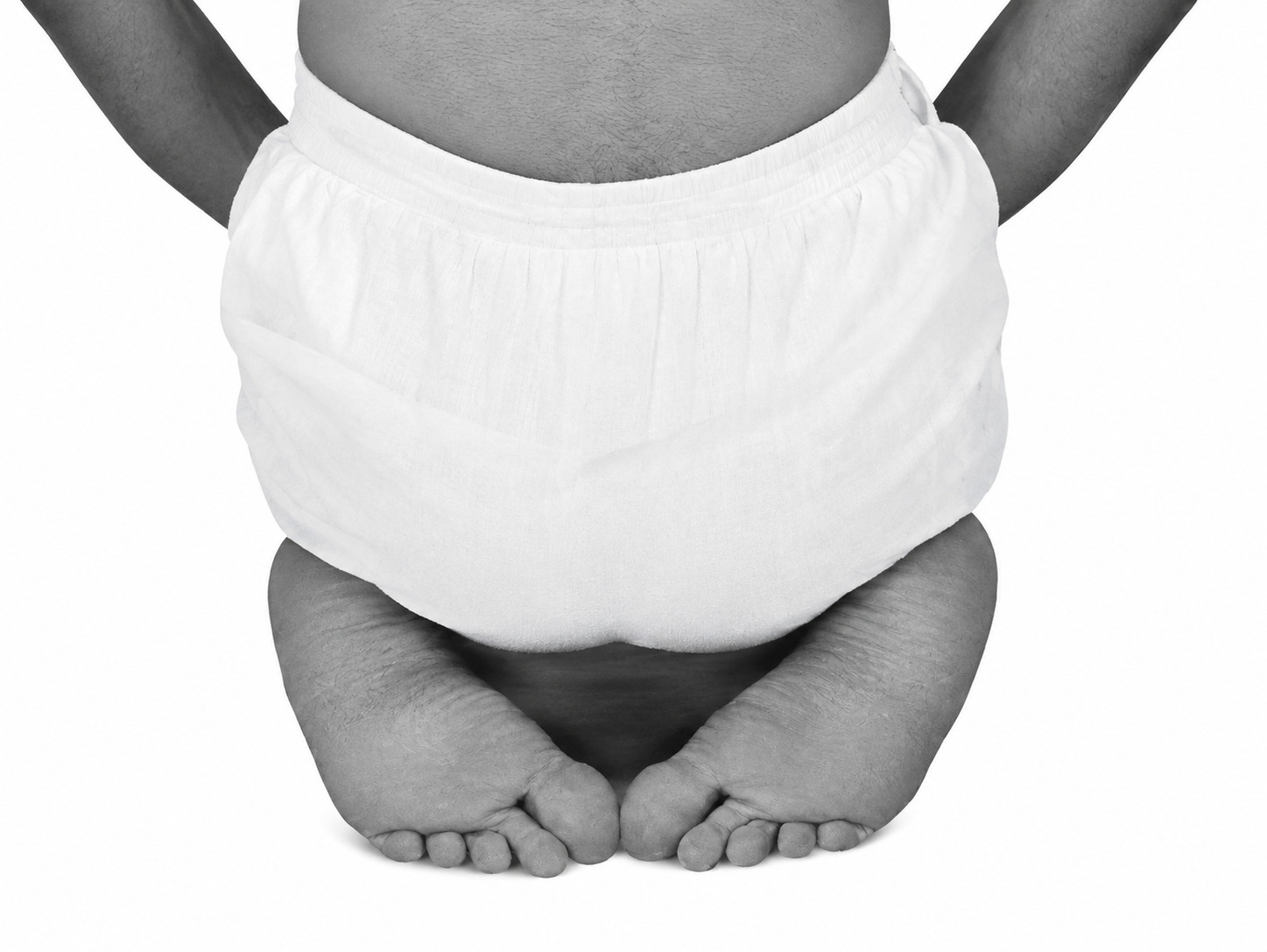
3. Place your hands comfortably on your thighs. Keep the spine perfectly upright, forming a 90-degree angle with the floor. Throughout the time you remain in Vajrasana, do not allow the body to bend forward or slump. Sit straight and steady, like a pillar.
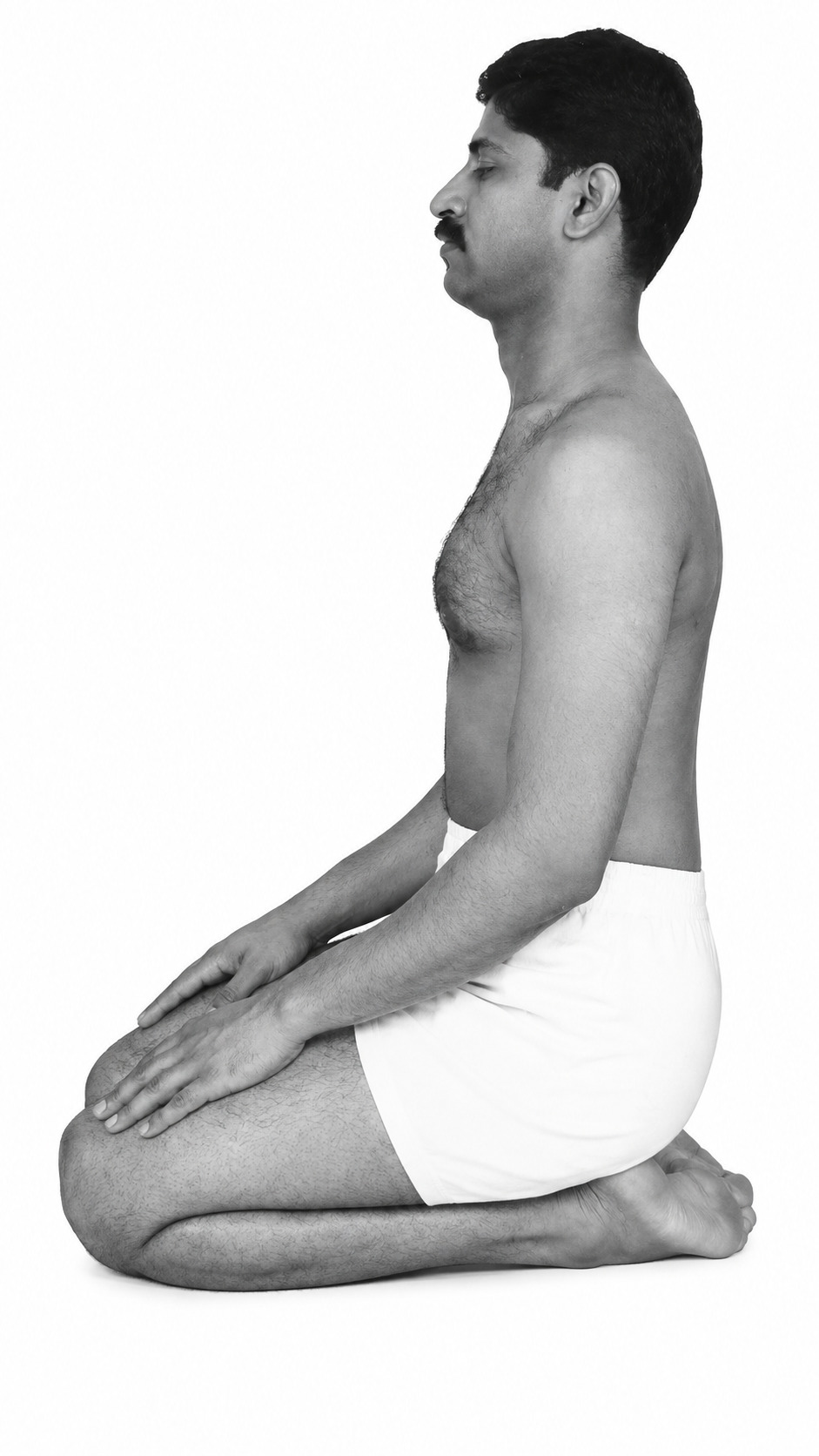
Important Points:
1. Let us understand why a folded blanket is placed beneath the ankles.
When you sit in Vajrasana, about 60–70% of your body weight rests on the ankles. Since these joints may never have been stretched to this extent before, the increased stretch naturally causes discomfort.
Because the ankles are not accustomed to bearing so much weight while being fully stretched, many people feel, after just two or three minutes, that they can no longer remain in the posture and want to come out of it. Others may begin to feel this discomfort after five or six minutes.
Placing a thin folded blanket beneath the ankles reduces the pressure on this area, making it possible to remain in Vajrasana comfortably and without movement for a longer time. It greatly reduces the discomfort and helps prevent pain.
2. Those who are not accustomed to practicing Vajrasana will not be able to sit in the posture for a long time at first. Within five to ten minutes, they may experience pain, numbness, or tingling in the legs, prompting them to come out of the posture.
This is perfectly normal. Until the body becomes accustomed to the posture, increase the duration gradually, adding a little more time each day. As the body adapts, you will naturally be able to remain in Vajrasana for longer periods with greater comfort.
Asana Stage:
Place your hands comfortably on your thighs, keep the spine perfectly upright, close your eyes completely, and rest your attention on the breath. Sit quietly and peacefully, allowing the mind to remain free from unnecessary thoughts.
One of the special features of this posture is that it does not produce fatigue or exhaustion.
As soon as you sit in Vajrasana with the spine held erect, a better alignment is established between the nervous system and the brain. As a result, nerve impulses flow more freely from the brain throughout the body. The mind gradually becomes calm and free from restless thoughts.
Keeping the spine straight also allows the lungs to expand fully. This enables each breath to become deep and complete. As long as you remain in Vajrasana, the breathing naturally becomes slow, deep, and full.
With these deeper breaths, the body and the mind receive a greater supply of oxygen. Gradually, the mind withdraws from its constant stream of thoughts and enters a state of increasing peace and tranquility.
It is remarkable that such mental changes arise simply by sitting in Vajrasana, even without any other form of meditation.
Because the body continues to receive an abundant supply of oxygen while you remain in the posture, you experience a sense of renewed energy, and feelings of tiredness or weakness gradually disappear.
Remain in Vajrasana for as long as you can sit comfortably without excessive difficulty in the legs. Do not come out of the posture prematurely.
While sitting in Vajrasana, the knees remain bent and bear much of the body's weight. Because of this, the blood vessels in the legs are partially compressed, reducing the flow of blood to the lower legs and feet. As a result, you may experience numbness in the feet or discomfort around the ankles while remaining in the Asana Stage.
Do not become concerned by these sensations. If they are within your comfort level, continue to remain in the posture for a little longer.
With regular practice, you will gradually become able to sit comfortably in Vajrasana for 20 to 30 minutes.
While you remain in the Asana Stage, the most important practice is to keep your attention on your breathing and allow the mind to remain free from unnecessary thoughts.
When you finally feel that you can no longer remain in Vajrasana, slowly stretch out your legs and move into the Relaxation Stage.
Relaxation Stage:
Come out of Vajrasana by gently stretching both legs straight out in front of you. Allow them to relax naturally, with the feet falling comfortably to the sides. Place your hands behind you for support and gently lean your head back. In this position, the entire body becomes relaxed and free of tension.
During the Relaxation Stage, keep your attention on the breath and remain as calm and peaceful as possible.
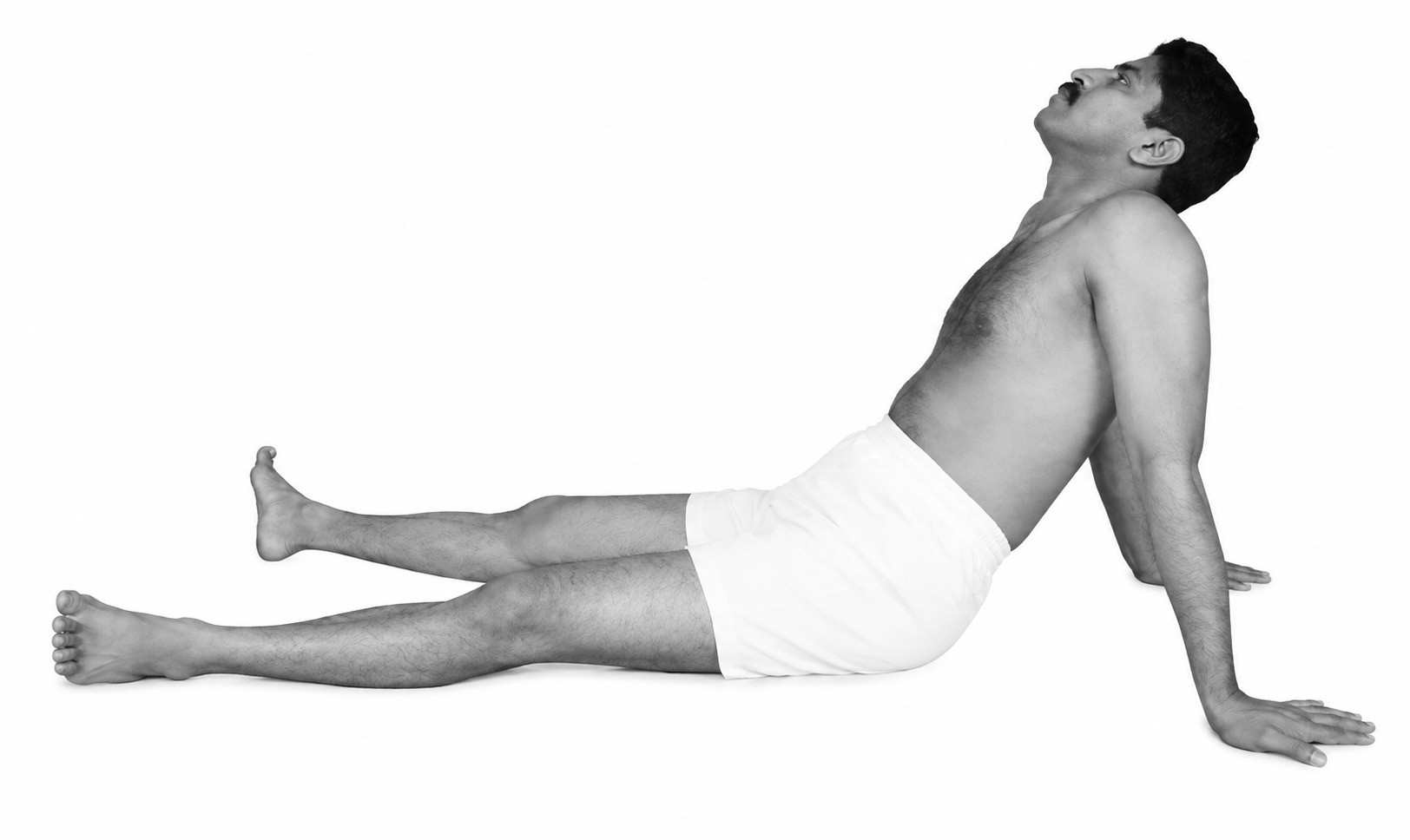
As soon as you stretch out your legs, the numbness that developed during Vajrasana may become more noticeable, making it difficult to keep the mind steady. You may feel a strong pulling sensation in the legs. It is a peculiar feeling — neither intensely painful nor pleasant — but somewhere in between, with various sensations arising in the legs.
During this period, it is natural for the mind to shift its attention from the breath to the legs and feet.
For one or two minutes after coming out of Vajrasana, the numbness may even increase and become more uncomfortable before it gradually begins to subside.
As blood circulation becomes more active, a larger volume of blood flows rapidly into the feet, causing them to become warm and gradually turn pinkish-red. While remaining in Vajrasana, the feet often become pale because of the reduced blood flow.
When you stretch your legs during the Relaxation Stage, the blood that had accumulated above the knees while you were in Vajrasana rushes quickly toward the feet. As a result, the feet receive a much greater supply of blood than usual and take on a healthy rosy colour.
Remain in the Relaxation Stage until the blood circulation returns to its normal state.
While you are in Vajrasana, the parts of the body above the knees receive the greatest benefit. After releasing the posture and entering the Relaxation Stage, the greatest benefit is experienced in the legs — from the knees down to the tips of the toes.
To receive these benefits fully, it is important to remain in the Relaxation Stage with your legs stretched out for four to five minutes. Without taking this period of complete relaxation, the full benefits of the posture cannot be obtained.
Therefore, always be sure to complete the practice with adequate relaxation.
Incorrect Posture:
A posture can be called Vajrasana only when the spine is kept perfectly upright, forming a 90-degree angle with the floor.
Some people are unable to keep the spine erect and gradually begin to bend forward at the waist. Others allow the neck to droop forward as well. Bending the waist forward is an incorrect posture.
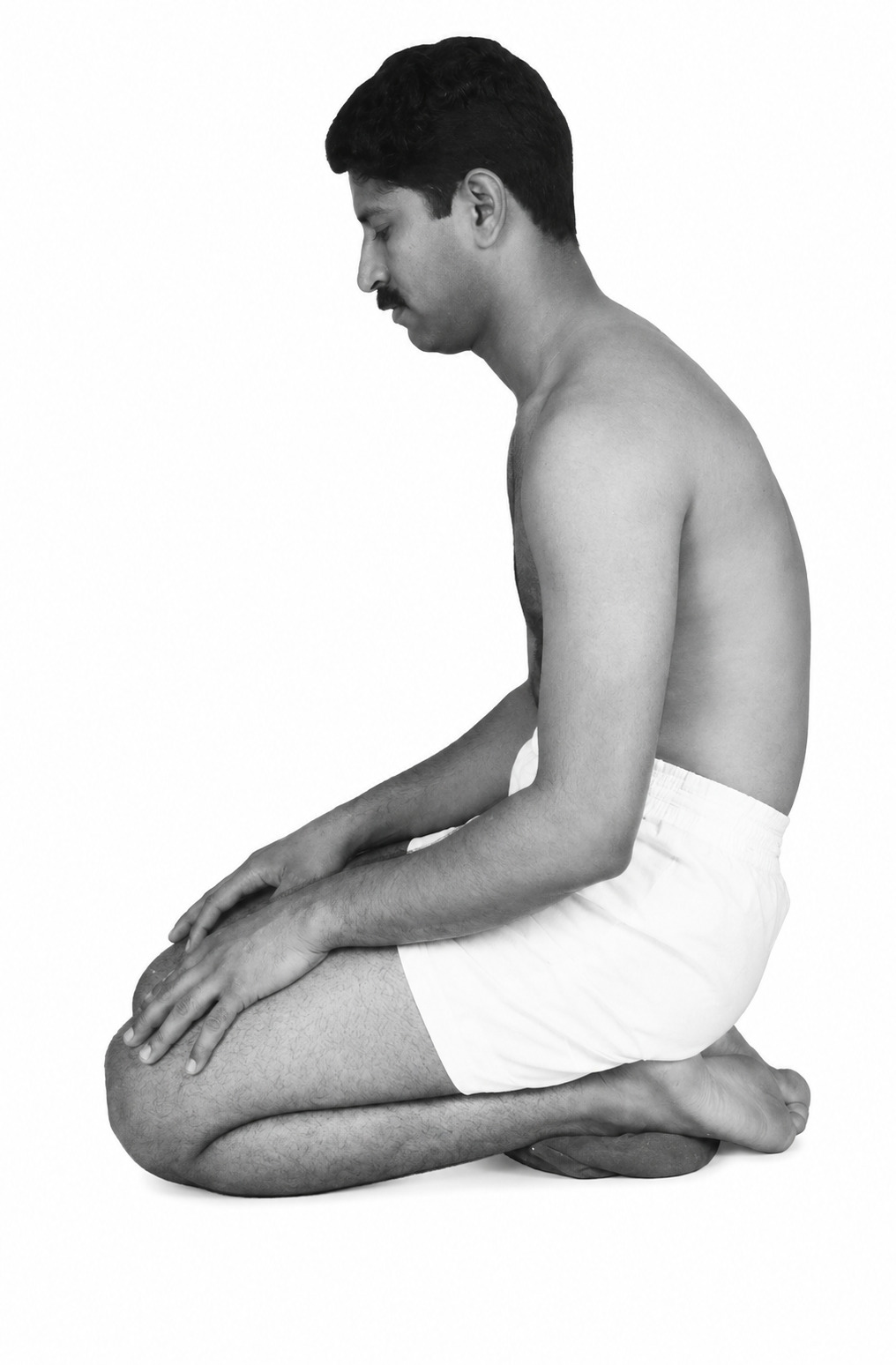
Do not sit as shown in the photograph.
When the waist is bent forward, the diaphragm remains expanded in an improper position. As a result, the lungs cannot expand fully, and nearly half of their capacity is restricted. The body is then unable to receive an adequate supply of oxygen, causing the breathing to become faster.
Bending the spine also interferes with the smooth communication between the brain and the nervous system. As the rate of breathing increases, the mind is unable to remain calm and peaceful.
In this position, Vajrasana cannot produce its intended benefits.
Therefore, whenever you practice Vajrasana, keep the spine perfectly upright without allowing it to bend forward, and maintain that position for as long as you can.
If your back begins to ache, come out of the posture rather than remaining in it with a bent spine.
Benefits
1. Vajrasana is one of the best postures for practicing pranayama. Because the spine remains upright, it becomes easier to inhale deeply and exhale completely. The chest stays open, allowing the lungs to expand fully and fill with air.
Whatever type of pranayama you practice, performing it while sitting in Vajrasana enables you to receive its benefits more fully.
2. For those who practice meditation, Vajrasana brings great mental calmness. As soon as you sit in the posture, the mind naturally becomes steady, and thoughts begin to subside.
When the mind enters such a state, it becomes much easier to move into meditation and experience its benefits more deeply.
Keeping the spine perfectly upright is one of the most important requirements for meditation.
3. Most asanas should not be practiced after eating. Vajrasana, however, is an exception and is recommended even immediately after a meal.
Sitting in Vajrasana after eating helps the food digest more quickly.
In particular, when the spine is kept upright, the lungs expand fully and receive an ample supply of oxygen. This increased supply of oxygen helps make the digestive process more active.
When the spine is erect, the weight of the abdomen does not press against the diaphragm, allowing the breathing to remain free and unrestricted.
Practicing Vajrasana after meals also helps prevent the feeling of heaviness or discomfort that sometimes follows eating. The upright position of the spine is the main reason for this benefit.
In addition, sitting in Vajrasana helps the gases trapped in the stomach and intestines pass out more easily, leaving the abdomen feeling lighter and more comfortable.
4. You may sit in Vajrasana while praying, in a temple, during worship, while eating, or whenever you are sitting quietly without any other activity.
In this posture, the mind remains calm and steady, making it easier to perform these activities with greater attention and concentration.
5. Whenever the mind feels disturbed, irritable, or restless, when too many thoughts are crowding the mind, or when you are unable to sleep well, simply sit in Vajrasana for 5 to 10 minutes with your attention focused on the breath.
This simple practice helps you come out of these conditions with ease and provides considerable relief.
6. Vajrasana promotes blood circulation in the legs to a degree that is rarely achieved during ordinary daily activities. As a result, it helps maintain the health of the legs.
Problems such as numbness, tingling, burning sensations in the feet, and pain around the ankles can be prevented. Those who already suffer from these complaints can gradually obtain complete relief through regular practice.
7. Those who do not have knee pain should practice Vajrasana every day. Regular practice keeps the knee joints flexible and under good control, allowing them to move freely and helping to prevent knee problems from developing later in life.
8. Vajrasana increases the appetite and helps improve digestion.
Those suffering from indigestion can benefit by practicing Vajrasana twice a day, when noticeable improvement can be seen over time.
9. If you experience abdominal bloating, trapped gas, or a feeling of heaviness in the stomach, sitting in Vajrasana for about 10 minutes helps the gas escape naturally through belching, providing quick relief and making the abdomen feel more comfortable.
10. Those with mild lower back pain often find that sitting on the floor in the usual cross-legged position makes the pain worse.
Whenever you need to sit on the floor, sit in Vajrasana instead. This helps prevent the back pain from increasing and allows you to sit comfortably without discomfort.
Note
1. There is no need to practice Vajrasana separately in addition to your regular asana routine. It can be practiced while doing pranayama, during meditation, when sitting quietly, or after meals. In this way, you make good use of your time while gaining its benefits.
Practicing Vajrasana during pranayama before your asana practice is sufficient.
2. Those who have severe knee pain should not practice Vajrasana.
3. Simply getting into Vajrasana and coming out of it immediately serves little purpose. Try to remain in the posture for at least 5 to 10 minutes, or longer if you are able. This is how you receive its real benefits.
This asana was devised by the sage Matsyendra. It is said that one who masters this posture can float on water like a fish. Hence, it is called Matsyasana (Fish Pose).
Method of Practice:
Before beginning this asana, sit near the front edge of your mat or folded blanket.
1. Those who are able to bend their legs comfortably should first sit in Padmasana.
For many people, however, Padmasana is difficult to perform. If you are unable to sit in Padmasana, do not think that you are therefore unable to practice this asana. Simply bring your legs comfortably together and sit in Sukhasana (Easy Pose) instead.
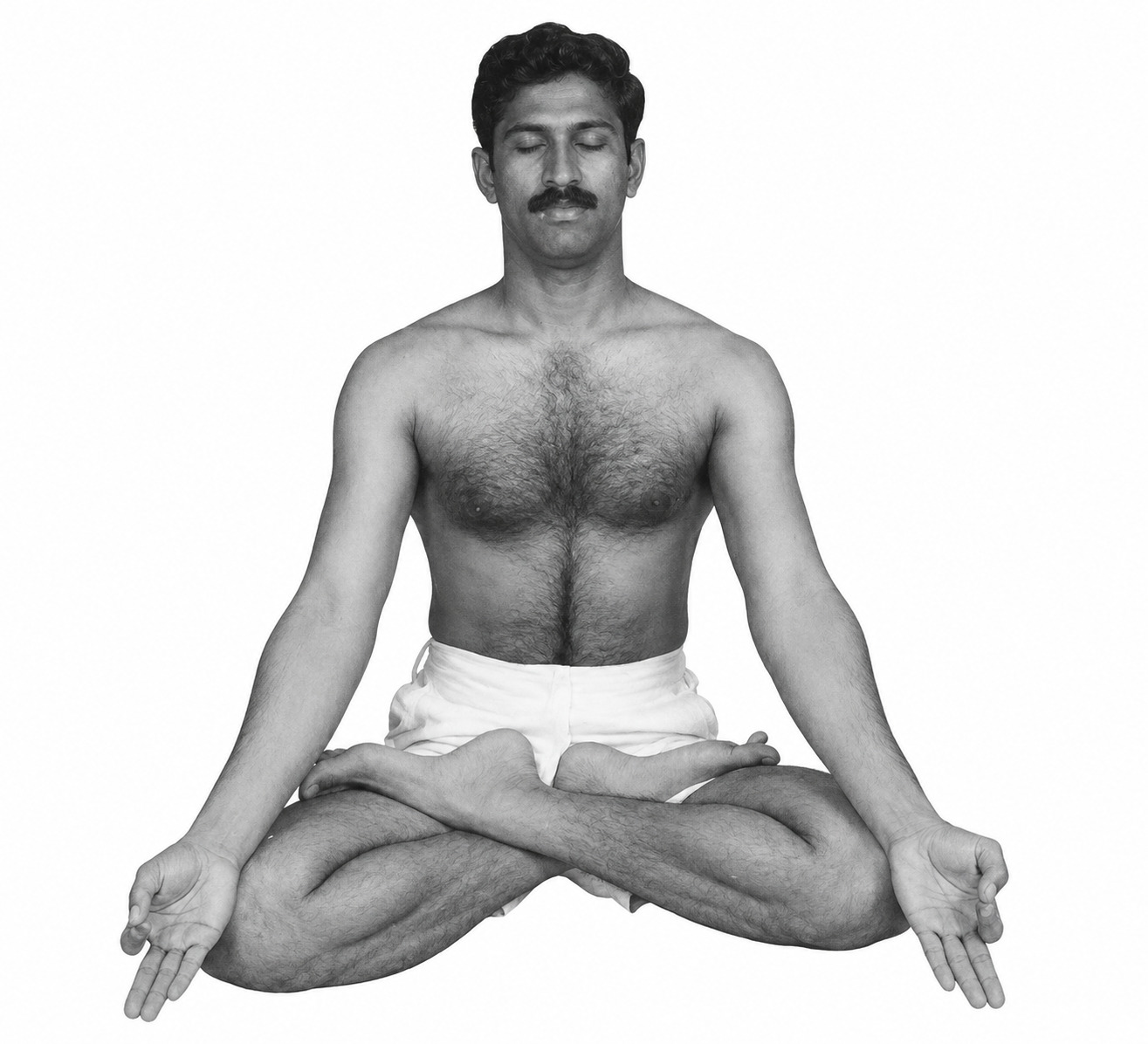
2. Next, place one forearm on the floor for support and gently lean the chest backward.
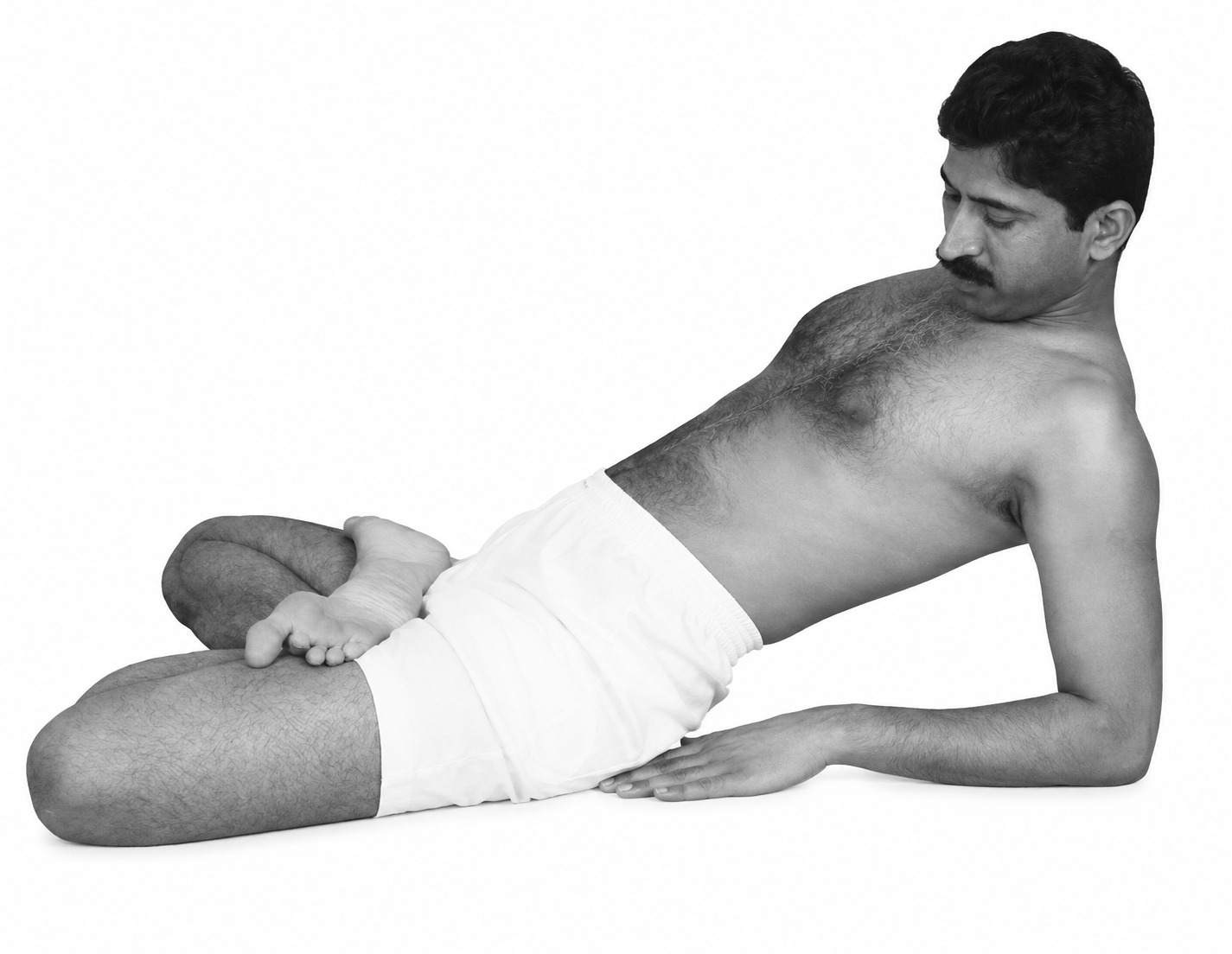
3. Then place the other forearm on the floor in the same way on the opposite side.
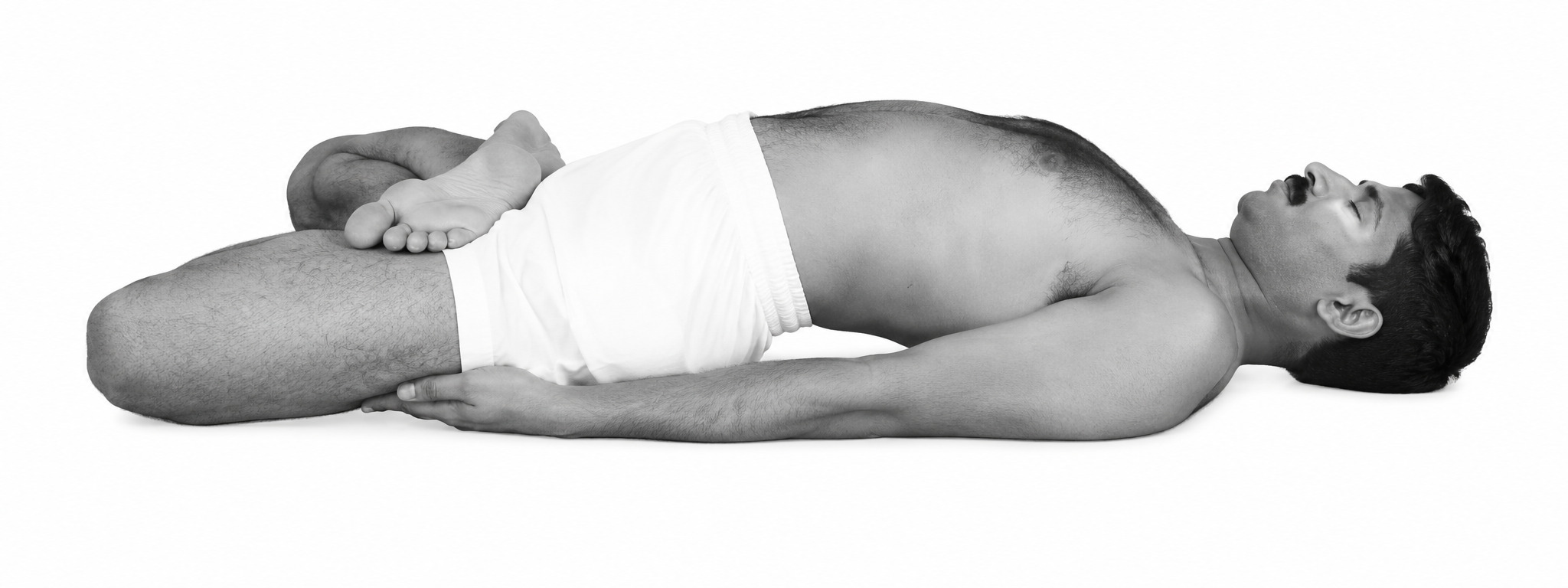
4. Gradually slide both hands toward the legs while lowering yourself backward until your back rests on the floor.
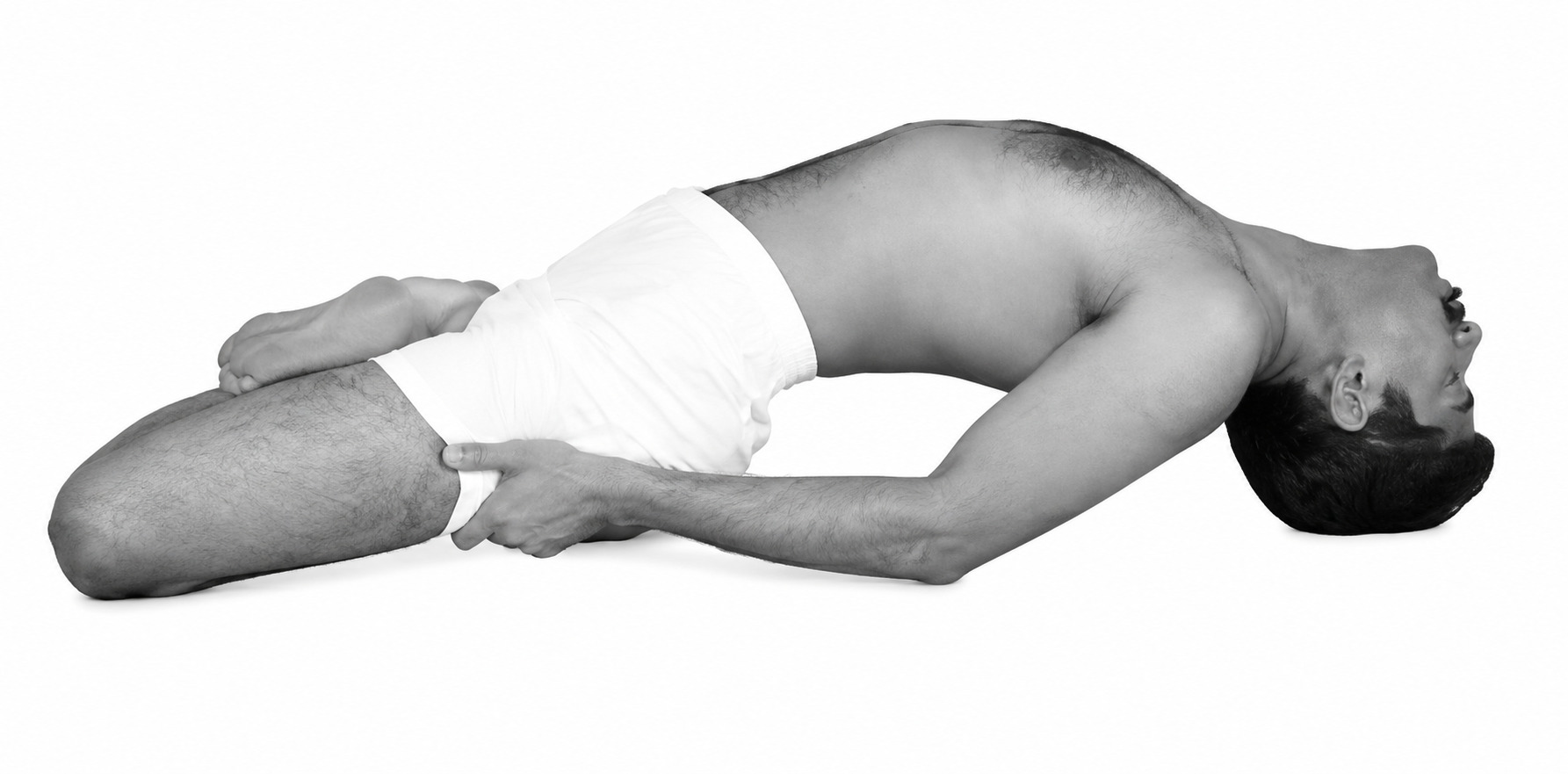
5. Now place both palms beneath the thighs. Press both elbows firmly into the floor and lift the chest upward from the waist. Arch the upper back, gently bend the neck backward, and lower the crown of the head to the floor.
The accompanying photograph shows the method for those practicing the posture while sitting in Sukhasana, for those who are unable to perform Padmasana.
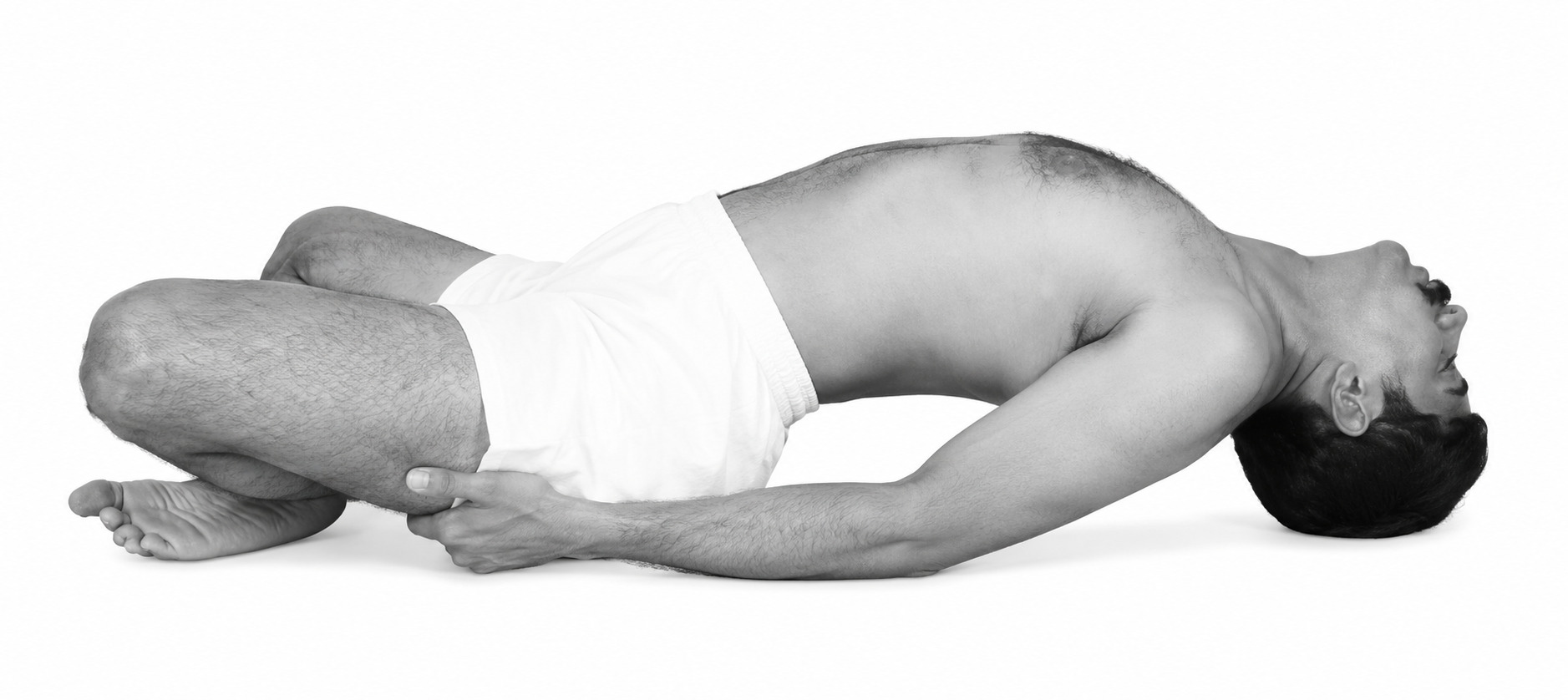
6. Close your eyes completely.
Asana Stage:
After assuming the full posture as shown in the photograph above, allow the mind to become free from unnecessary thoughts. Keep your attention focused on the neck and throat region.
Remain completely still in the posture for as long as you can. Continue until the discomfort becomes too great and you feel that you can no longer remain in the posture. At that point, gently come out of the asana.
To release the posture, first lower the head and chest back onto the floor. Then place the arms comfortably by your sides. If you are practicing the version with Sukhasana, stretch both legs out after releasing the posture. If you are practicing it from Padmasana, keep the legs in Padmasana while coming out of the posture.
Then slowly sit up and prepare for the next asana, which involves bending the body forward.
An Alternative Method:
Matsyasana can also be practiced in another way. This variation is especially suitable for those who are unable to fold their legs comfortably. It is much easier for them to perform.
Choose whichever method is more comfortable for you. Those who can comfortably sit in Padmasana should practice Matsyasana in that way, as it gives better control over the legs. Everyone else may practice this alternate version.
Method of Practice
1. Lie flat on your back with your head positioned on the mat or folded blanket. Place both palms on the floor and slide them beneath the buttocks. Keep both legs stretched out straight.
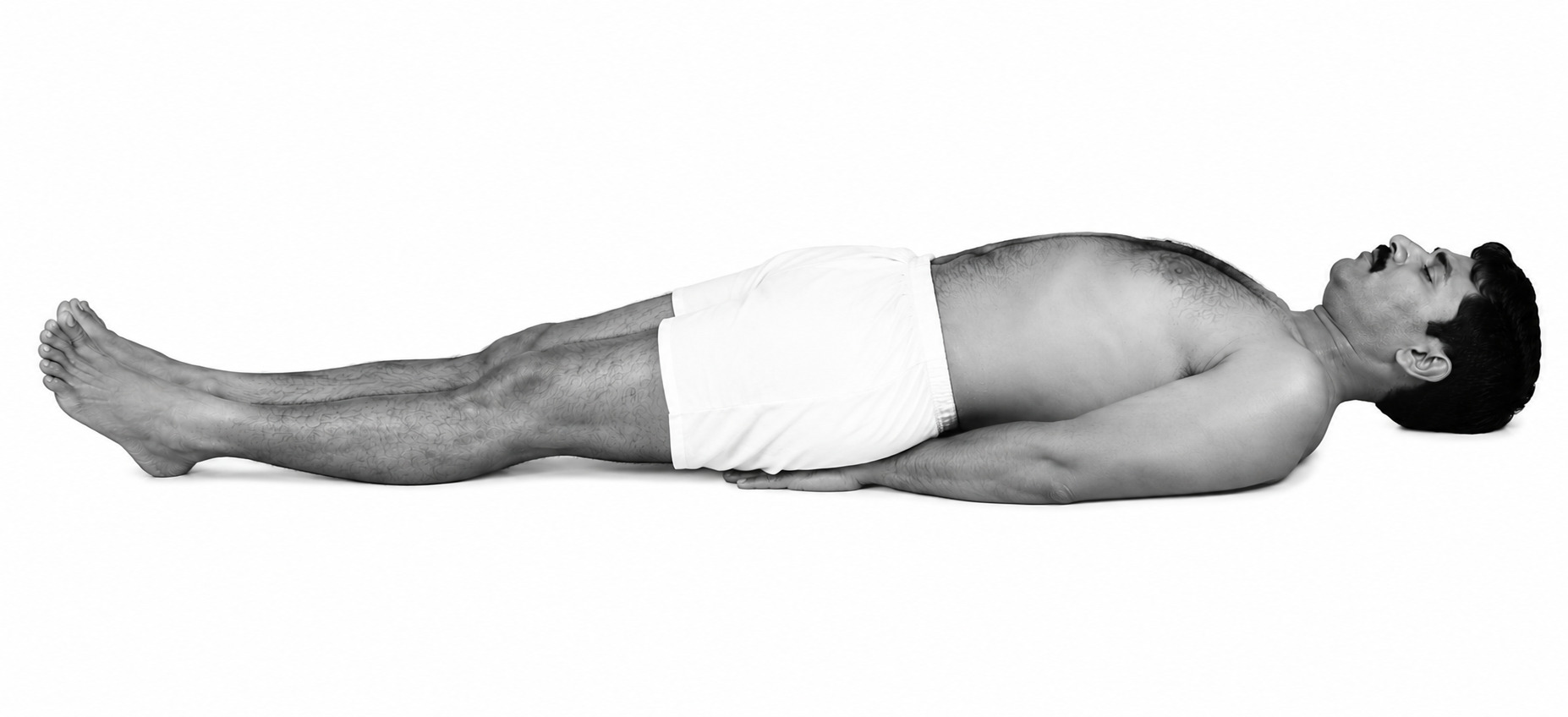
2. Keeping the legs and palms in the same position, lift the chest and the head by pressing firmly through the elbows.
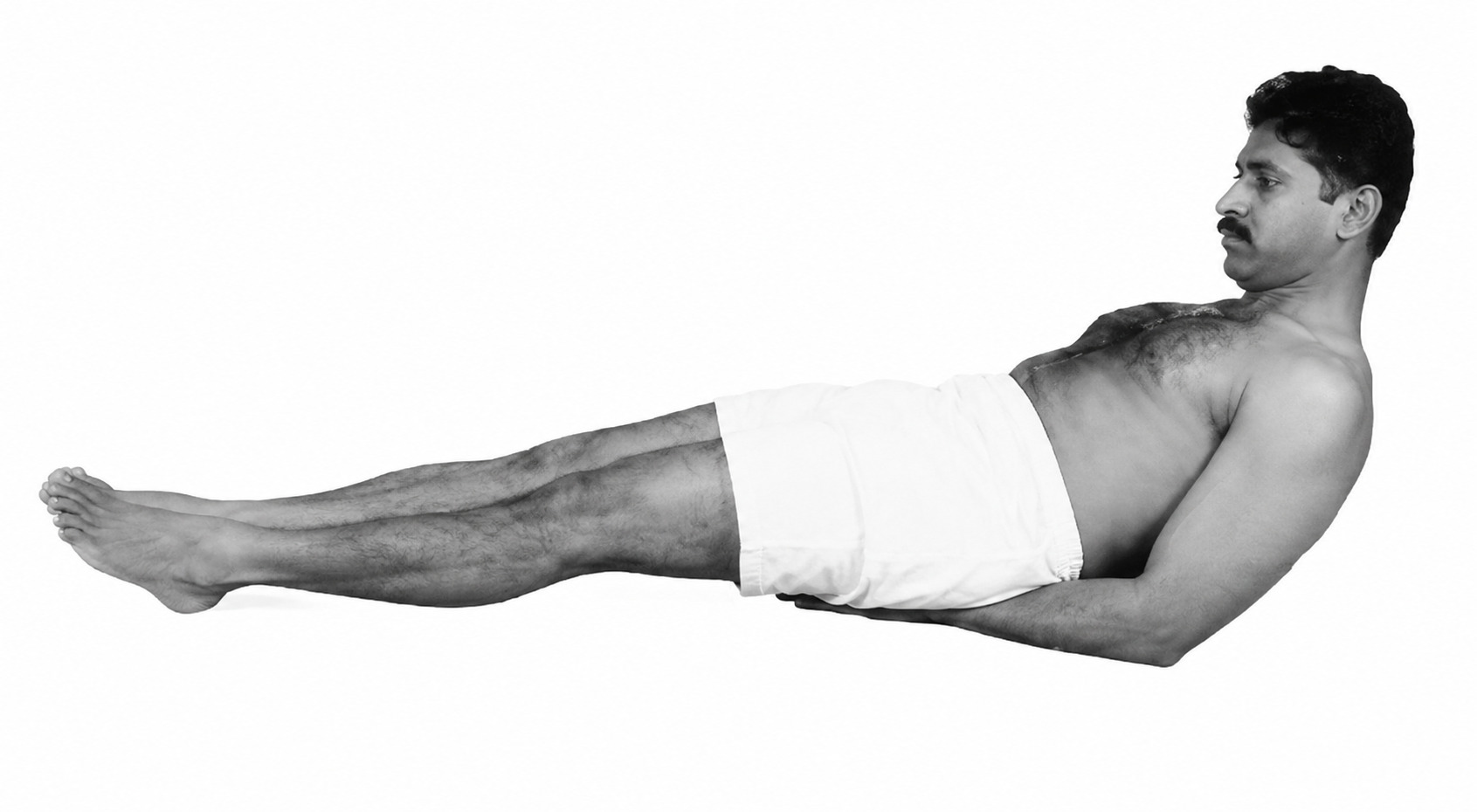
3. Then arch the chest well backward and gently lower the crown of the head to the floor. In this position, neither the waist nor the back rests on the floor. The body's weight is supported mainly by the head.
4. Close your eyes completely and remain in the posture for as long as you are able.
Incorrect Posture:
The greatest benefits of Matsyasana are experienced in the neck and throat region. Therefore, it is essential to bend the neck well backward so that the crown of the head rests on the floor. If this is not done correctly, the posture loses much of its intended benefit.
Many people perform the rest of the posture correctly, and it may even look proper from the outside. However, if the most important part of the posture is not correctly aligned, the purpose of practicing the asana is defeated.
The following photographs show common mistakes made in both variations of Matsyasana. Apart from these errors, the rest of the posture has been performed correctly.
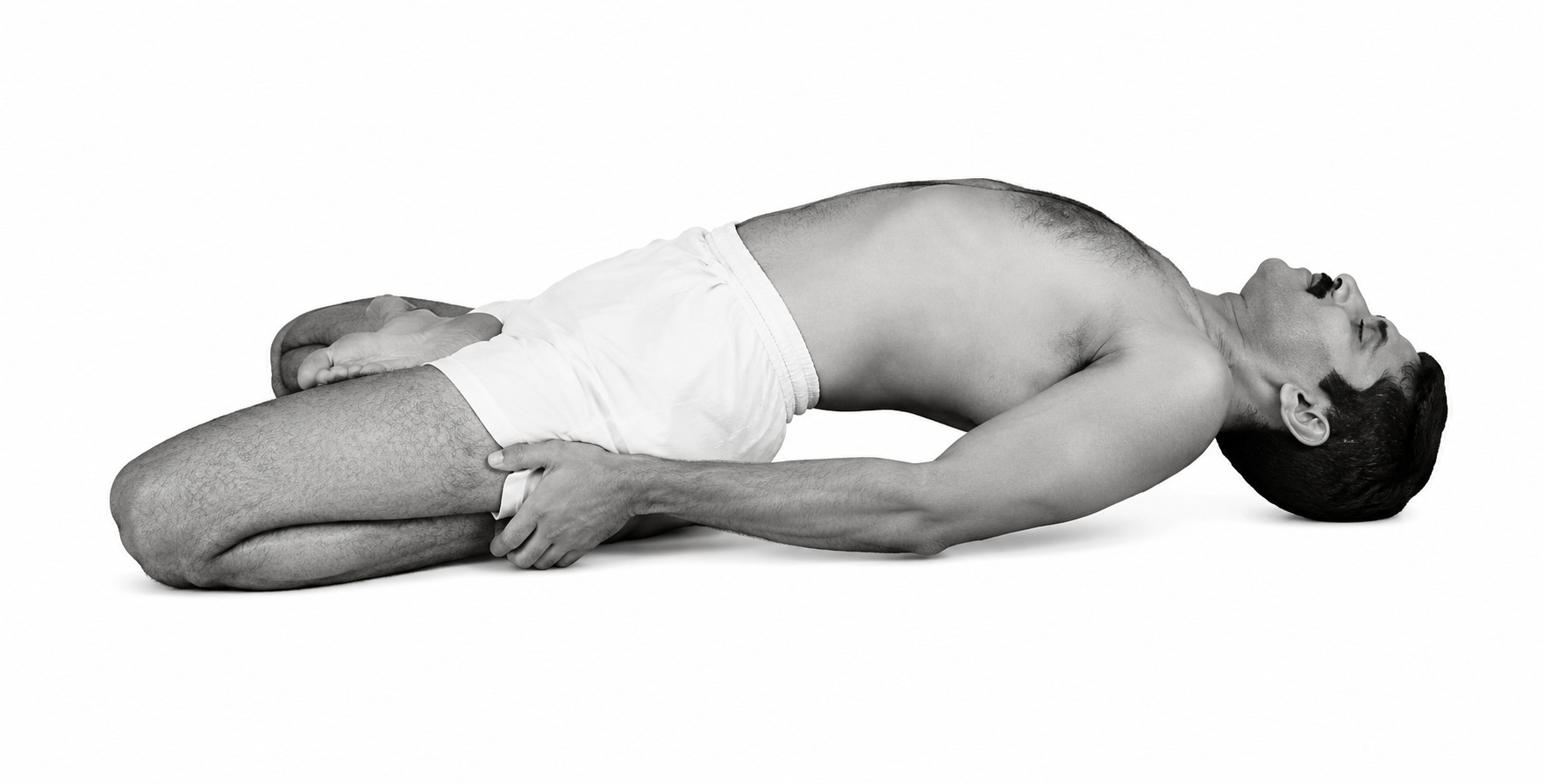
In the first incorrect posture, the chest has been lifted properly, but instead of placing the crown of the head on the floor, the back of the neck is resting on the ground. As a result, the neck is not bent backward sufficiently and does not receive the intended stretch.
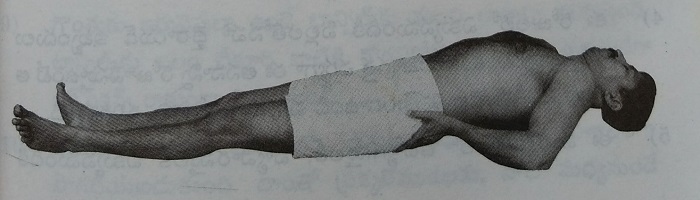
In the second incorrect posture, the hands have slipped out to the sides instead of remaining properly positioned beneath the chest. Because of this, the waist and chest cannot lift upward adequately. As a result, the crown of the head does not reach the floor, and once again it is the back of the neck that rests on the ground.
If the waist and the neck are not arched backward properly, the posture provides little or no benefit.
Observe these common mistakes carefully and learn to practice the asana correctly.
Benefits
1. Matsyasana is an excellent asana for those with thyroid gland disorders. Throughout the time you remain in this posture, the thyroid gland (located in the throat) is alternately compressed and stretched.
As soon as you come out of the posture, the thyroid receives an increased supply of blood and oxygen—far greater than it ordinarily does. This improves the functioning of the gland.
The enhanced blood circulation to the thyroid continues throughout the day. Practicing Matsyasana also provides the thyroid gland with an effect similar to a gentle internal massage.
2. Behind the thyroid gland lie the parathyroid glands. While you remain in Matsyasana, the flow of energy is concentrated in this region.
The parathyroid glands normally regulate the body's calcium levels. This process is essential for healthy muscle function and for the contraction and relaxation of the heart.
By improving blood circulation to these glands, Matsyasana helps the bones maintain their strength and flexibility.
3. An iodine deficiency can cause enlargement of the thyroid gland.
When adequate iodine is supplied through food or medication, and Matsyasana is practiced daily, such swelling can subside more quickly.
4. Today, thyroid disorders have become increasingly common, even among children.
Practicing Matsyasana every day as a preventive measure helps keep the thyroid gland functioning properly and contributes to maintaining good health.
5. Nowadays, many office workers and business professionals suffer from neck pain. In some cases, the nerves in the neck become so compressed that surgery is required.
Matsyasana is especially beneficial for those suffering from cervical spondylitis or other forms of neck pain.
People who spend long hours sitting with the neck bent forward are particularly prone to these problems. In Matsyasana, the neck is bent backward, providing a stretch that can bring considerable relief.
If neck pain is accompanied by lower back pain, it is better to practice the lying variation of Matsyasana rather than the seated one.
Those suffering from neck pain should practice this asana twice a day. If necessary, they may practice it once, come out of the posture, rest for a while, and then repeat the same asana a second time.
6. Those who do not currently suffer from neck pain should practice Matsyasana regularly as a preventive measure, especially if they are office workers or business professionals. This helps reduce the likelihood of developing such problems in the future.
Otherwise, the condition may become so severe that even using a pillow becomes difficult. (Once neck pain develops, it is best to stop using a pillow altogether.)
Some people experience mild neck pain while riding a scooter, and many women notice discomfort after spending time with the neck bent forward while cutting vegetables. Matsyasana is an excellent asana for completely relieving such problems.
7. Matsyasana strengthens the muscles and blood vessels in the neck. As a result, they are better able to supply blood to the head.
It also helps prevent the accumulation of fatty deposits in the blood vessels that carry blood to the brain, thereby promoting healthy circulation.
8. For those with lower back pain, bending the back backward in Matsyasana provides a beneficial stretch to the nerves in that region, helping to relieve discomfort.
9. Matsyasana is beneficial for the tonsils, which are located on either side of the throat. It strengthens the tonsils, improves their resistance, and helps protect them against frequent infections.
10. Throughout the time you remain in Matsyasana, the chest is stretched and expanded fully. This improves the movement of the rib cage, the muscles between the ribs, and the lungs, allowing them to expand and contract more effectively. As a result, deep breathing naturally occurs after coming out of the posture. With regular practice, Matsyasana also helps make deep, full breathing a more natural part of your everyday breathing pattern.
Note
1. Since the neck and the back are bent well backward in Matsyasana, they return to their normal position more easily if they are subsequently bent forward. Therefore, a forward-bending asana should be practiced immediately after Matsyasana.
2. Those who have neck pain or lower back pain should not bend the back forward after coming out of Matsyasana. They should avoid practicing a forward-bending asana immediately afterward.
3. When you are first learning Matsyasana, do not remain in the posture for more than 10 to 15 seconds. Come out of the posture immediately after that.
Because the body is not yet accustomed to the posture, remaining in it for too long during the first five or six days may lead to neck pain or stiffness on the second or third day.
After five or six days, once the body has adapted, gradually try to remain in the posture for as long as you comfortably can.
4. If neck pain develops or is already present, applying coconut oil to the neck and then using a hot-water compress twice a day provides considerable relief.
5. Many people practice Matsyasana after Paschimottanasana, believing that this sequence produces greater benefit. There is nothing wrong with following that order.
However, greater benefit is obtained by beginning with the easier asanas and then progressing to the more difficult ones. Therefore, in the sequence presented in this book, the relatively easier postures — Matsyasana and Yogamudrasana — are practiced first.
6. After coming out of Matsyasana, do not take a rest immediately. Practice Yogamudrasana first, and then take the Relaxation Stage.
Yogamudra is one of the mudras described in Hatha Yoga. It is given this name because it is said to awaken Kundalini through the power of Yoga and bring together the energies of the mind.
Even if we do not practice this posture for that purpose, there is nothing wrong with practicing it for the many other benefits it offers.
Method of Practice:
This asana is practiced immediately after Matsyasana while remaining in Padmasana.
After completing Matsyasana, do not release Padmasana. Remain seated in the same position and prepare to practice Yogamudrasana.
If there is significant discomfort in the legs, you may release Padmasana after completing Matsyasana and then assume Padmasana again before beginning this asana.
However, it is even better to assume Padmasana only once and maintain it until both Matsyasana and Yogamudrasana have been completed.
The reason is that, while sitting in Padmasana, blood circulation from the knees down to the feet is considerably reduced, and the legs gradually become numb.
Since these two asanas together require you to remain in Padmasana for about four to five minutes, the circulation in the legs remains restricted during that time. When you finally release Padmasana and stretch out your legs, a much greater volume of blood flows to the feet than they normally receive, producing an additional beneficial effect.
1. Sit in the middle of your mat or folded blanket in Padmasana. Take both hands behind your back. Make a fist with one hand and hold that fist with the other hand. Draw both arms close to the back of the chest, lower the chin toward the chest, and bend the head forward.
Those who are unable to sit in Padmasana may practice the posture in Sukhasana, following the same method.
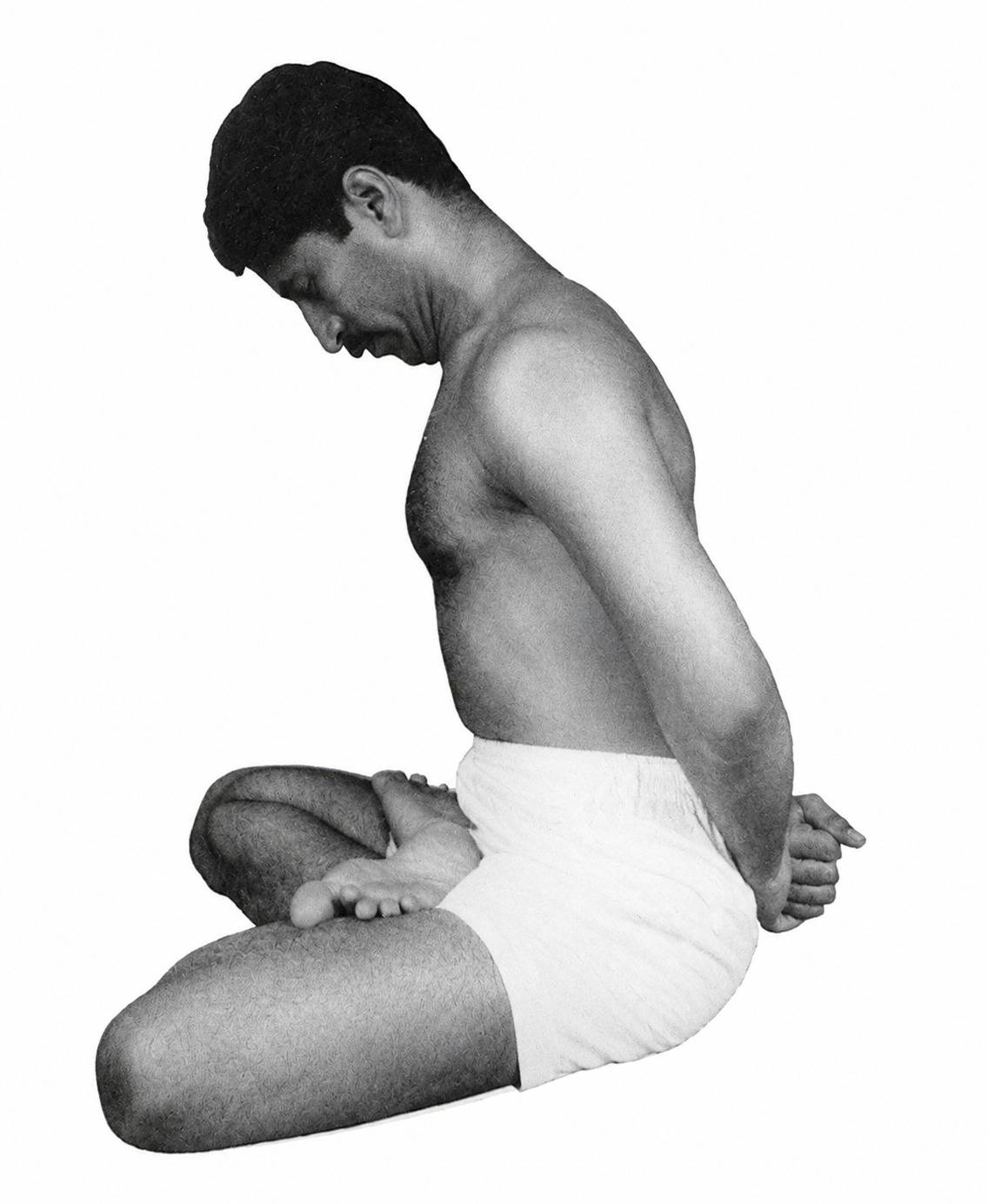
2. Close your eyes completely. As you bend forward from the waist, slowly exhale through both nostrils, emptying the lungs completely. Continue bending until the head reaches the floor. By the time the crown of the head touches the floor, the exhalation should be complete.
Remain steadily in this position with the crown of the head resting on the floor and the chin pressed against the chest.
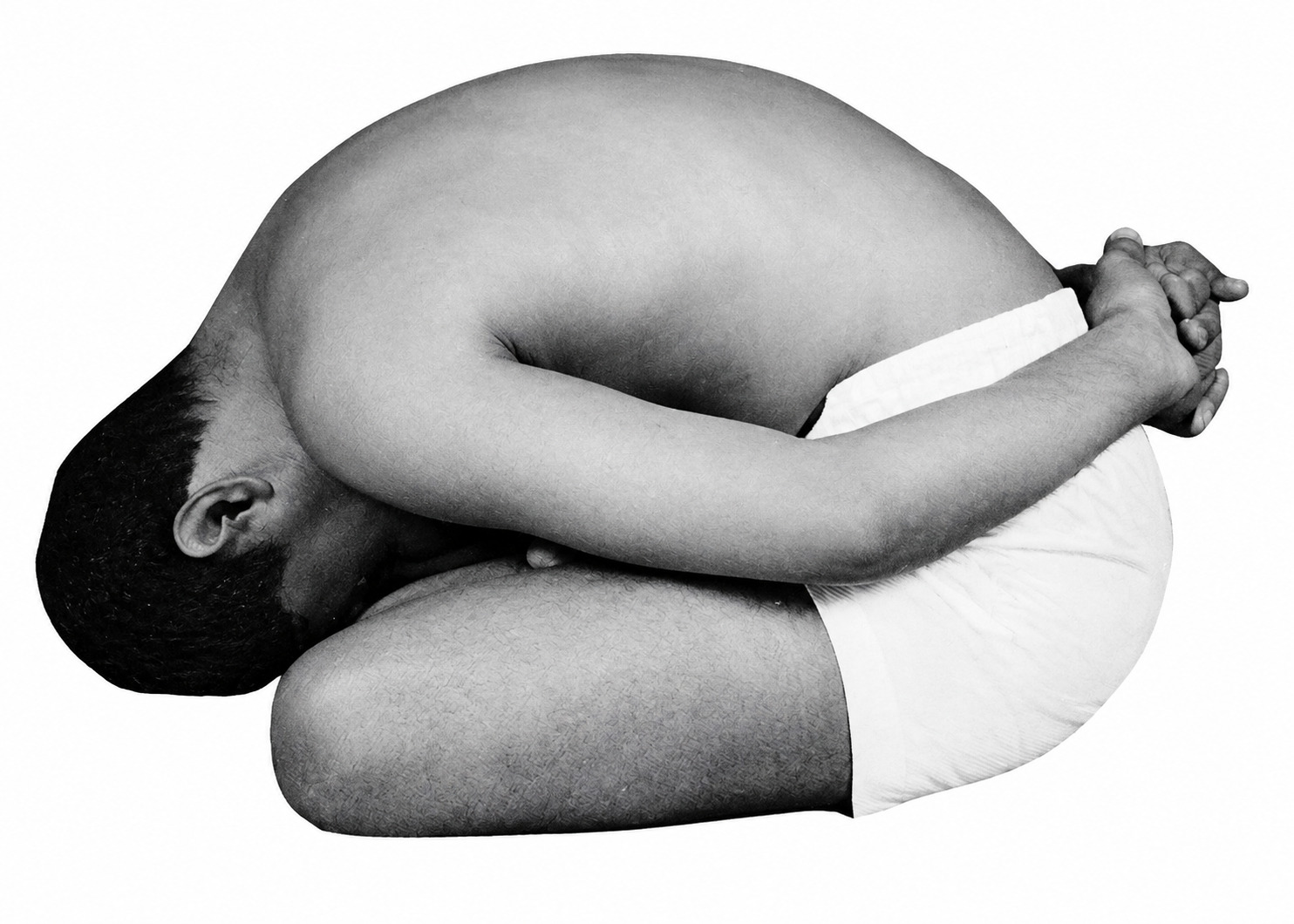
Asana Stage:
After assuming the full posture, with the crown of the head resting on the floor, do not inhale. Remain in the posture holding the breath comfortably (Kumbhaka) for as long as you are able.
During this time, keep your attention focused on the throat region.
When you feel the need to breathe, gently lift the head and, while slowly inhaling, raise the chest and return to the upright sitting position.
Relaxation Stage:
Release Padmasana and stretch both legs out fully in front of you. Place your hands behind you for support, gently lean the neck back, close your eyes, and allow the mind to become calm.
Rest your attention on your breathing. Observe the movement of the breath just below the nostrils and above the upper lip.
Remain in this Relaxation Stage for about one minute.
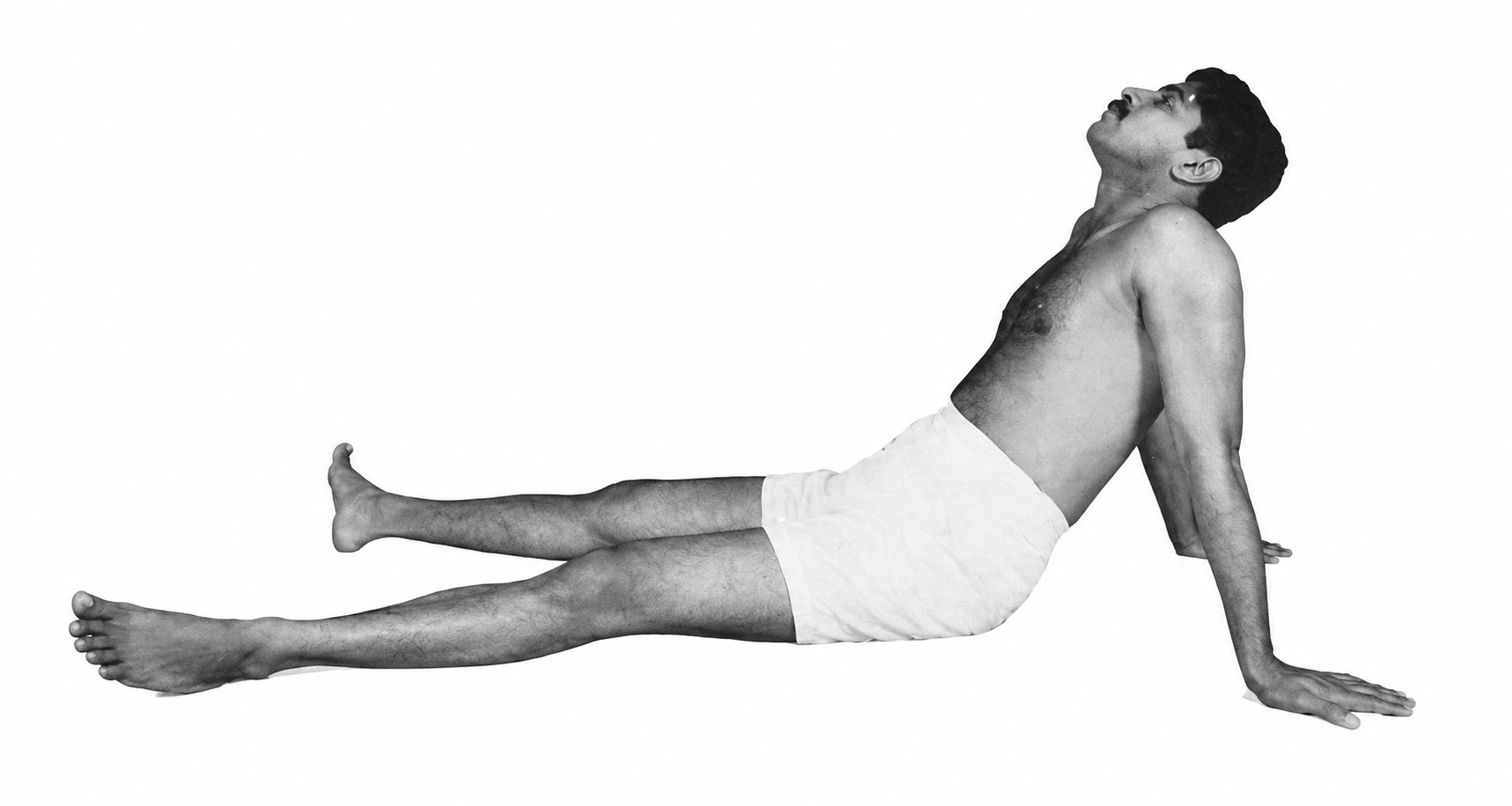
Alternative Methods:
If you find the method described above difficult, you may practice Yogamudrasana in either of the following ways. The first method is especially suitable for those who are overweight.
1. Sit in Sukhasana (Easy Pose). Raise both arms straight upward toward the sky. Then, while slowly exhaling, bend forward and lower the hands and head toward the floor.
Make sure the chin remains in contact with the chest.
Once you have reached the final position, do not inhale. Remain holding the breath (Kumbhaka) for as long as you comfortably can. Inhale only while slowly returning to the upright sitting position.
Some people may be able to place their hands on the floor while the head does not quite reach it. Do not worry if this happens. Wherever you experience the greatest difficulty, that is where the posture is working. Practice according to your present ability, and that is sufficient.
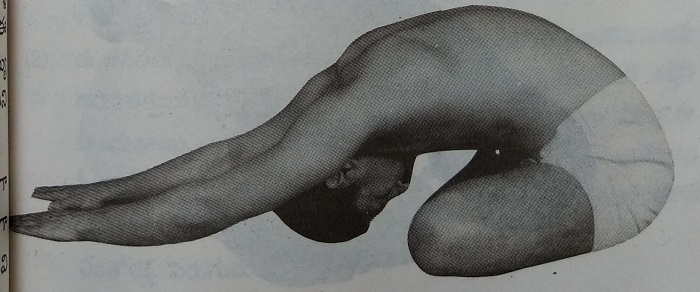
2. Yogamudrasana may also be practiced while sitting in Vajrasana. Some people find this variation easier. If it is more comfortable for you, practice it in this way, while following the same Asana Stage described above.
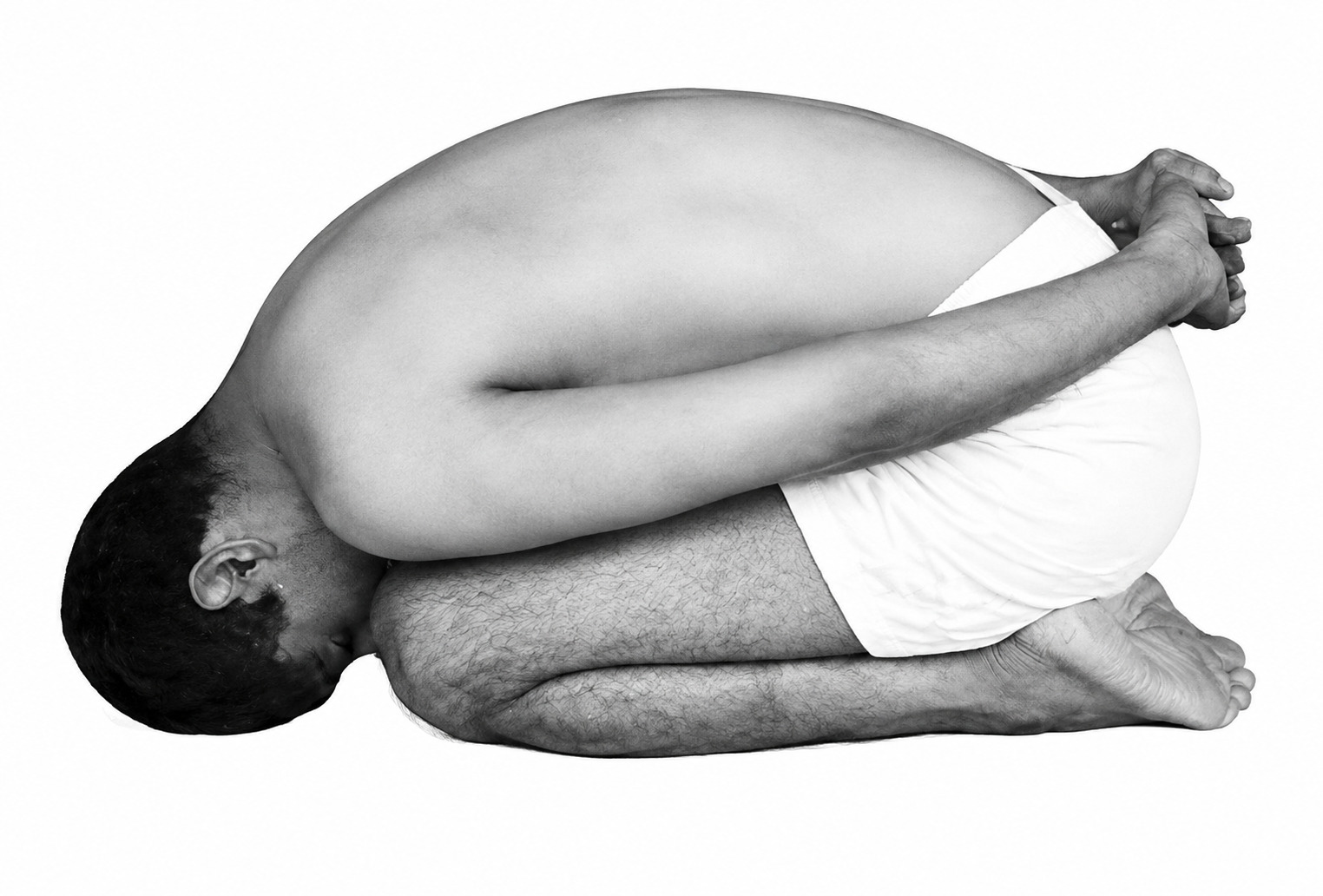
Incorrect Posture:
In every asana, there are certain common mistakes that reduce its effectiveness.
In Yogamudrasana, the forward bend is intended to benefit not only the back but also the abdominal muscles and the intestines. To receive these benefits, the buttocks must remain firmly in contact with the floor while bending forward.
Do not lift the buttocks off the floor as shown in the photographs. Instead, keep them fully grounded and then bend forward from the waist, lowering the head.
If the buttocks lift off the floor, the effectiveness of the posture is reduced.
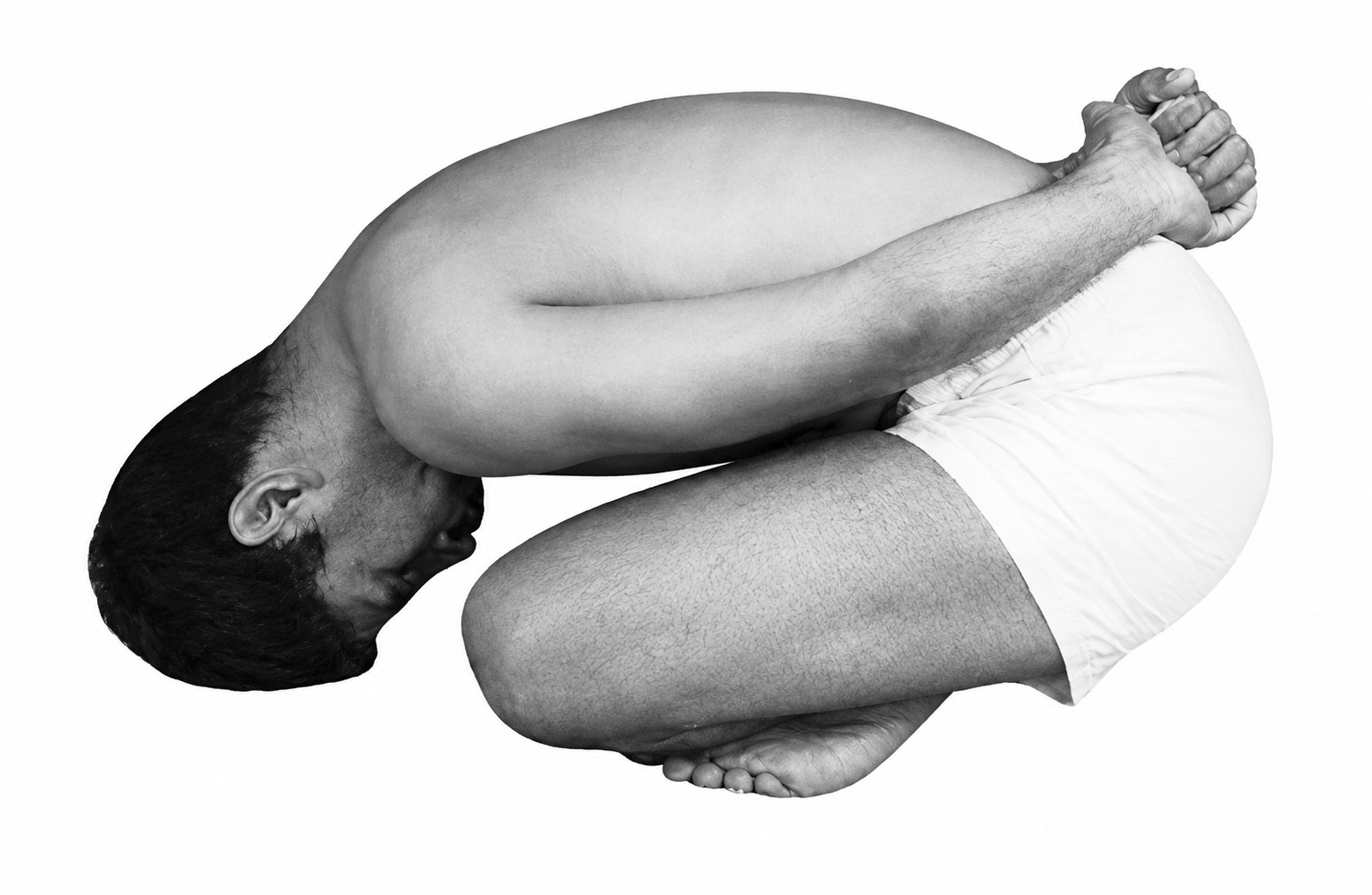
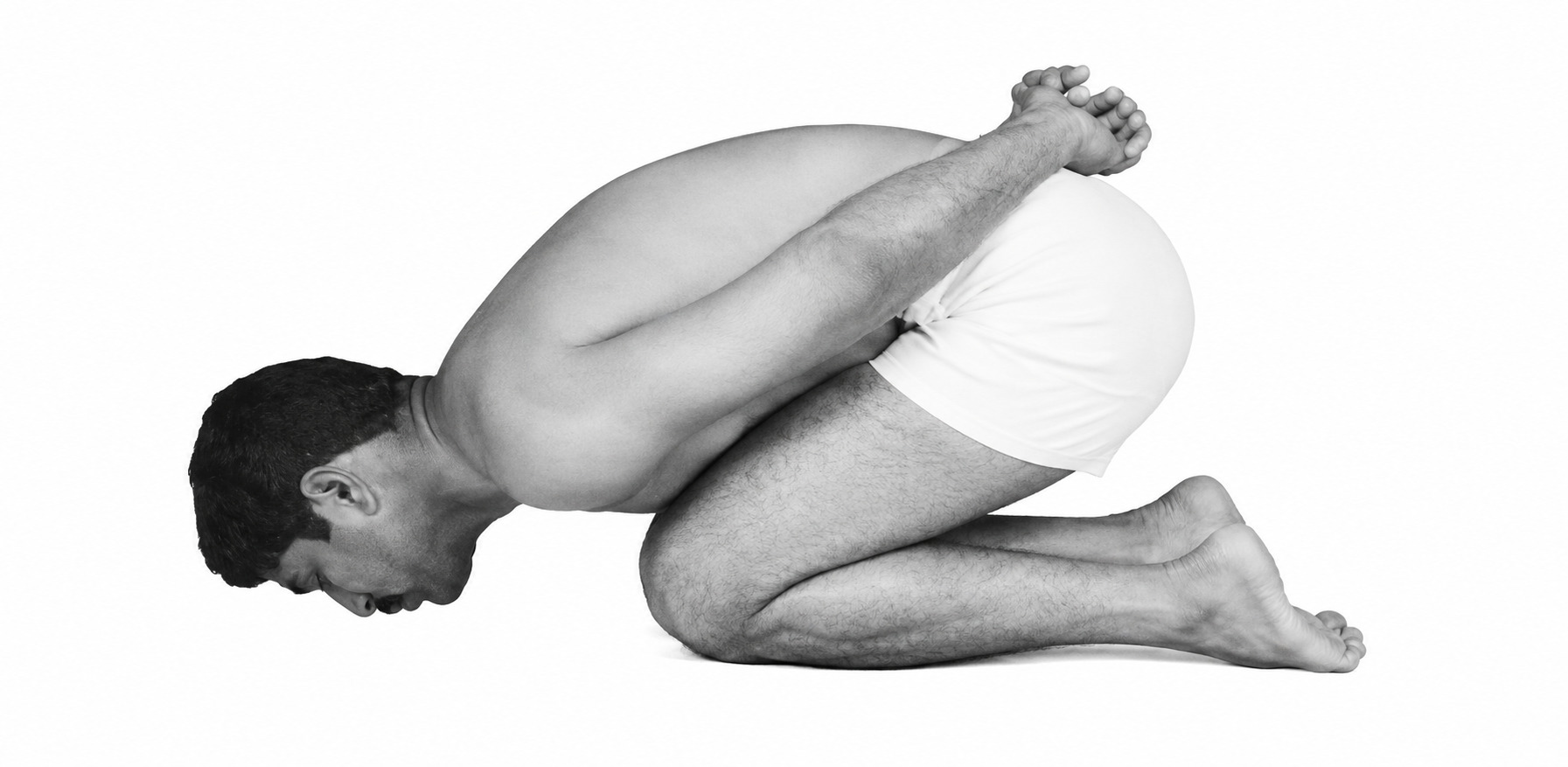
Benefits
1. Practicing Yogamudrasana immediately after Matsyasana provides additional benefits. In Matsyasana, the thyroid and parathyroid glands are stretched and expanded, whereas in Yogamudrasana they are compressed.
When an organ undergoes these two opposite movements—stretching followed by compression—its blood circulation is greatly improved. The cells of these glands are gently compressed, almost as though they are being squeezed. As a result, the glands and their cells receive a richer supply of oxygen and nourishment.
2. Since the breath is held (Kumbhaka) throughout the Asana Stage, the lungs are allowed to contract completely, improving their ability to empty fully.
As soon as you come out of the posture, you are naturally able to take a deep, full inhalation. With regular practice, this trains the breathing to become slower, deeper, and fuller. If deep breathing becomes your natural pattern throughout the day, it greatly increases your energy.
3. While remaining firmly bent forward in this posture, the abdominal muscles and the intestines are subjected to a good amount of pressure. This helps reduce some of the excess fat accumulated in the abdominal region, making the abdomen slimmer. At the same time, it strengthens the intestines.
4. For those with thyroid disorders, practicing Yogamudrasana together with Matsyasana helps improve the functioning of the thyroid and parathyroid glands. With regular practice, it may help reduce the need for thyroid medication.
5. Children whose growth has slowed or stopped may benefit from practicing Matsyasana together with Yogamudrasana. These two postures help the thyroid gland function more efficiently, promoting better hormone production and supporting healthy growth.
Note
1. It is sufficient to practice Yogamudrasana once. Because it is a relatively easy posture, some people feel like repeating it several times. There is no need to do so.
2. The Kumbhaka (breath retention) performed in this asana allows the thyroid gland and the throat region to contract more completely. It is specifically for this benefit that the breath is held in Yogamudrasana. We practice Kumbhaka only in this asana and not in the other asanas described in this book.
3. If, for any reason, you do not practice Matsyasana, there is no need to practice Yogamudrasana either. Yogamudrasana is practiced immediately after Matsyasana because the forward bend enhances the specific benefits of Matsyasana.
4. Many people do not experience much discomfort while remaining in this posture and may feel they can stay in it for a long time. However, because Kumbhaka is incorporated into the practice, the posture is naturally released after about 20 to 25 seconds. This duration is sufficient to obtain its intended benefits.
5. Those who have neck pain, lower back pain, or leg pain should not practice Yogamudrasana.
This posture is called Vakrasana because it involves twisting the spine to one side.
Method of Practice: Vakrasana should be practiced on both sides. After completing the twist to one side, repeat it on the other. Let us first learn the method of twisting to the left.
Twisting to the Left
1. Sit in the middle of your mat or folded blanket with both legs stretched straight out in front of you. Place both hands on the floor behind you for support. Keeping the right leg stretched straight, bend the left leg and draw the left foot toward the left knee.
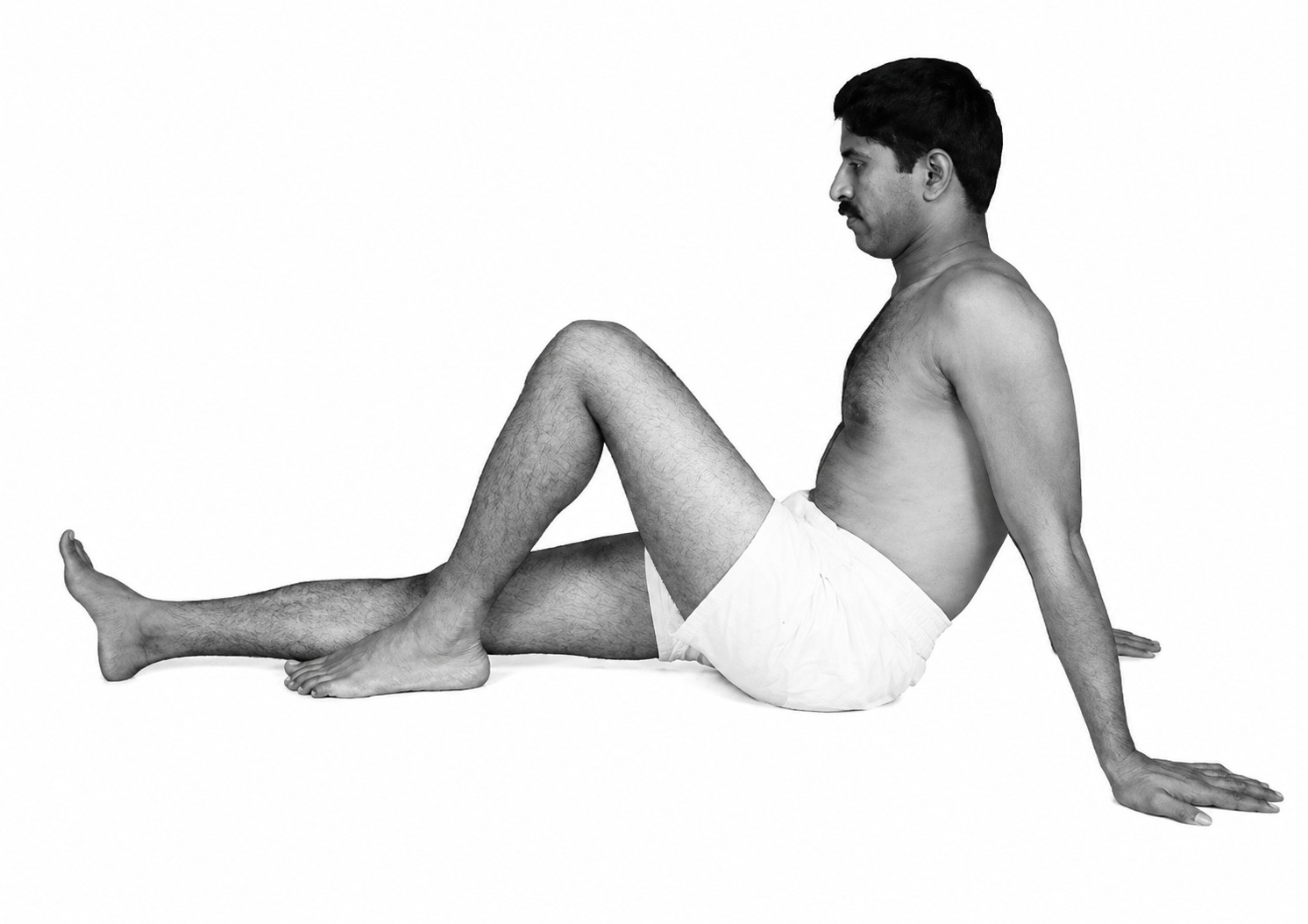
2. Extend the right arm straight and place it against the outer side of the left knee. Hold the left leg firmly so that it does not move from side to side. Keep the right leg fully straight and steady, without allowing it to lean to either side.
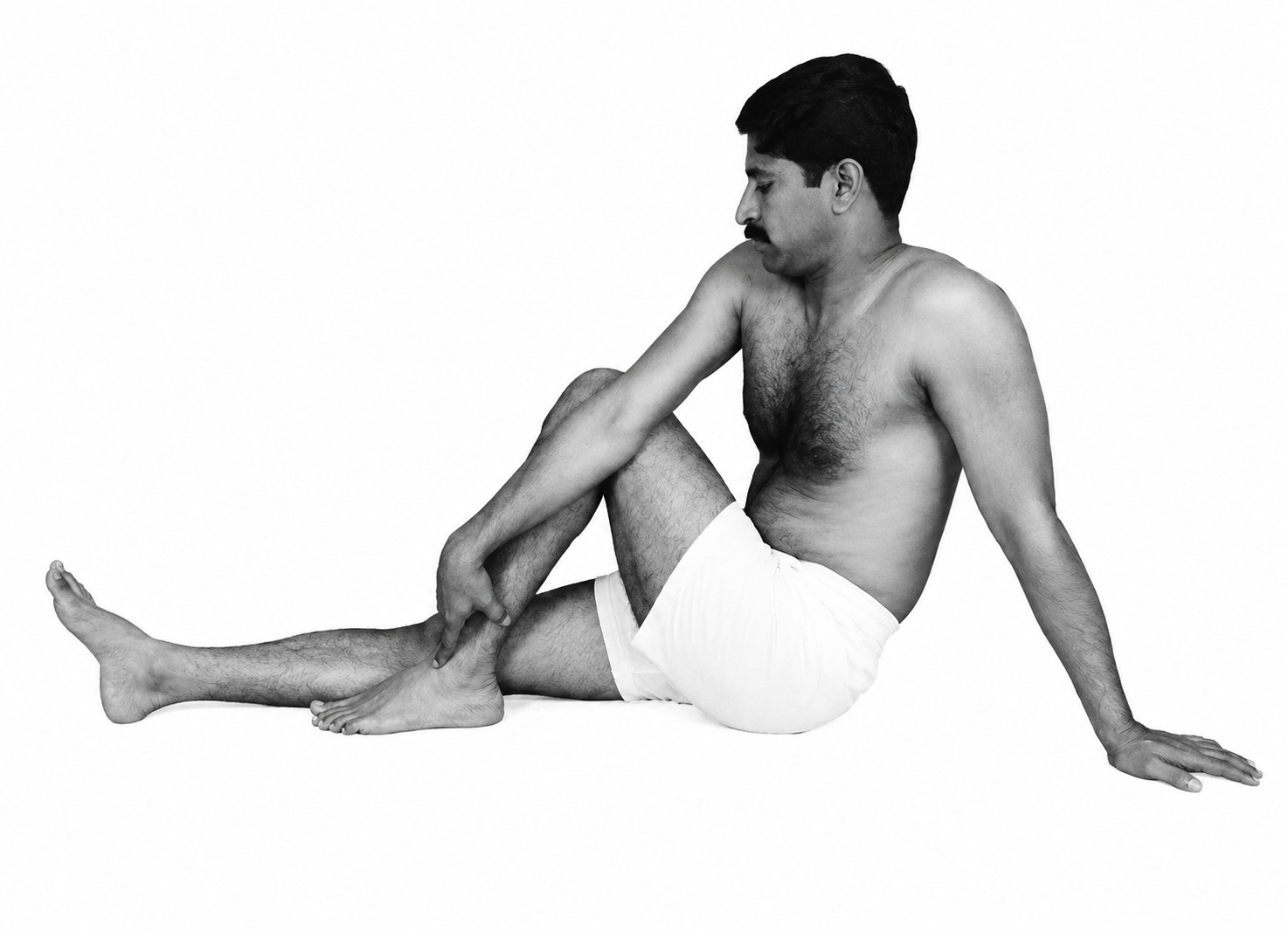
3. Using the right arm to press against the left leg, twist the waist and neck completely toward the left. As you turn, the right shoulder and left shoulder should come into the same line. While twisting into the posture, some people may hear a series of clicking sounds from the rib cage. This is normal. Close your eyes completely.
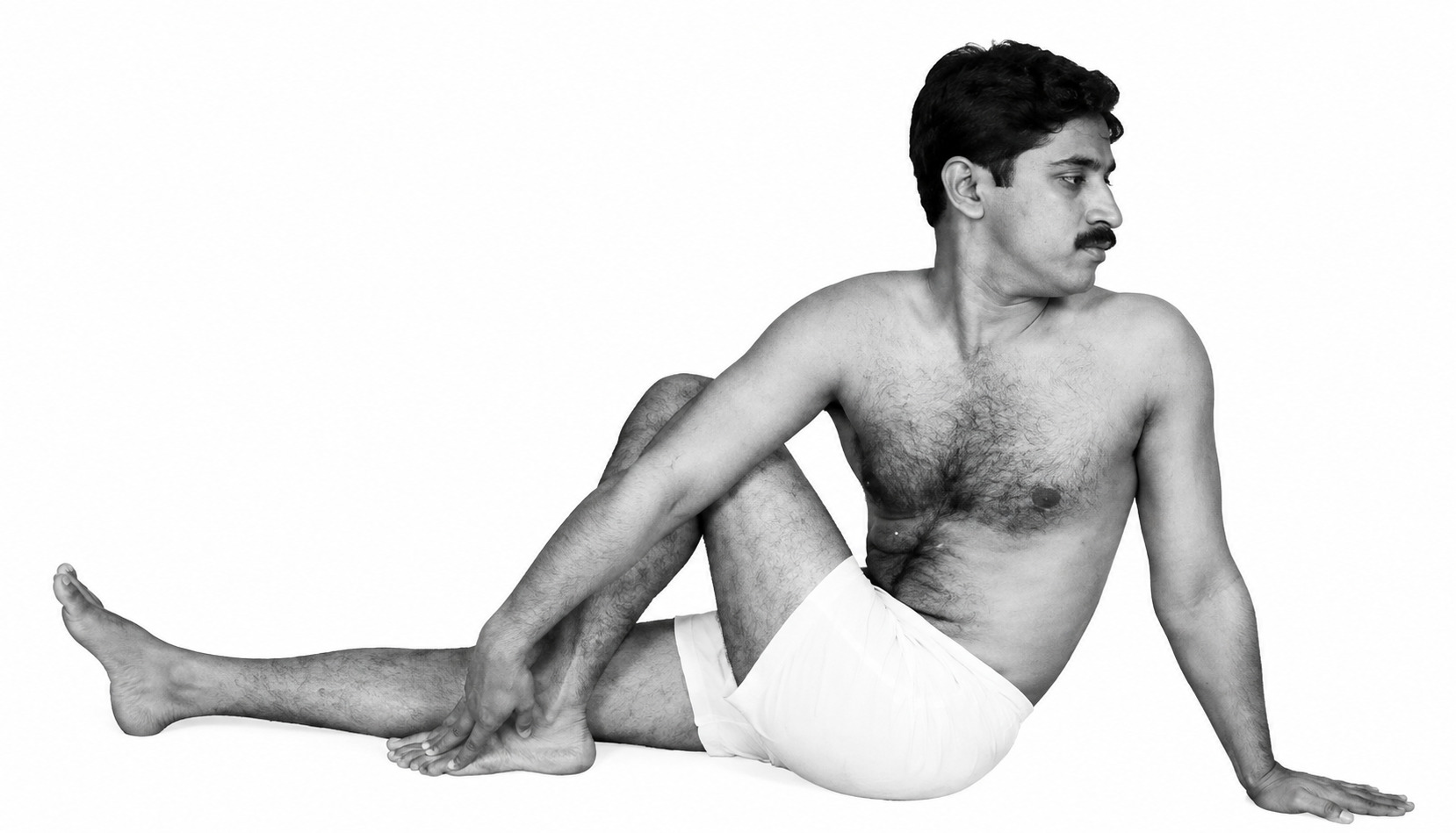
Asana Stage:
Twist the waist as far as you comfortably can toward the left. Once you have reached your fullest twist, keep your attention focused on the area of the waist where you feel the greatest stretch or discomfort.
Remain in the posture for as long as you are able, keeping the hands and legs completely still. Stay as motionless as possible, with the mind quietly observing the sensations in the body.
The longer you are able to remain in the posture, the greater the benefit. When the discomfort in the waist and the sides of the abdomen becomes too great and you feel you can no longer remain in the posture, gently come out of it.
While you are in this posture, the twisting of the abdomen prevents the breath from expanding fully into the lower parts of the lungs. The breathing is confined mainly to the upper chest. Because of this, you may notice a slight feeling of breathlessness while holding the posture. Those with a larger abdomen may experience this to a greater extent.
Remain in the posture only for as long as you comfortably can. Do not try to stay beyond your capacity.
Relaxation Stage:
To come out of the posture, keep your eyes closed. Slowly turn the neck back to face forward. Then gently release the right hand and place it behind you on the floor for support. Lean the neck back comfortably and sit in a relaxed position with the legs at ease.
At this stage, the breathing naturally becomes deep and very slow. Keep your attention on the breath and allow the mind to remain free from unnecessary thoughts.
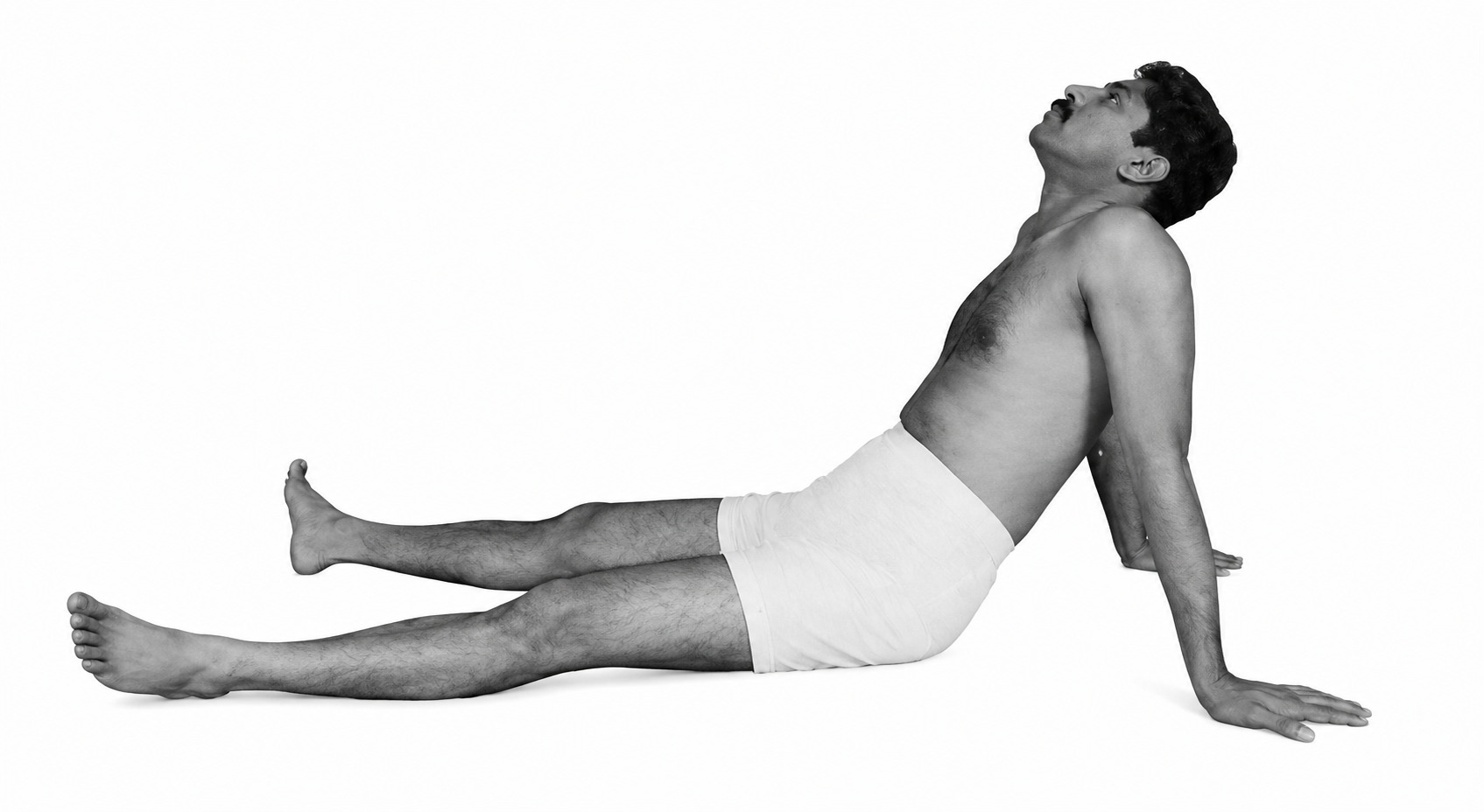
As soon as you release the posture, you will notice a strong flow of blood returning to the abdomen and the side of the waist. The areas where you felt discomfort during the Asana Stage now receive an increased supply of blood.
To receive the full benefit of this improved circulation, remain quietly in the Relaxation Stage for about one to two minutes.
Once your breathing has completely returned to its normal rhythm, practice Vakrasana on the right side in the same manner.
Let us now begin the right-side variation.
Twisting to the Right:
Now stretch the left leg straight in front of you, keeping it steady and aligned. Bend the right leg and draw the right foot toward the left knee.
Extend the left arm straight and place it against the outer side of the right knee. Hold the right leg firmly so that it does not move from side to side.
Using the left arm to press against the right leg, twist the waist and neck completely toward the right.
Close your eyes completely and remain steadily in the posture, keeping your attention in the same way as described for the left-side variation.
After releasing the posture, sit comfortably in the same relaxed sitting position described earlier and rest for one to two minutes.
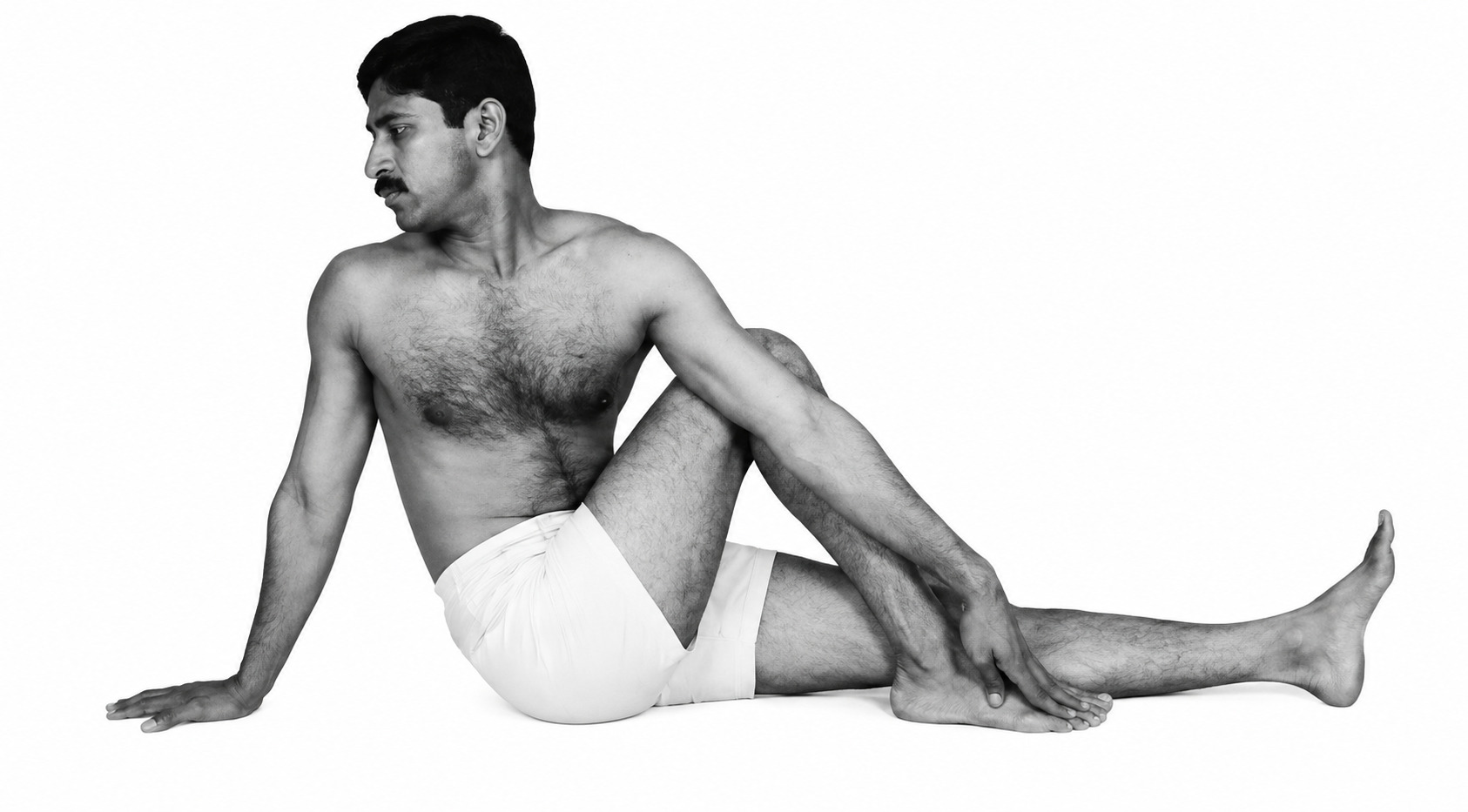
Full Position:
Once you have become well accustomed to this asana, you may gradually bring the bent foot closer to the body, positioning it beside the buttock.
Bringing the foot closer in this way increases the compression of the abdominal muscles and the muscles of the waist. As a result, the breathing becomes even more restricted, making it somewhat more difficult to remain in the posture for a long time.
As your practice improves, gradually move the foot a little closer over time.
Those who are learning the posture for the first time should continue to practice it in the basic manner described earlier.
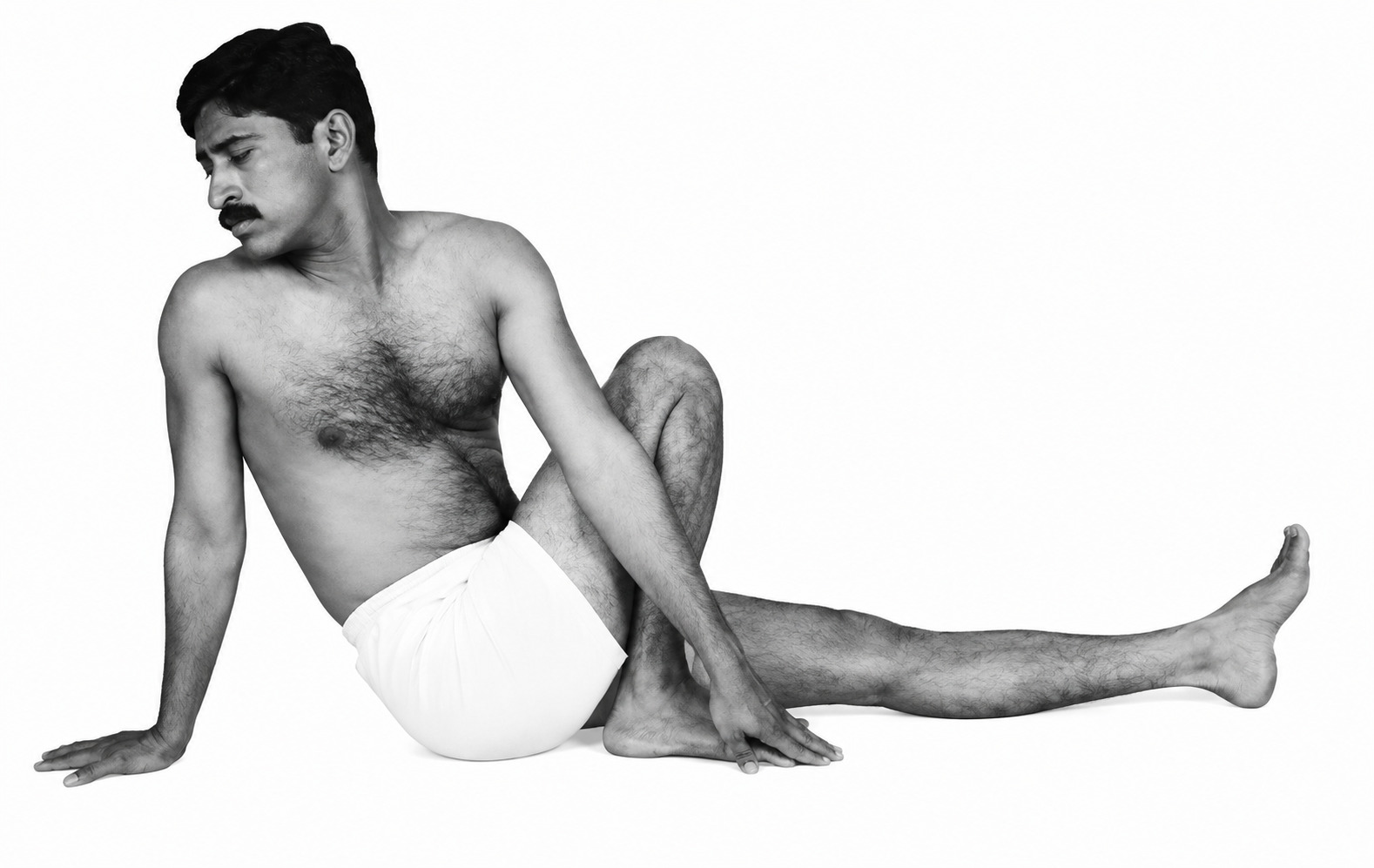
Alternative Method:
This variation is intended for those who are overweight, have large thighs, a prominent abdomen, or a broad, rounded chest.
A slender person may need to make a full spinal twist to obtain the maximum benefit. However, for an overweight person, even a partial twist provides essentially the same benefit. This is because the abdominal and waist muscles are already compressed sufficiently with a smaller degree of rotation. In fact, this variation often produces excellent results for them.
Practice with confidence and do not become discouraged.
Keep the left leg stretched straight in front of you. Make sure it remains firm and does not lean to either side, as this helps keep the waist properly engaged.
Instead of placing the right foot near the left knee, draw it closer and place it beside the left hip. If you are overweight, you may keep the foot a little farther away if that makes the posture more comfortable and helps you avoid unnecessary breathlessness.
Next, place the back of the left wrist against the right knee. Using the arm to press against the leg, twist the neck and waist toward the right as far as you comfortably can.
In this variation, your shoulders may not come into a straight line, and that is perfectly acceptable.
You may position your arm and leg as shown in the illustration, or place them wherever they feel most comfortable while maintaining the twist. The important thing is to make a sincere effort to practice the posture.
Remain in the posture for as long as you comfortably can.
Those who are overweight will feel a strong compression in the waist and abdomen, and may notice a pronounced throbbing sensation while holding the posture. Some people may become tired and come out of the posture sooner.
Remain in the posture only as long as your breathing remains comfortable. Then release it slowly and rest in a comfortable sitting position. If needed, you may take a slightly longer Relaxation Stage before continuing.
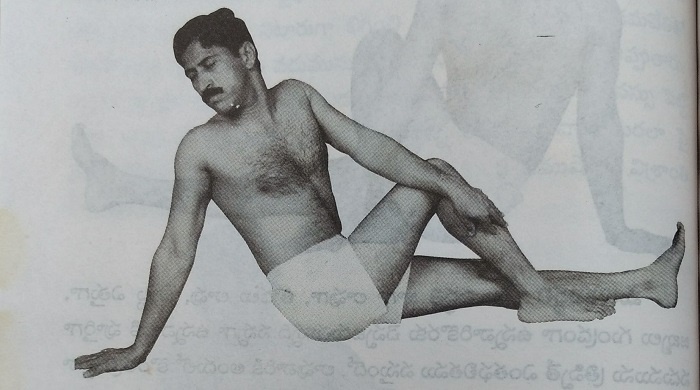
Incorrect Posture:
Many people make mistakes while practicing Vakrasana. When the posture is performed incorrectly, the spine does not twist fully to the side, and the abdominal and waist muscles do not receive the proper stretch and compression.
If you can remain in the posture for a long time without feeling any firmness in the twist, without discomfort along the sides of the waist, and without even a slight increase in the need to breathe, it is a sign that the posture is being performed incorrectly.
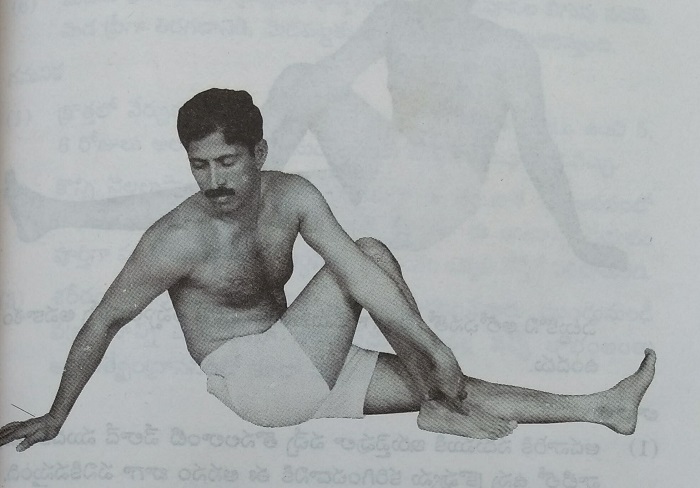
1. In the posture shown in the illustration, the left leg has slipped slightly to the side. Because the left arm is not pressing properly against the right leg, the waist has twisted only halfway toward the right.
The shoulders, which should be in a straight line, are out of alignment. Since the waist has not been fully twisted, the right hand, which should be in line with the left leg, remains toward the right side instead.
When the posture is performed this way, it feels comfortable. To an observer, everything may appear to be correctly positioned, and even the person practicing may not notice the mistake. It is possible to remain in the posture for a long time without any discomfort.
However, when the waist, spine, and abdominal muscles are properly twisted, the breathing naturally becomes more active. If you observe the posture carefully while practicing, you can avoid mistakes like this.
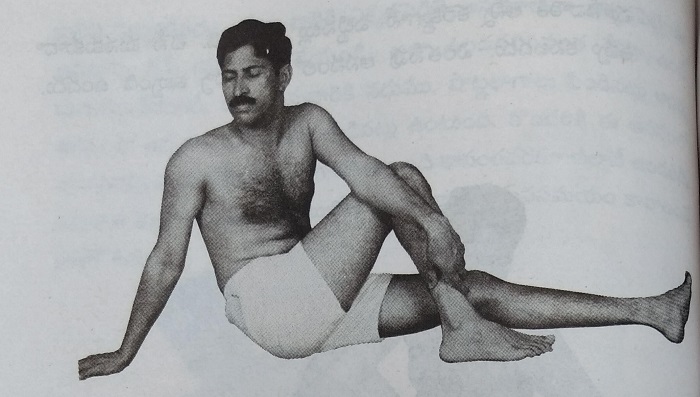
2. In this illustration, you can see that the left leg has tilted completely to one side. Apart from that, the rest of the posture appears to be correct, and at first glance it may seem that there are no mistakes.
The main error here is that the entire body has leaned onto the left buttock, causing the right buttock to lift off the floor.
When the body leans to one side in this way, the waist and abdominal muscles do not receive proper compression. Blood circulation is not restricted in the areas where it should be during the posture, and the intended benefits are therefore lost.
To avoid this mistake, keep the body upright and balanced while twisting the waist to the side.
Practice each movement slowly and with full attention. If you remain mindful throughout the practice, you are unlikely to make these mistakes.
Benefits
1. Vakrasana is especially beneficial for reducing the folds of fat that commonly develop on either side of the waist, particularly in women. Regular practice helps tone these areas and reduce the accumulated fat.
2. Because the waist is fully twisted and held firmly in this posture, the areas where you feel the greatest stretch or discomfort during the Asana Stage receive the greatest benefit. It helps reduce the fat accumulated in those regions, making the waist slimmer.
For most people, excess fat and muscle bulk tend to accumulate around the sides of the waist. This is the primary benefit of Vakrasana.
3. While holding the spine in a sideward twist, the joints between the vertebrae and the surrounding muscles receive healthy movement. As a result, the waist becomes more flexible and is less likely to become stiff or strained during activities that involve bending forward or twisting to the side.
4. The muscles on both sides of the spine receive an abundant supply of blood. Every vertebra, from the neck down to the tailbone, is gently twisted during Vakrasana. This helps strengthen the vertebrae as well as the intervertebral discs.
5. Even for those who do not have excess fat around the waist, this posture helps strengthen and tone the waist region.
6. Twisting the neck fully to both sides helps relieve stiffness in the cervical vertebrae, allowing the neck to move more freely and reducing the tendency for neck stiffness.
Note
1. When you are first learning this posture, hold it for about 10 to 15 seconds. After practicing for five or six days, gradually increase the duration and remain in the posture for as long as you comfortably can.
2. After practicing Vakrasana for a few months, if you find that you can remain in the posture for any length of time without discomfort or pain, you may stop practicing it altogether and replace it with Ardha Matsyendrasana, as that posture provides the same benefits.
3. Those whose bodies are naturally flexible and respond well to asana practice may omit Vakrasana from the beginning itself. All the benefits of this posture can also be obtained through Ardha Matsyendrasana.
This posture is named Ardha Matsyendrasana after the great yogi Matsyendra, who is credited with its development.
In nature, many animals instinctively stretch and loosen their spines in different directions—forward, backward, and sideways—as soon as they wake up. This helps remove stiffness and prepares the body for activity. Mobilizing the spine in this way is a natural process that stimulates the flow of energy throughout the body.
Similarly, practicing this asana early in the morning produces a variety of movements in the spine, releasing energy and benefiting the body in many ways.
Method of Practice:
Like Vakrasana, Ardha Matsyendrasana should be practiced on both sides, one side at a time. Let us first learn the method of twisting to the right.
Twisting to the Right
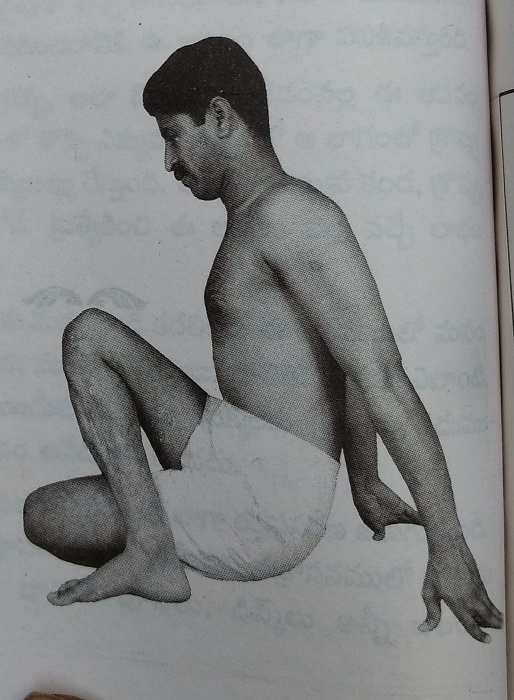
1. Sit in the middle of your mat or folded blanket with both legs stretched straight out in front of you. Place both hands on the floor behind you for support. Bend the left leg and bring the left heel between the buttocks, then sit on the left foot. Next, bend the right leg, lift it over the left thigh, and place the right foot firmly on the floor beside the left thigh.
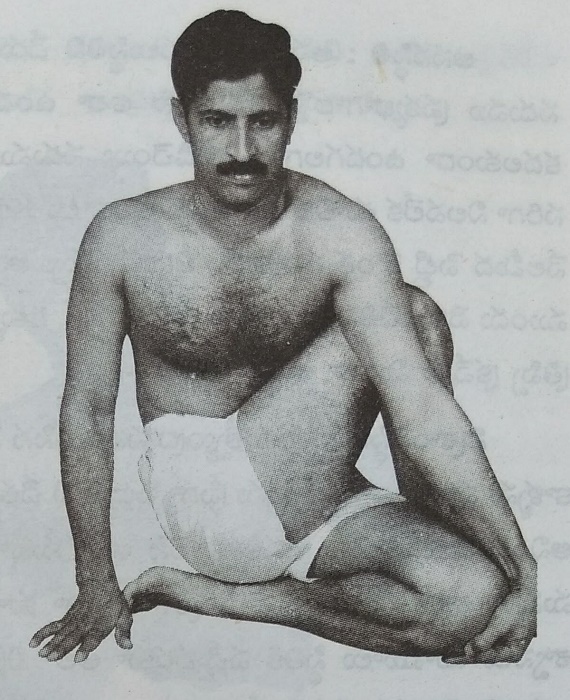
2. Bring the left arm across the right knee, as you did in Vakrasana, and hold the right kneecap with the left hand.
3. Press the right leg firmly into the left armpit while twisting the waist and neck completely toward the right. Then lift the right hand off the floor and place it on the waist, balancing the body steadily on the left leg. Remain completely still in the posture. Keep your eyes fully closed.
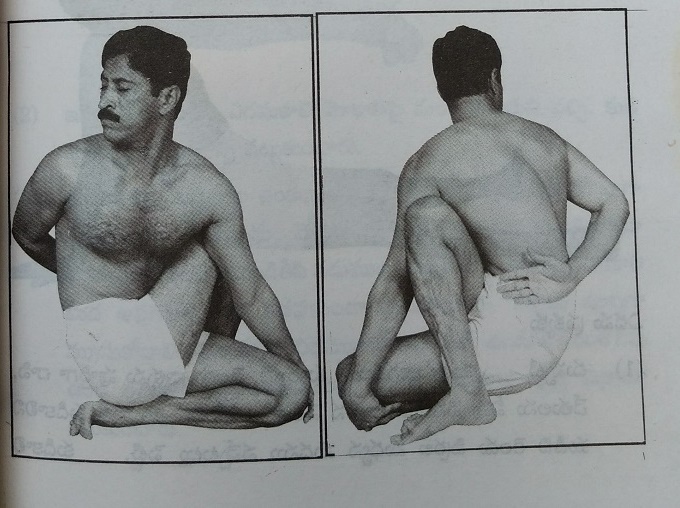
Asana Stage:
Once you have assumed the full posture, focus your attention on the lower abdomen and the sides of the waist. Remain in the posture for as long as you comfortably can, keeping the body completely still and without losing your balance.
If you find it difficult to maintain your balance after placing the right hand on the waist, you may keep the hand on the floor from time to time until you become accustomed to the posture.
When you are ready to come out of the posture, first bring the right hand back to the floor behind you. Keeping your eyes closed, slowly turn the neck to face forward, and then gradually release the rest of the posture.
Relaxation Stage:
As soon as you release Ardha Matsyendrasana, keep your eyes closed. Stretch both legs out straight in front of you and let them relax comfortably.
Place both hands on the floor behind you to support the body, gently lean the neck back, and sit comfortably in a relaxed position.
Remain in this Relaxation Stage for one to two minutes, keeping your attention on the breath and allowing the mind to become calm.
Continue resting until all tiredness has disappeared and your breathing has completely returned to its normal rhythm.
Then practice Ardha Matsyendrasana on the other side.
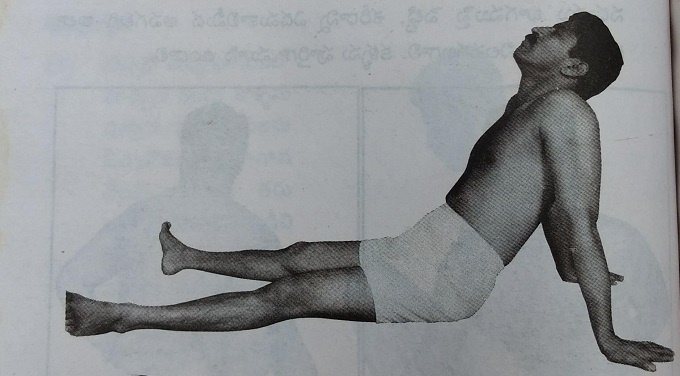
Twisting to the Left
1. Sit in the middle of your mat or folded blanket with both legs stretched straight out in front of you. Place both hands on the floor behind you for support.
Bend the right leg and bring the right heel between the buttocks, then sit on the right foot.
Next, bend the left leg, lift it over the right thigh, and place the left foot firmly on the floor on the opposite side of the right thigh.
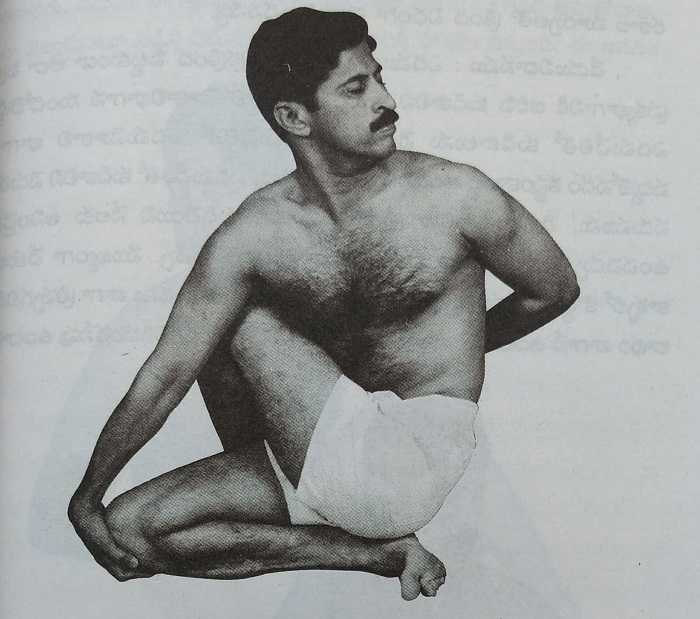
2. Bring the right arm across the left knee and hold the left kneecap with the right hand.
3. Press the left leg firmly into the right armpit with the right arm while twisting the waist and neck completely toward the left.
Then lift the left hand off the floor and place it on the waist, balancing the body steadily on the right leg. Keep the body completely still.
Close your eyes completely.
Remain in the posture for as long as you comfortably can, following the same method described for the right-side variation.
After releasing the posture, rest in the Relaxation Stage for one to two minutes, allowing the body and breath to return completely to normal before continuing.
Alternative Method:
Those who have large thighs or a prominent abdomen may find it difficult to perform the standard version of this posture. If it can be done without excessive discomfort, try the following modified method.
Method of Practice:
Instead of placing the left foot under the buttocks, bend the left leg and move it to the side of the left buttock.
Then bend the right leg and place the right foot beside the left knee.
It may be difficult to reach and hold the left kneecap with the left hand as described in the standard method. In that case, simply place the hand as far as you comfortably can.
Use the left arm to press firmly against the right leg, while twisting the waist and neck as far as possible toward the right.
You may either keep the right hand on the floor for support or place it on the waist, whichever is more comfortable.
Even if the positions of the hands and legs are modified slightly, you will still receive good benefits as long as you are able to twist the waist and neck well.
Practice the posture on both sides, remaining in each side for as long as you comfortably can.
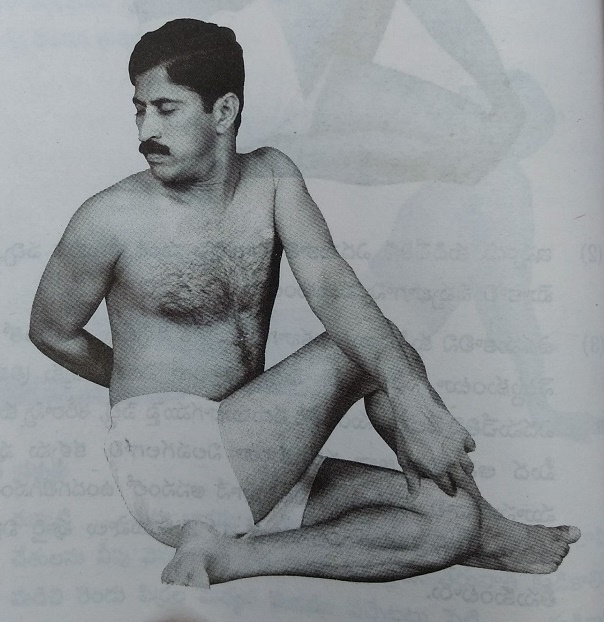
Incorrect Posture:
At first glance, the positions of the hands and legs may appear to be correct. However, the body looks as though it is simply sitting comfortably, without any real twist.
This indicates that the waist has not been rotated sufficiently.
To achieve a proper spinal twist, you must press firmly against the leg with the arm while rotating the waist. When you actively use the arm to deepen the twist, everyone can obtain the intended benefits of the posture.
If Ardha Matsyendrasana is not performed correctly, the breathing remains almost normal. However, when the waist is twisted properly, the breathing becomes even more restricted than in Vakrasana, making each breath noticeably heavier and more difficult. This is a sign that the posture is being performed effectively.
If you can remain in the posture comfortably without feeling any stretch or discomfort in any part of the body, it indicates that something is not being done correctly.
Whenever this happens, do not simply move on after assuming the posture. Instead, readjust your position carefully and deepen the twist until the posture is performed correctly.
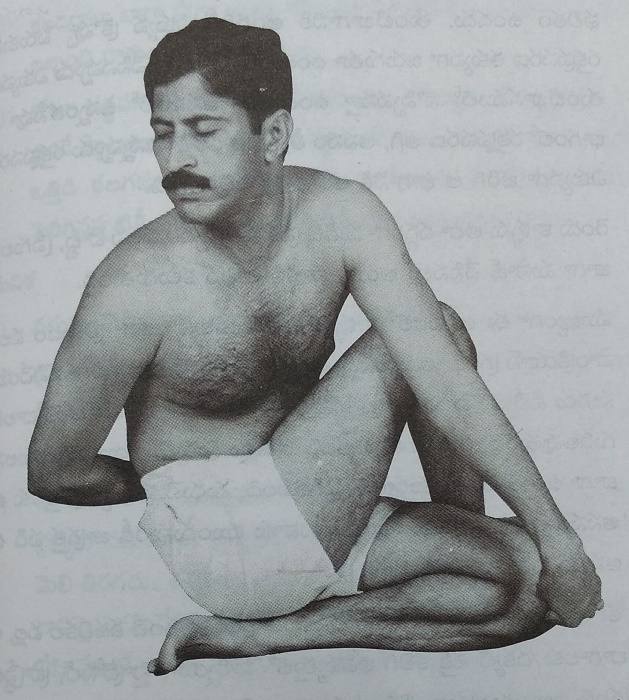
Benefits
1. Ardha Matsyendrasana is about twice as demanding as Vakrasana. Because both legs are folded close to the body, this posture is especially effective in reducing the fat around the hips. This particular benefit is not obtained to the same extent in Vakrasana.
In most people, fat tends to accumulate around the hip region, where blood circulation is comparatively poor. During the Asana Stage, this area often experiences the greatest discomfort. While holding the posture, blood flow to the compressed area is temporarily reduced. After releasing the posture and entering the Relaxation Stage, blood circulation increases significantly, nourishing the tissues and improving the health of the hip region.
2. Folding both legs close to the body and twisting the trunk gives the abdomen and intestines a deep massage, which is highly beneficial for these organs.
3. This posture places considerable pressure on the pancreas—the gland that produces insulin. As the pancreas is repeatedly compressed and released, its functioning is improved and its ability to produce hormones is enhanced.
For this reason, Ardha Matsyendrasana is especially beneficial for people with diabetes. It is also an excellent preventive practice for those who do not have diabetes.
4. The movements created in the organs below the navel help strengthen these organs. With regular practice, this posture may help prevent problems such as hernia, hydrocele, and prostate disorders.
5. This posture effectively reduces the fat on both sides of the waist, making the waist slimmer and better toned. It is one of the best asanas for reducing fat in this region.
6. The nerves that emerge from the spinal cord, as well as the surrounding nerves, are strongly stimulated during this posture, helping them become healthier and more energetic.
7. In our daily activities, we rarely twist the waist fully to either side or rotate it backward. As a result, the vertebrae and the muscles surrounding the spine gradually become stiff.
In Ardha Matsyendrasana, the waist is fully twisted to both sides. This helps loosen the vertebrae and the muscles that support them, allowing the spine to move more freely. As a result, the back remains flexible and is less likely to become strained during the day's movements, whether bending or twisting.
8. Practicing Ardha Matsyendrasana every day helps keep the intervertebral discs—the cushion-like structures between the vertebrae—in their proper position. This reduces unnecessary pressure on the vertebrae and the spinal nerves.
As a result, even as you grow older, regular practice helps protect the lower back from many common spinal problems.
Note
1. Those who have lower back pain or leg pain should not practice Ardha Matsyendrasana.
2. When learning this posture, it is best to first practice Vakrasana regularly for 10 to 20 days. Once you are able to perform Vakrasana comfortably and correctly, begin practicing Ardha Matsyendrasana.
Those who are overweight or have significant stiffness or difficulty should progress gradually and patiently.
3. A common mistake in this posture is twisting the waist in the wrong direction. Instead of twisting toward the raised leg, some people twist toward the opposite side. In that case, the spine does not receive the intended twist, and the posture provides little or no benefit.
To avoid this mistake, remember this simple rule:
When the right leg is raised, place the left arm across it and use the arm to press against the leg while twisting toward the right.
When the left leg is raised, place the right arm across it and use the arm to press against the leg while twisting toward the left.
Following this method will help you perform the posture correctly.
4. Those who are overweight, have large thighs, or have a prominent abdomen may find this posture difficult to perform correctly. If so, do not be discouraged or worry that you are missing its benefits.
Continue practicing Vakrasana instead. It provides essentially the same benefits and will gradually prepare your body until you are able to practice Ardha Matsyendrasana comfortably.
This posture is called Gomukhasana because, when the knees are placed one directly above the other, they resemble the shape of a cow's face.
Method of Practice:
Like the previous twisting postures, Gomukhasana is practiced on both sides. Perform it once with the right side and then repeat it with the left side. Let us first learn the right-side variation.
Right-Side Variation
1. Sit with both legs stretched straight out in front of you.
First, bend the right leg and draw it close to the body, placing the right foot beside the left buttock.
Next, bend the left leg. Holding the left foot with both hands, bring it over the right thigh and place it beside the right buttock.
Adjust the legs so that the two knees are stacked one directly above the other.
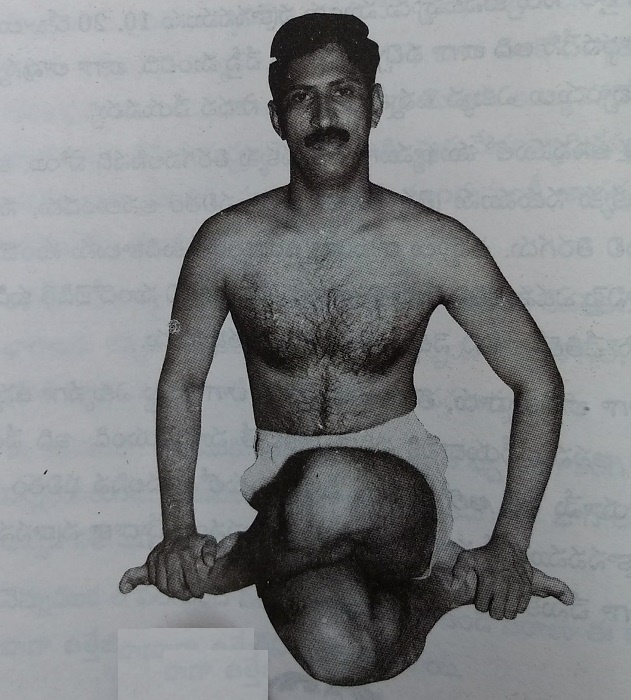
2. Raise the right arm behind your back as though you were reaching up to scratch or wash your back. Slide it upward as far as you comfortably can.
Then raise the left arm straight overhead, keeping it close to the left ear with the palm facing forward.
Now bend the left elbow and bring the left hand down behind your back. Join the fingers of both hands and clasp them together.
Once you have secured the grip, close your eyes.
Keep the left elbow pointing straight upward toward the sky. Sit with the neck upright and the spine erect.
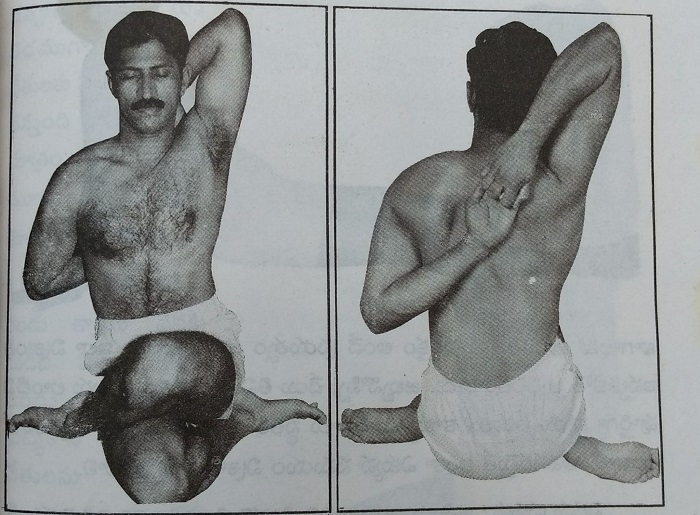
Asana Stage:
Draw the hands toward each other so that the grip becomes as firm as possible. Make sure the arms are positioned so that Gomukhasana forms a clear 90-degree alignment.
Focus your attention on the right shoulder and remain in the posture for as long as you comfortably can.
You will usually feel the greatest compression and discomfort around the right shoulder. Remain in the posture for as long as you are able to tolerate this sensation.
When you are ready to come out of the posture, first release the grip of the hands. Slowly lower the upper arm, then gently release the lower arm.
Next, stretch the left leg forward, carefully release the right leg, and extend both legs comfortably in front of you.
Relaxation Stage:
Stretch both legs out comfortably and place both palms on the floor for support. Gently lean the neck back and sit in a relaxed position.
Keep your attention on the breath and remain calm in this Relaxation Stage for about one minute.
During the Asana Stage, blood circulation to the arms and legs is temporarily reduced because of the position of the limbs. As soon as you release the posture, the circulation returns rapidly, sending an increased supply of blood to the areas that experienced the greatest discomfort while holding the asana.
Without this period of relaxation, you will not receive the full benefit of the posture.
Remain in the Relaxation Stage until any shoulder pain, tingling in the arms, or tingling in the legs has completely disappeared and the arms and legs feel normal again.
If necessary, rest for a little longer before continuing.
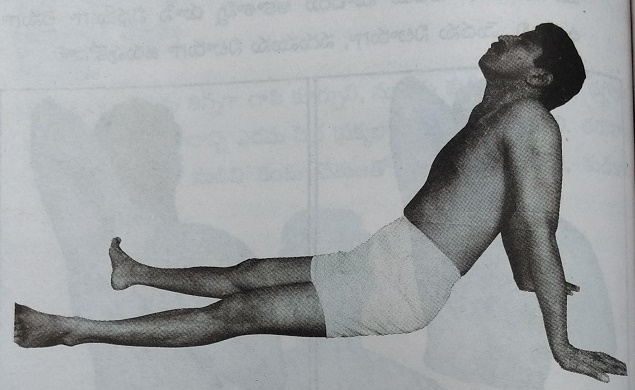
Left-Side Variation:
Now place the left leg underneath and the right leg on top.
Similarly, bring the left arm behind the back from below and the right arm behind the back from above. Clasp the fingers of both hands together and practice the posture in exactly the same way as described for the right-side variation, following all the same instructions.
Release the posture slowly and rest in the Relaxation Stage for one to two minutes, allowing the body to recover completely.
Alternative Methods:
Those who have large thighs or a broad body may find it difficult to sit with the legs in the standard Gomukhasana position. If you are unable to sit in that position, do not skip the posture.
To obtain the benefits of Gomukhasana for the shoulders and arms, sit in any comfortable leg position and practice the arm movement correctly.
Those who cannot sit on the floor, or who have lower back problems, may sit upright on a stool and perform the arm position in the same manner.
Whatever sitting position you choose, the most important point is to keep the spine erect.
When Gomukhasana is practiced in the standard sitting position, both the arms and the legs receive excellent benefits. However, if you practice using one of the alternative sitting positions described below, you will receive the full benefits for the arms, but not the additional benefits for the legs.
The posture may be practiced in three alternative sitting positions.
1. Vajrasana Variation:
Sit in Vajrasana with both legs folded back and the feet placed beneath the buttocks. Then perform the arm position of Gomukhasana, bringing one arm from above and the other from below and clasping the hands behind the back.
Repeat the posture after reversing the positions of the arms.
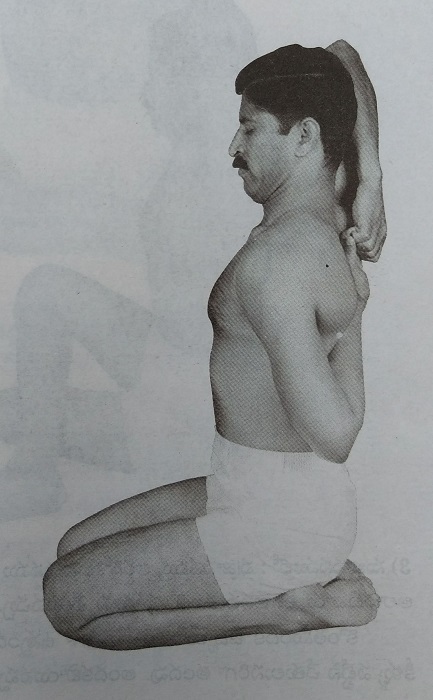
2. Ardha Gomukhasana:
For most people, the lower leg bends without much difficulty. However, because of large thighs or stiffness in the joints, the upper leg may bend only partially.
Even if you are unable to perform the full Gomukhasana, it is worthwhile to practice the posture as shown in the illustration. Even a partial leg position provides greater benefits than practicing the arm position while sitting in Vajrasana or Sukhasana.
Therefore, those who cannot yet perform the full posture should first try Ardha Gomukhasana. If that is also not possible, use one of the other alternative methods.
Even in Ardha Gomukhasana, take care to keep the spine erect.
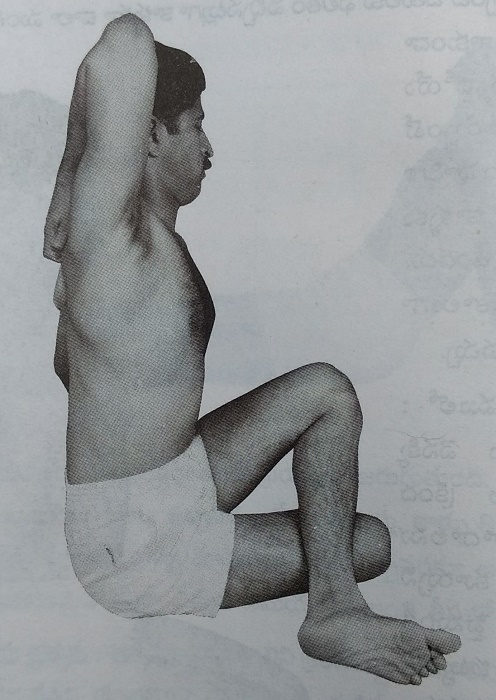
3. Sukhasana Variation: Some people may be unable to sit comfortably in either Vajrasana or Ardha Gomukhasana. They may simply sit in Sukhasana and practice the arm position of Gomukhasana.
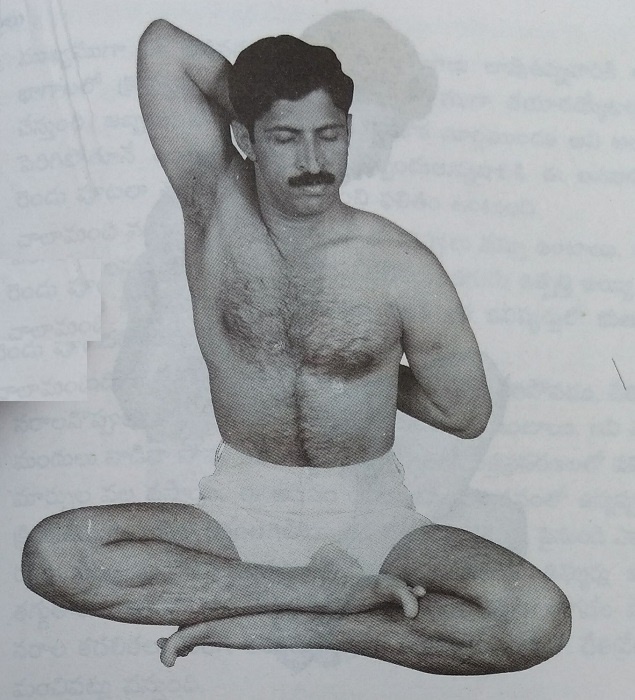
Some people have very broad shoulders, while others have stiff shoulder joints, making it difficult for the hands to meet behind the back. Even if the hands do not touch, push them toward each other as far as you comfortably can and hold the position. You will still receive good benefits.
If you wish to gradually improve your reach, hold a handkerchief or small towel in the upper hand, letting it hang down behind your back. Then grasp the cloth with the lower hand and use it to slowly bring the hands closer together.
If someone experienced with asana practice is available, they may gently help bring your hands closer together. However, this should be done with great care. Excessive force may cause the shoulder joint to slip out of place.
Do not be discouraged if your hands do not yet meet. In fact, if you experience a good amount of stretching or discomfort while practicing the posture, it means that you are receiving greater benefit. There is no need to worry.
Incorrect Posture:
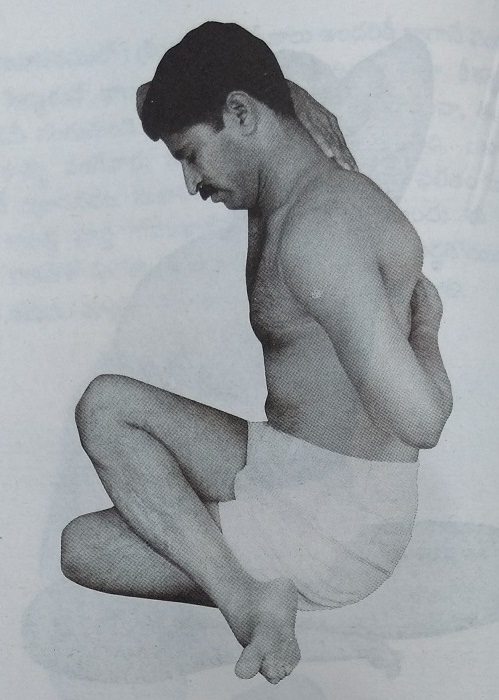
Even in a posture as simple as Gomukhasana, many people make one or more mistakes and therefore receive only limited benefit.
One of the most common mistakes is not keeping the upper arm vertical. Most people are able to raise the upper arm fairly well, but they stop before lifting it fully. Continue to raise it until it is as close to a straight vertical line as possible.
Similarly, the lower arm should be moved well upward behind the back. Simply placing the hand behind the back without actively reaching upward will not produce the intended benefits.
Another common mistake is leaning the trunk forward. When the waist bends forward, the shoulders and arms do not receive the proper stretch. As a result, the posture provides very little benefit. You may be able to remain in the posture for a long time without any discomfort in the arms, but that indicates that it is not being performed correctly.
In the illustration, both the neck and the upper arm are bent forward. The lower arm has not been lifted firmly upward, and the waist has also leaned forward.
Compare this posture with the correctly performed Gomukhasana. You will notice how relaxed and loose this incorrect posture appears.
Any mistake such as the ones shown in the illustration will greatly reduce the benefits of the asana.
Benefits
1. The primary benefit of Gomukhasana is that it helps reduce excess fat around the upper arms and shoulders, giving them a more toned and well-shaped appearance.
Once fat accumulates in these areas, it is often difficult to reduce by other means. For those with this problem, practicing Gomukhasana twice a day can produce very good results.
2. As people grow older, many develop pain in the shoulder joints. This posture improves the mobility of the shoulder joints and promotes the production of natural joint lubrication, helping to relieve such pain.
With regular practice, it also helps protect the shoulders from developing pain in the future.
3. Many people suffer from tingling in the arms, weakness of grip, and nerve pain in the hands. These problems often persist despite taking medicines because they result from changes in the nerves and blood circulation around the shoulders and upper arms.
During the Asana Stage, blood flow to the lower arm is greatly reduced by the position of the limbs. As soon as the posture is released, a strong flow of blood rushes from the shoulder all the way to the fingertips. This helps reduce tingling and improves circulation throughout the arm.
In addition, firmly drawing the hands toward each other stretches and mobilizes the nerves, making them more supple and improving the strength of the grip.
4. By firmly clasping the hands — one from above and the other from below — the muscles of the arms, upper arms, and shoulders are given an intense stretch and compression, almost as though a wet cloth were being tightly wrung out.
This helps eliminate stiffness in these muscles, making them more flexible. As a result, both arms gradually become freer to move upward and backward with ease.
5. Practicing this asana every day greatly improves the mobility of the shoulders and arms. As a result, everyday activities such as washing your back, reaching to scratch your back comfortably, and putting on clothes become much easier.
6. This posture can be practiced by people of all constitutions. Women may also practice the arm position of Gomukhasana while sitting in Sukhasana or Vajrasana during menstruation.
7. Regularly practicing the full sitting position of Gomukhasana helps improve the mobility of the knee joints and the hip joints, bringing them under better voluntary control.
With continued practice, it may help prevent age-related problems such as arthritis, joint stiffness, and wear and tear of the joints.
8. Once you become accustomed to sitting in Gomukhasana, you can remain comfortably in this posture for long periods while attending spiritual discourses or sitting in temples, keeping the mind calm and steady.
Unlike Vajrasana, this posture does not require a soft surface. You can sit comfortably almost anywhere. Even today, many elders naturally sit in this position.
9. If you sit in the Gomukhasana leg position for 10 to 15 minutes without performing the arm position, a strong flow of blood reaches the feet immediately after you release the posture. This is helpful in reducing burning sensations and tingling in the feet.
10. Sitting with the knees closely stacked in Gomukhasana helps reduce excess fat around the hips and improves blood circulation in that region.
11. Those who experience mental stress or anxiety can find a sense of calm by practicing Gomukhasana. Immediately after releasing the posture, the body naturally takes in a deeper supply of oxygen, leaving you feeling refreshed and relaxed.
Note
1. Some people find that one arm reaches behind the back more easily than the other. For example, the left arm may not reach as easily as the right, or vice versa. They may be able to clasp the hands on one side but not on the other, and this often causes unnecessary concern.
This is a common experience for beginners. In daily life, we tend to use one hand more than the other for activities such as washing the back, putting on clothes, or scratching the back. As a result, that arm becomes more flexible and is able to reach the opposite hand more easily, while the other arm remains comparatively stiff.
With regular practice, both arms gradually become equally flexible, and the hands will eventually meet with ease.
2. During the first four or five days of practice, enter the posture and come out of it almost immediately. Then gradually increase the time you remain in the posture.
If you try to hold the posture for too long in the beginning, the shoulder joints may become strained.
3. If your hands do not meet, do not force them together or allow someone to push them together with excessive pressure. Doing so may strain the nerves and cause considerable pain.
Never perform the posture by force.
4. Many people become confused about which arm should be above and which should be below, and similarly about the position of the legs.
A simple rule will help you remember:
The leg that is underneath is on the same side as the lower arm.
The leg that is on top is on the same side as the upper arm.
Remembering this will help you avoid mistakes.
5. Once you are able to clasp your hands comfortably behind your back, bringing them close to the wrists, and can remain in the posture for two to three minutes without any pain or discomfort, there is no further need to continue practicing Gomukhasana. You may discontinue this posture and use that practice time for another asana.
The word supta means lying down or reclining. Since this posture is performed by reclining backward from Vajrasana, it is called Supta Vajrasana.
Method of Practice
1. Move toward the front of your mat or folded blanket and sit in Vajrasana. Place the left palm on the floor beside the toes of the left foot, as shown in the illustration. Slowly lean toward the left, lowering yourself until the left elbow rests on the floor.
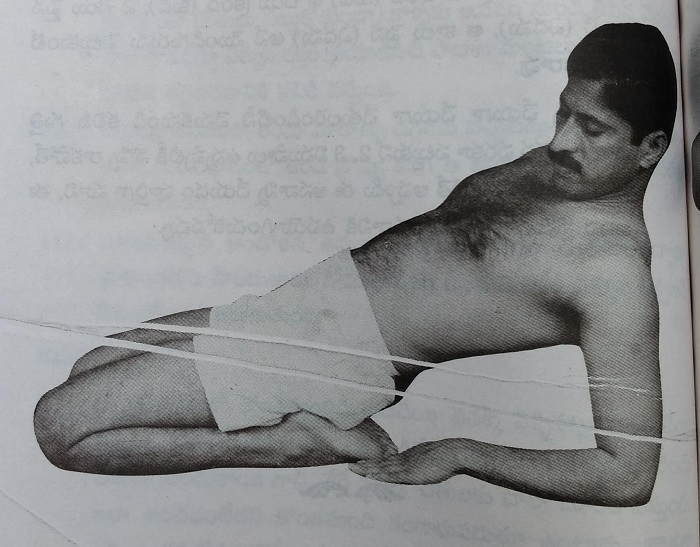
2. Place the right palm on the floor beside the toes of the right foot. Slowly lean toward the right, lowering yourself until the right elbow rests on the floor.
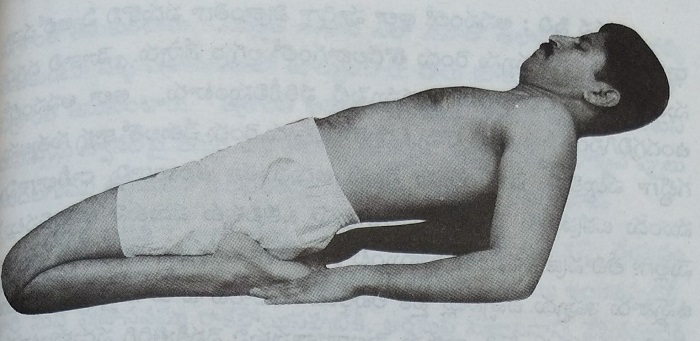
3. Next, gently lift both knees slightly while slowly reclining backward. Continue lowering yourself until the crown of the head touches the floor.
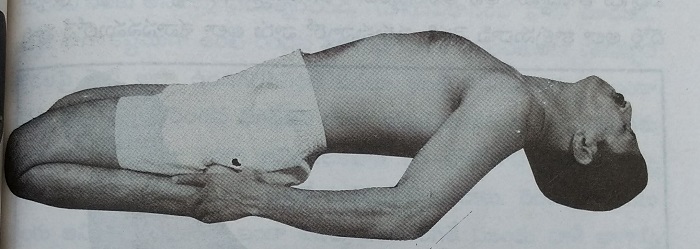
4. Then gradually lower the rest of the body until the back, legs, arms, and head are resting completely on the floor. The lower back will remain naturally lifted and will not touch the floor. Close your eyes completely.
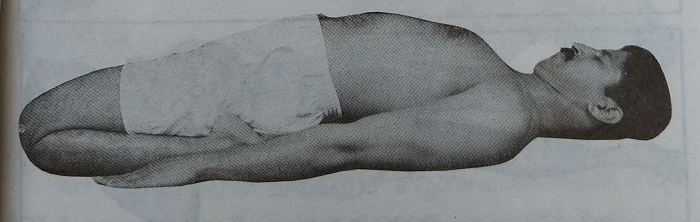
Asana Stage:
Once you are fully settled in the posture, relax completely. Allow the mind to become free from all thoughts and focus your attention on both thighs.
Observe the sensations in the thighs, beginning at the knees and moving upward along the entire length of the thighs.
Remain in the posture for as long as you comfortably can. When the discomfort becomes too great to tolerate, hold both ankles firmly with your hands. Press the elbows into the floor and first raise the head and chest, coming up through one side in the same way that you lowered yourself into the posture. Then slowly return to Vajrasana.
Those who are overweight or have a heavier body may not be able to come up in this manner. In that case, simply roll gently onto one side, slowly stretch both legs out, and then turn onto your back.
Relaxation Stage:
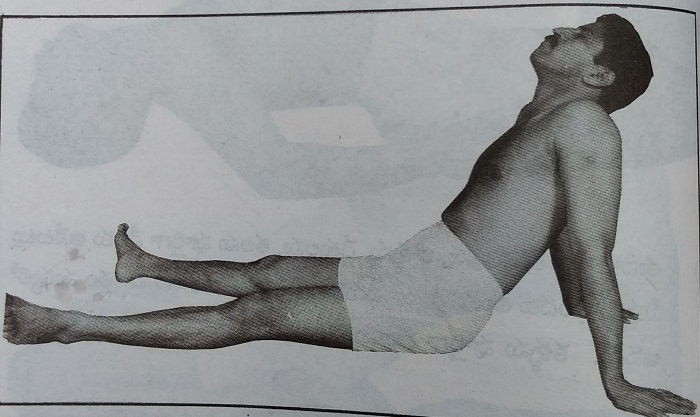
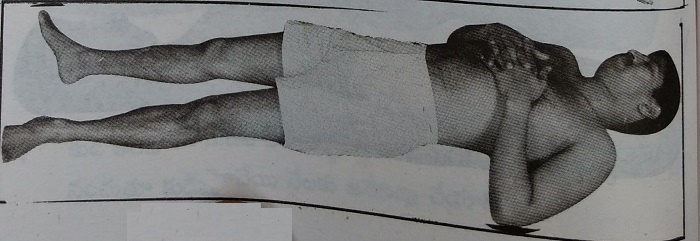
This is a demanding posture, and while holding it you may often feel eager to come out of it.
Those who come out of the posture by rolling onto one side and stretching the legs should remain in Shavasana for the Relaxation Stage.
Those who return to Vajrasana by reversing the steps of the posture should then sit in a comfortable relaxed sitting position for the Relaxation Stage.
As soon as you assume the relaxation posture, close your eyes and focus your attention on the breath. Allow the entire body to relax.
Rest for one to two minutes, or until the breathlessness, pain in the legs, and any other discomfort have completely subsided.
Alternative Method:
Those who are overweight or have a heavier body can benefit greatly from this posture. Although Supta Vajrasana is somewhat difficult, they need not be discouraged if they are unable to perform the full posture. Even practicing Ardha Supta Vajrasana (Half Reclining Thunderbolt Pose) provides them with essentially the same benefits.
Before attempting this posture, you should first be able to sit comfortably in Vajrasana.
From Vajrasana, slowly lean to one side and try to lower one elbow to the floor (see the illustration in the Method of Practice section).
If you find this position sufficiently challenging, there is no need to lower the second elbow. Simply focus your attention on the thighs and remain in this position for as long as you comfortably can.
If you are able to go a little farther, lower the second elbow to the floor and remain in that position.
If you are still unable to lower the head to the floor, continue practicing in this position (shown in the second illustration) for several days, keeping your attention on the thighs.
Once both elbows rest comfortably on the floor, gradually begin bending farther backward. First arch the chest, then lift both knees slightly, and finally try to bring the crown of the head to the floor.
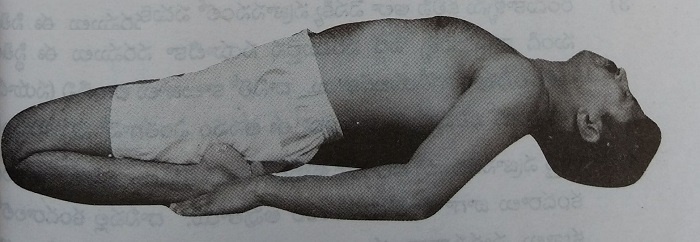
Practice in this position (as shown in the illustration) for a few days. After the discomfort has lessened, gradually try to lower the chest toward the floor.
With patient and regular practice, even those who are overweight can gradually perform this posture comfortably and receive its full benefits.
After releasing the posture, rest in the Relaxation Stage as described earlier.
Incorrect Posture:
There is no specific incorrect posture in Supta Vajrasana. Whatever degree of backward bend you are able to achieve, you will still receive the benefits of the posture.
Benefits
1. This posture is especially beneficial for women who have large thighs that rub against each other while walking, sometimes causing soreness and skin irritation. The extra weight in the thighs can also make walking uncomfortable.
Supta Vajrasana is particularly effective for people who are overweight or have heavy thighs, as it helps reduce the fat accumulated in the thighs. Other methods often do not work as effectively for reducing fat in this specific area. Although overall body weight may decrease through other means, few asanas are as beneficial as Supta Vajrasana for slimming the thighs.
Practice this posture twice a day, and gradually increase the time you remain in it. With regular practice, you can achieve significant improvement in the thighs.
2. Even for those who do not have excess fat in the thighs, this posture helps make the thigh muscles firm and well toned.
During Supta Vajrasana, the thighs receive a level of blood circulation that they seldom experience in everyday life, helping to improve the health of the thigh muscles and tissues.
3. Reclining backward from Vajrasana with both legs folded stretches the sciatic nerves, the large nerves that run from the lower back into the legs.
Holding this position helps keep these nerves supple and may help prevent sciatica and similar leg pain in the future.
4. While lying in Supta Vajrasana, the muscles of the thighs and waist are placed under strong compression. This helps the muscle cells eliminate waste products more effectively and receive a richer supply of Prana (vital life energy).
As a result, the entire region from just above the knees to the lower back receives excellent benefits.
5. While holding this posture, the abdominal muscles and the intestines remain firmly compressed. This strengthens these organs and helps them function more efficiently.
Note
1. Those who have lower back pain or sciatica should not practice Supta Vajrasana until these problems have subsided.
2. This is a challenging posture. Those who are just beginning to learn asanas should wait about a week to ten days before attempting it. By then, the body will have become somewhat more flexible and accustomed to practice.
3. Only those who can sit comfortably in Vajrasana for 5 to 10 minutes without pain should attempt this posture.
If you experience pain immediately on sitting in Vajrasana, do not try Supta Vajrasana.
4. During the first four or five days of learning this posture, it is best not to hold it for long. Enter the posture briefly and then come out of it.
5. Both while entering and while coming out of Supta Vajrasana, move very slowly, carefully, and with full attention. Otherwise, you may strain a muscle or joint, or develop pain in some part of the body.
The word ushtra means camel. This posture is called Ushtrasana because, when it is performed, the front of the body and the neck arch backward in a manner that resembles the posture of a camel.
Method of Practice
1. Arrange your mat or folded blanket so that it provides a little extra cushioning. Kneel on both knees, keeping about one foot (30 cm) of space between the knees and also between the feet. Tuck the toes under so that you are resting on the balls of the feet.
2. Gradually arch the waist and neck backward. Lean slightly more toward the left and reach back with the left hand to grasp the left heel.
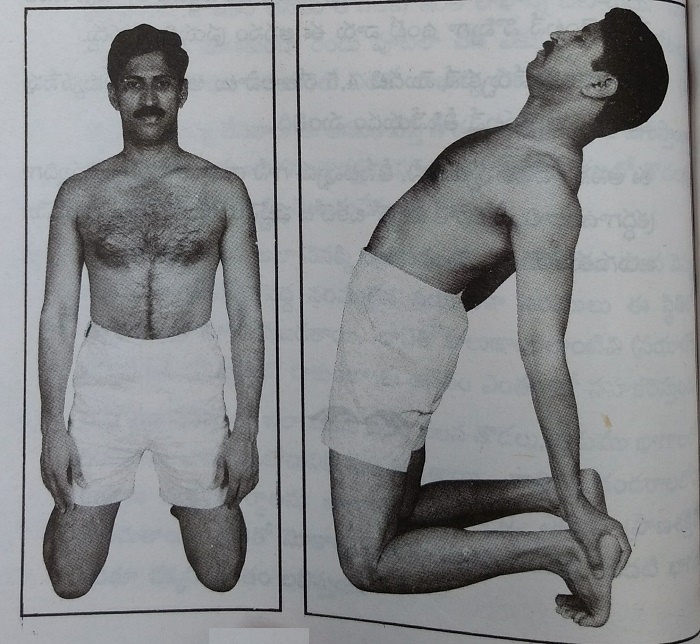
3. Then slowly lean slightly toward the right and reach back with the right hand to grasp the right heel.
Close your eyes completely.
Holding both heels firmly, arch the neck well backward while pressing the hips and the lower waist strongly forward, creating a deep backward bend in the spine.
Keep your eyes closed throughout the posture. Under no circumstances should you open them while holding the asana.
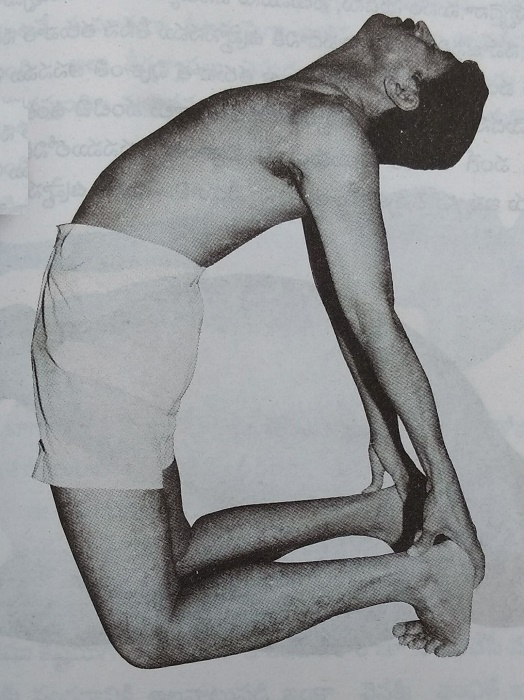
Asana Stage:
Once you are in the full posture, if you are able to push the waist farther forward, do so. Focus your attention on the waist and the lower back.
You will usually feel the greatest discomfort in the neck. Remain in the posture only for as long as you can comfortably tolerate this characteristic discomfort.
When you can no longer remain in the posture, come out of it carefully. Otherwise, you may feel dizzy, and some people may even feel as though they are losing their balance immediately after releasing the posture.
Without opening your eyes, first release one hand from the heel. As you gradually bring the waist forward, bend the neck completely forward. Then release the second hand and slowly return to Vajrasana.
Whenever the neck and waist have been deeply arched backward, they should be brought back to their natural position by practicing a forward-bending posture immediately after Ushtrasana. This should be followed by the Relaxation Stage.
Those who have neck pain, lower back problems, or sciatica should not practice the forward-bending posture. They should proceed directly to the Relaxation Stage.
Everyone else should perform the following posture.
After returning to Vajrasana from Ushtrasana, place both hands behind your back and clasp them together. As you exhale, bend forward until the forehead touches the floor. The chest should rest against the thighs.
Complete the exhalation by the time the forehead reaches the floor. Remain in this position with the breath held out (Kumbhaka) without inhaling.
When you need to breathe again, slowly raise the body while inhaling steadily, continuing the inhalation until you return to the upright position.
This posture is called Yogamudrasana.
You may also perform this forward bend by sitting in Vajrasana with the knees spread comfortably apart and the buttocks resting on the floor between the feet. If you are able to practice it in this way, it is also beneficial for the legs.
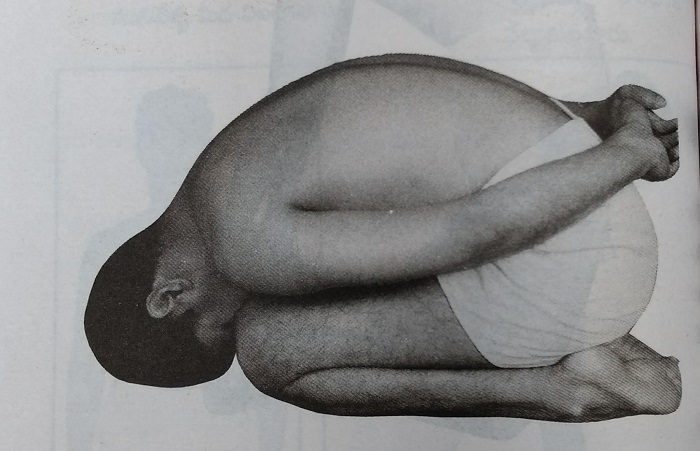
Relaxation Stage: When the waist is deeply arched backward, the lungs remain fully expanded, allowing only a small amount of air to move in and out during the posture.
Immediately after releasing Ushtrasana, you will naturally take a deep inhalation, often drawing in more than a litre of air. Whenever such deep breathing occurs, the body receives a greater supply of energy.
Release Vajrasana, stretch out the legs, lie on your back, and keep both the arms and legs completely relaxed. Rest in this position for two to three minutes.
During this period of rest, each breath naturally becomes deep, filling the lungs completely. The mind also becomes very calm.
At this time, focus your attention on the breath. The mind will remain clear, quiet, and free from unnecessary thoughts.
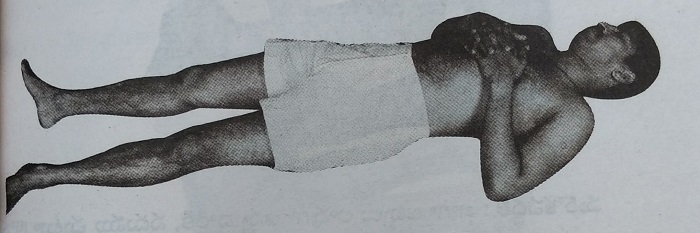
Full Position:
When first learning Ushtrasana, reaching back to hold the heels may be difficult.
With daily practice over a period of time, the waist becomes more flexible, and you may feel that you are able to bend farther backward.
At that stage, instead of placing the hands on the heels, place the palms on the soles of the feet as shown in the illustration. Then bend farther backward and press the waist farther forward.
This makes the posture slightly more challenging and, as a result, enhances its benefits.
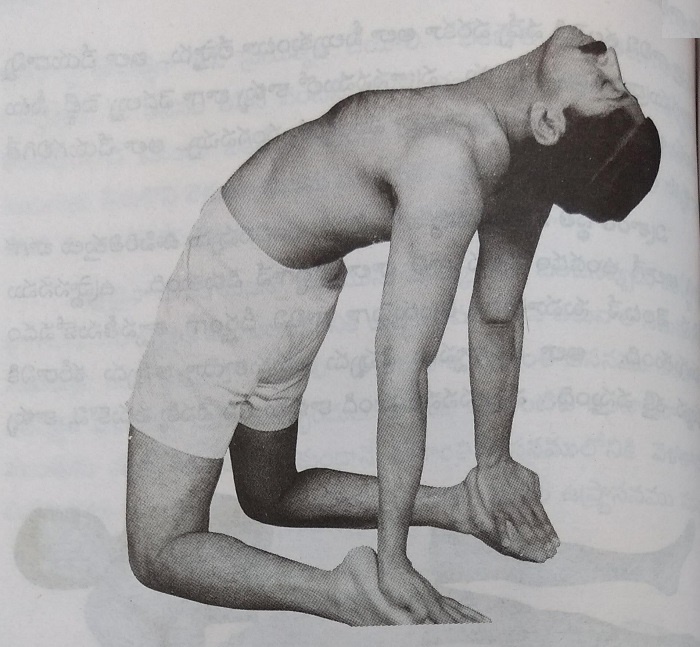
Alternative Method:
Those who have heavy upper arms, excess fat around the waist, or a large abdomen may find it difficult to bend the waist sufficiently. Even if they are able to bend a little, the excess tissue around the armpits may prevent them from reaching the feet with both hands.
Do not give up this posture simply because you cannot hold both feet. You would miss out on many of its benefits. Instead, practice it in a way that suits your present ability.
Kneel on both knees, keeping the knees comfortably apart, and tuck the toes under. First lean toward one side and place the fingertips of one hand on the upper part of the corresponding heel. Place the other hand on the waist, as shown in the illustration.
Using the hand on the waist for support, gently push the waist forward while trying to arch both the waist and the neck backward.
Since only one hand is holding the heel, be careful that the fingers do not slip. Also bend backward slowly and carefully. Otherwise, you may lose your balance and fall to one side.
Remain in this position for as long as you comfortably can, then come out of the posture slowly as described earlier.
Rest in a seated position for 20 to 30 seconds, or until the fatigue has subsided. Then repeat the posture on the opposite side in the same manner.
After completing both sides, practice Yogamudrasana as the forward-bending counterpose. Then lie down in the Relaxation Stage and enjoy the deep sense of calm.
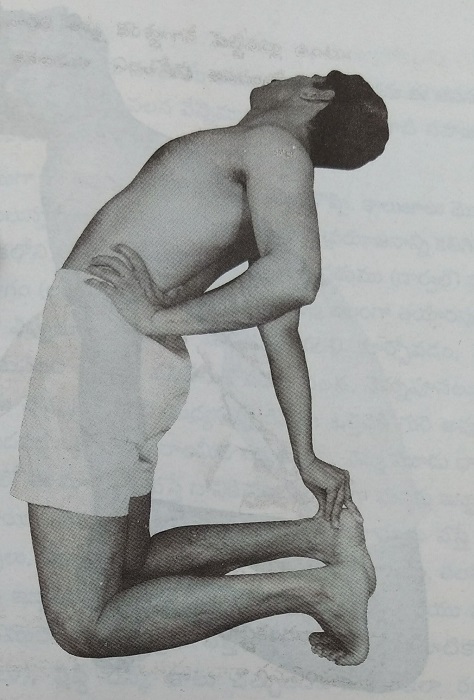
Incorrect Posture:
To obtain the full benefits of Ushtrasana, make every effort to arch the waist well backward, forming a smooth curve. The neck should also be allowed to bend comfortably backward.
In the illustration below, although the practitioner has correctly reached and held the feet, the waist has not been pushed sufficiently forward. As a result, the backward bend of the lower back is incomplete.
If the waist is not fully arched, the spine will not receive the maximum benefit of the posture.
Some people naturally have a very stiff lower back, making it difficult to bend backward. In such cases, the posture may resemble the one shown in the illustration. If your back is not so stiff, you should be able to bend a little farther.
The important thing is to make an honest effort to arch the spine as much as your body comfortably allows. Whatever degree of backward bend you achieve through sincere effort is beneficial. However, if you have the ability to bend farther but do not actively push the waist forward, you will not receive the full benefit of the posture.
When Ushtrasana is performed correctly, the greatest discomfort is usually felt in the lower back. If that area feels completely comfortable, it generally means that the waist has not been pushed forward enough.
The posture is also highly beneficial for the neck. Therefore, carefully try to bend the neck well backward while maintaining control throughout the posture.
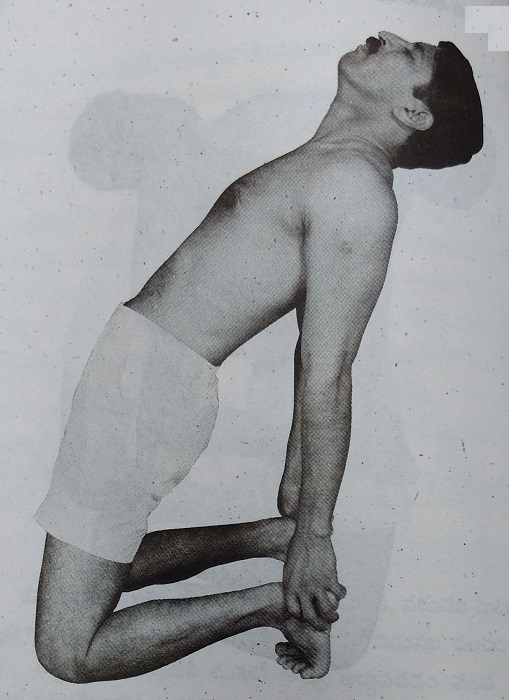
Benefits
1. Most of us habitually bend the spine forward throughout the day. By deeply arching the spine backward in Ushtrasana, the vertebrae gradually regain their natural alignment and elasticity.
2. This posture is especially beneficial for those suffering from lower back pain, neck pain, sciatica, and similar disorders.
The three regions of the spine — the cervical spine, thoracic spine, and lumbar spine — are all strengthened through the practice of Ushtrasana.
Because we spend much of our time sitting with the waist bent forward and working with the neck inclined forward, the vertebrae become compressed. As a result, the intervertebral discs between them are subjected to continuous pressure. This pressure is then transmitted to the nerves.
When these changes occur in any part of the spine, they give rise to problems related to that region.
If they occur in the cervical spine, they may cause neck pain, pain radiating into the arms, numbness in the hands, stretching pain along the arm nerves, headaches, and similar complaints.
If they occur in the thoracic or lumbar regions, they may lead to conditions such as disc prolapse, sciatica, slipped disc, numbness in the legs, and various other disorders.
The underlying cause of all these problems is excessive forward compression of the vertebrae.
Practising Ushtrasana twice a day bends the spine backward and helps restore the natural space between the vertebrae. This reduces the pressure on the intervertebral discs.
For this reason, regular practice of Ushtrasana can bring significant relief from many of the above problems within one to two months. Neck pain often improves even sooner.
3. By deeply arching the lower back, pressure is applied to that region, helping to reduce excess fat around the waist.
4. Ushtrasana relieves the pressure that the rib cage, chest muscles, and surrounding tissues place on the lungs. As a result, the lungs expand more fully and the body naturally begins to take deeper breaths throughout the day.
5. This posture stimulates the thyroid gland, the pancreas, and the digestive system, increasing blood circulation to these organs and helping them function more efficiently.
6. Practising Ushtrasana every day helps prevent lower back pain, neck pain, stiffness of the waist, muscle strain in the lower back, and similar problems.
It is an excellent posture that everyone should practice regularly as a preventive measure for maintaining spinal health.
Note
1. Do not open your eyes immediately after coming out of Ushtrasana. Doing so may cause dizziness or a sensation of movement within the head. Open your eyes only after you have returned to a stable position.
2. During the first week of practice, hold the posture for only five to six seconds before releasing it. As your body becomes accustomed to the posture, you may gradually increase the duration.
If you bend too deeply or remain in the posture for too long at the beginning, the lower back may become stiff or painful.
3. Those who have neck pain or lower back pain should practice this posture with great care. After Ushtrasana, they should not perform the forward-bending counterpose.
4. To obtain maximum benefit in a shorter period, practice Ushtrasana twice a day without interruption. During each practice session, perform the posture twice—after completing it once and resting until the fatigue has subsided, repeat the posture a second time.
The word utthana means to raise upward. Since this posture involves raising both legs and holding them in the air, it is called Utthana Padasana.
This is a very simple posture to perform. However, holding it for an extended period is quite challenging.
Method of Practice
1. Lie flat on your back on a mat or folded blanket. Bring both legs together and stretch the feet forward. Interlock the fingers and place the hands beneath the head.
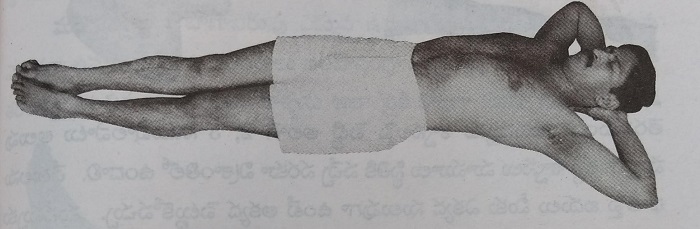
2. Keeping both legs together and the knees straight, raise the legs to a height of about one foot (30 cm) above the floor. Close your eyes.
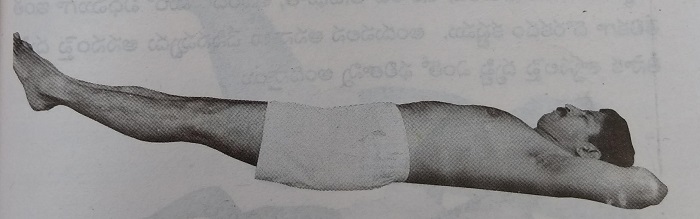
Asana Stage:
Hold both legs steady at a height of about one foot (30 cm) without allowing them to move.
Focus your attention on the lower abdomen, below the navel.
Remain in the posture for as long as you comfortably can.
After some time, the muscles of the lower abdomen will become fatigued and will no longer be able to support the weight of the legs. When this happens, gently lower the legs to the floor.
Relaxation Stage:
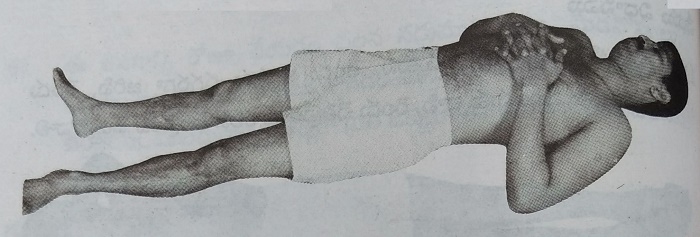
While holding the posture, the abdominal muscles become firmly contracted. As a result, the diaphragm has very little movement, preventing the lungs from expanding fully. Consequently, only a small amount of air enters the lungs, and breathing becomes shallow.
This is why the posture produces considerable fatigue.
Immediately after releasing the posture, the body naturally begins taking deep breaths.
Remain lying on your back. Remove your hands from beneath the head and place them on the chest, then relax. If another hand position feels more comfortable, you may use that instead.
Keep your eyes closed and focus your attention on the breath. Rest in this way for two to three minutes, or until the fatigue has completely disappeared and your breathing has returned to normal.
At this time, the mind naturally becomes free from distracting thoughts. This is because the deep breathing that follows the posture supplies the body and the brain with a greater amount of oxygen, leaving the mind clear and tranquil.
Such a feeling of calm and well-being is not easily experienced by other means. For this reason, after completing an asana, shifting your attention from the posture itself to the breath greatly enhances its benefits.
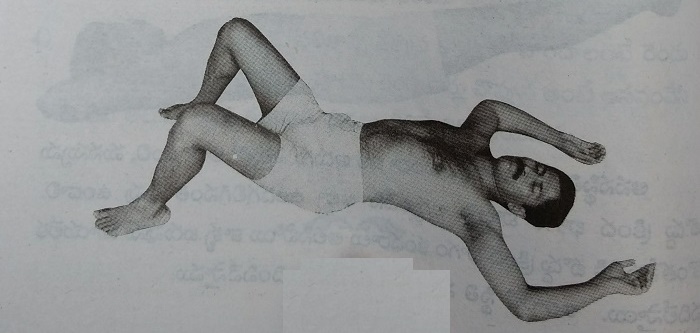
Because the legs are held slightly above the floor, the lower lumbar vertebrae and the surrounding muscles must support their weight throughout the posture. This causes them to become somewhat fatigued.
Some people may notice mild discomfort or aching around the base of the spine after releasing the posture.
If this happens, instead of stretching the legs out completely during the Relaxation Stage, bend both knees slightly and keep the feet resting on the floor.
In this position, the lower back rests fully against the floor, allowing that region to relax completely and relieving any discomfort.
You may choose whichever of these two relaxation positions feels more comfortable and suitable for you.
Alternative Method:
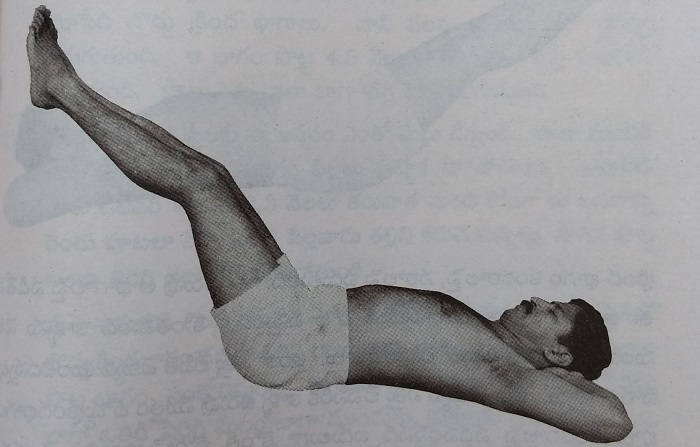
Those who are significantly overweight, have heavy thighs and calves, have weak abdominal muscles, or have an untrained, delicate physique may find it impossible to lift both legs, even slightly, while keeping the knees straight.
They may be able to lift one leg, but that does not provide the intended benefit of this posture.
For such practitioners, there is an alternative method.
Since you are unable to raise both legs without bending the knees, keep the knees slightly bent while lifting the legs until you have developed enough strength to perform the posture correctly.
Raising the legs to a height of one foot (30 cm) above the floor may be too difficult at first. Therefore, lift the legs only to whatever height you are able to hold comfortably, and maintain the posture at that level.
Even holding the legs in this modified position for a short time provides substantial benefits.
With regular practice for 10 to 20 days, even those who are overweight can usually progress to performing the posture in the standard way.
Those with a heavier body or a large abdomen will generally find the Relaxation Stage more comfortable if they keep the knees bent and the feet resting on the floor, as described earlier.
Incorrect Posture:
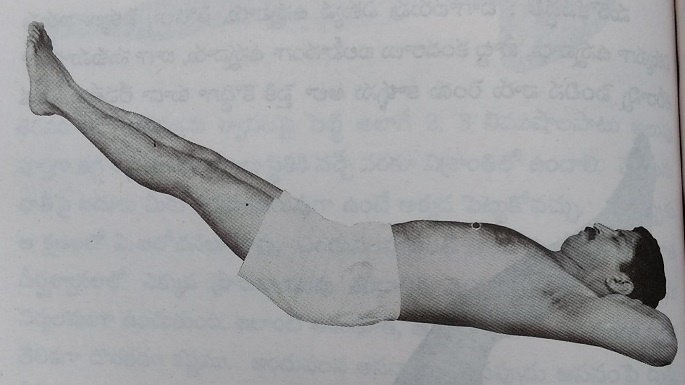
Even in a posture as simple as this, some people make mistakes.
Although these mistakes are unlikely to cause harm, they do prevent the posture from producing its full benefit in the intended area.
When both legs are raised to a height of about one foot (30 cm) above the floor with the knees kept straight, the entire weight of the legs is borne by the muscles and nerves of the lower abdomen, below the navel. This is exactly where the posture is intended to produce its greatest effect.
Some people raise their legs to a height of two feet (60 cm) or even higher, assuming that lifting them higher will produce greater benefits.
However, when the legs are raised too high, the weight is no longer concentrated on the lower abdomen. Instead, part of the load shifts to the upper abdomen, while the rest remains on the lower abdomen. As a result, neither area receives the full benefit.
A separate posture later in this book is designed specifically for the upper abdomen. Utthana Padasana is intended especially for the lower abdomen, so do not raise the legs higher than about one foot (30 cm) above the floor.
This is one of the most important points to remember while practicing this posture.
Also, once you are in the Asana Stage, do not move the legs up and down. Any such movement reduces the effectiveness of the posture.
Benefits
1. The primary benefit of Utthana Padasana is that it helps reduce the lower abdomen below the navel by effectively burning excess fat in that area.
No other asana is as beneficial for the lower abdomen as this one.
Almost everyone has some accumulation of fat in the lower abdomen. Although many people wish to have a flatter, more attractive abdomen, they often do not know how to reduce fat in this specific region. Even when overall body weight is reduced through various methods, the fat below the navel often remains unchanged.
Utthana Padasana, however, acts directly on this area and helps reduce the accumulated fat.
The combined weight of both legs may be around 20 to 30 kilograms. While holding this posture for one to two minutes, the muscles of the lower abdomen support this entire weight. This sustained effort helps burn fat in that region.
With regular practice for four to five months, the lower abdomen gradually becomes flatter, and the abdominal wall becomes firmer and more toned.
2. This posture is especially beneficial for women after childbirth.
In many women, both the upper and lower abdomen become stretched following delivery. Beginning about two to three months after childbirth, practicing this posture twice a day helps the stretched abdominal wall gradually regain its firmness and tone, returning close to its original condition.
3. This posture applies considerable pressure to the rectum and the large intestine.
During the Asana Stage, the lower abdomen becomes so firmly contracted that it feels almost as hard as a rock. This strong contraction increases pressure on the large intestine, helping move its contents forward and along its length.
For this reason, Utthana Padasana is especially helpful for those with a weak large intestine, constipation, or weak intestinal muscles.
Regular practice often promotes comfortable bowel movements after completing the asana session.
4. This posture provides particular benefits to the uterus.
The strong contraction of the abdomen strengthens the uterus and may help prevent problems such as uterine enlargement or excessive stretching. Even if such conditions are present to a mild degree, regular practice of this posture may help improve them.
Ordinary physical exercise does not produce such specific effects on the internal organs. In contrast, each asana brings about distinct changes in particular parts of the body by improving blood circulation, strengthening and contracting specific muscles, and stimulating the corresponding internal organs.
5. While holding this posture, the lungs remain well expanded. Immediately after releasing it, they contract fully.
This repeated expansion and contraction trains the lungs to breathe more deeply and more completely.
As a result, the body gradually develops the habit of taking deeper breaths throughout the day, enabling it to receive a much greater supply of oxygen than before.
As the circulation of oxygen throughout the body increases, so do your energy, strength, and working capacity.
6. The muscles of the abdomen and the intestines become significantly stronger through regular practice of this posture.
Note
1. Some people, eager to reduce their abdominal fat quickly, try to remain in the Asana Stage for as long as possible on the very first day.
Doing so may result in significant muscle soreness, making it difficult to walk or lie down comfortably for the next two or three days.
For the first five or six days, beginners should hold this posture for no more than five to six seconds.
2. If you hold the breath tightly while practicing this posture, you will not be able to remain in it for long, and the benefits will be reduced.
Instead, perform the posture without consciously focusing on the breath. The lungs will naturally draw in as much air as the body requires.
Therefore, do not hold the breath while practicing Utthana Padasana.
3. It is best to practice this posture after the bowels have been completely evacuated. This allows you to remain in the posture comfortably for a longer time.
If the bowels have not been emptied properly, discomfort will develop sooner, causing you to come out of the posture prematurely.
For Utthana Padasana to produce its full benefits, regular and comfortable bowel movements are very important.
When this posture is performed, the body resembles a boat, hence the name Naukasana (Boat Pose).
This posture has another name, Pranasana (Life Energy Pose), because it exerts a profound effect on the abdomen, where many of the glands and organs responsible for producing enzymes and hormones essential for good health are located. It also helps regulate the flow of Prana (vital life energy) throughout the body.
Method of Practice:
This posture is very easy to enter, but holding it is quite difficult.
1. Lie flat on your back. Stretch both the legs and arms straight. Keeping the legs together and the knees straight, raise both legs to a height of about one foot (30 cm) above the floor.
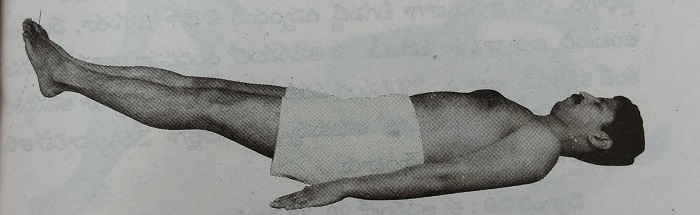
2. Next, without allowing the hands to touch the floor, hold the thighs with both hands and raise the head and chest. The upper back should not rest on the floor.
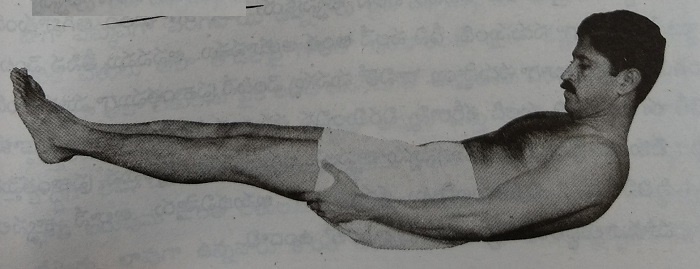
3. Now release your grip on the thighs and stretch both arms straight forward above the thighs, keeping them suspended in the air. Only the buttocks and the lower back should remain in contact with the floor. The rest of the body should be held off the ground. Close your eyes.
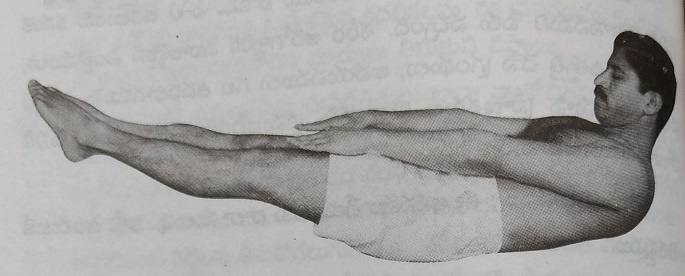
Asana Stage:
Hold the body and head steady without any movement. Focus your attention on the upper abdomen, above the navel.
While holding the posture, the upper abdomen and chest remain firmly contracted. Because of this, the body may tremble or shake slightly. This is perfectly natural.
Naukasana is even more challenging to hold than Utthana Padasana.
Remain in the posture for as long as you comfortably can, until fatigue makes it impossible to continue. Then slowly lower the body back to the floor.
Keep your eyes closed as you lie down.
Relaxation Stage:
Remaining motionless in this posture for even 20 to 30 seconds is quite difficult. Considerable fatigue develops in a very short time.
The entire abdomen and chest feel as though they have been firmly compressed.
Because the chest is held slightly raised throughout the posture, breathing is restricted by almost 80 to 90 percent. Only a small amount of breathing takes place, which is why the posture produces such intense fatigue.
Immediately after releasing the posture, the body naturally begins taking deep breaths. As a result, the mind quickly becomes calm and peaceful.
After coming out of the posture, lie flat on your back. Relax both the arms and legs completely, and focus your attention on the breath.
Remain perfectly still for one to two minutes, enjoying the clear and peaceful state of mind that follows the posture.
Continue resting until your breathing has returned to its normal rhythm.
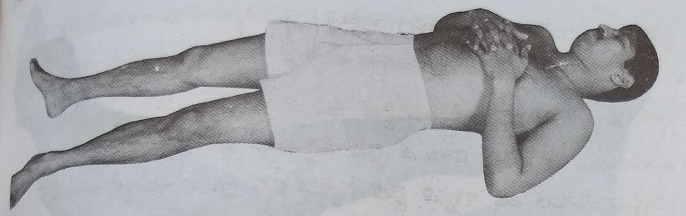
As in Utthana Padasana, some people may experience mild discomfort in the lower back because the legs are held about one foot (30 cm) above the floor.
If this happens, immediately after releasing the posture, bend both knees and keep the feet resting on the floor, as shown in the illustration.
This allows the lower back to rest fully against the floor, relieving the strain and making the Relaxation Stage more comfortable.
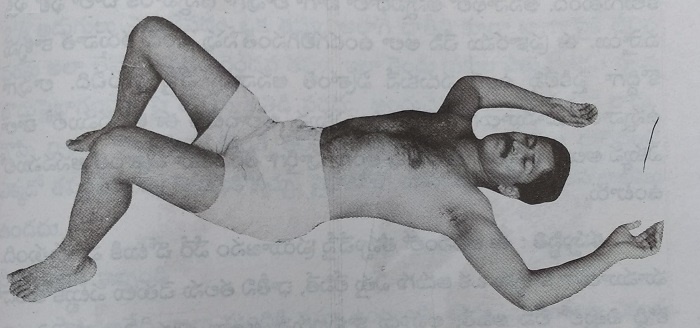
Alternative Method:
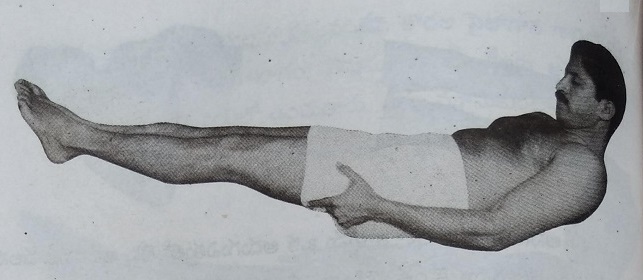
Those who are overweight, have a large abdomen, or have a broad, heavy chest may find it difficult to perform this posture as described above. In particular, holding the arms suspended above the thighs without any support can be very challenging.
Holding the arms in the air without any support produces the greatest benefit. However, those who are not yet able to do so may use the following modified method.
After raising both legs about one foot (30 cm) above the floor, lift the chest slightly. Hold the thighs with both hands and press both elbows firmly into the floor. In this way, allow the arms to support part of the weight of the chest while remaining in the posture.
Even though overweight practitioners use some support from the arms, they can still obtain the full benefits of the posture.
Supporting the body in this way still places considerable effort on the upper abdomen and the internal abdominal organs.
In fact, an overweight person practicing this Half Naukasana often receives greater benefit than a slender person performing the full posture. In general, people who are significantly overweight tend to gain substantial benefits from the practice of asanas.
Remain in this modified posture for as long as you comfortably can. Then release the posture and rest in the Relaxation Stage, preferably with the knees bent and the feet resting on the floor, as described earlier.
People who are overweight generally experience greater fatigue even during ordinary activities. Consequently, this posture may produce considerable exhaustion. Remain in the Relaxation Stage until all the fatigue has completely subsided.
Incorrect Posture:
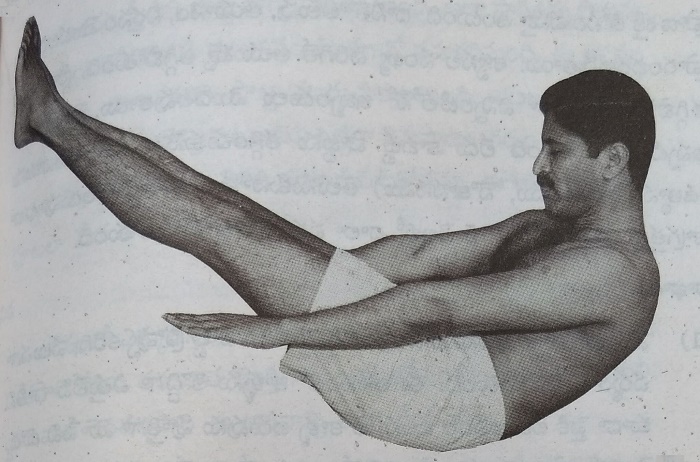
If this posture is performed incorrectly, its benefits are shifted away from the intended area.
When the legs are raised only about one foot (30 cm) above the floor, and the chest and head are lifted only slightly without holding the thighs, the entire weight of the legs is concentrated on the upper abdomen. This causes the muscles of the upper abdomen to contract powerfully, allowing that region to receive the maximum benefit of the posture.
The primary purpose of Naukasana is to provide a specific effect on the upper abdomen. Just as Utthana Padasana works mainly on the lower abdomen, Naukasana works on the upper abdomen. Together, these two postures contribute greatly to the health of the chest and abdominal regions.
Some people perform the posture as shown in the incorrect illustration. In this position, they are able to remain in the posture for a longer time. To an observer, it may appear that they have lifted the body higher and are performing the posture very well.
In reality, however, 60 to 70 percent of the intended benefit is lost.
The first mistake is raising the legs 2 to 2½ feet (60–75 cm) above the floor. The second mistake is lifting the chest much higher than necessary.
When both the legs and the chest are raised excessively, the upper abdomen no longer receives the required pressure. As a result, the posture becomes much easier to hold.
That is why fatigue develops more slowly, there is little or no characteristic discomfort, and breathing remains comparatively easy.
If these characteristic effects are absent, it is a sign that the posture is not being performed correctly.
Performing the posture in the manner shown in the incorrect illustration does not produce the intended benefits.
Problems due to Abdominal Fat
Excess abdominal fat is a common problem. For many people, the upper abdomen is where it is most noticeable. Everyone prefers a slim waist without a protruding abdomen. Yet some people do not know how to reduce it, while others know the methods but neglect to follow them, allowing it to increase gradually.
Even if a moderately enlarged abdomen does not seem to cause obvious discomfort, it significantly interferes with breathing and with the movement of the diaphragm.
When excess abdominal fat is present, the breath does not reach the lower parts of the lungs effectively. As a result, the lungs are unable to fill completely with air. Instead, breathing remains shallow, using only the upper part of the lungs.
This causes the breathing rate to become higher than normal. From that point onward, the body begins to receive an inadequate supply of Prana (vital life energy).
As a result, fatigue, breathlessness, lack of energy, and similar problems gradually begin to appear.
When the breathing rate remains persistently high, lifespan is reduced and the body's efficiency and capacity also decline. In this way, many health problems gradually begin to develop.
However, it is never too late to improve the situation.
Now that you have learned two excellent postures for reducing abdominal fat—Utthana Padasana and Naukasana—practice them carefully twice a day. With regular practice for four to five months, much of the excess abdominal fat can be reduced.
Benefits
1. The primary benefit of Naukasana is that it helps reduce excess fat in the upper abdomen, making the abdominal wall flatter and firmer.
Because both the legs and the chest are raised during the posture, the muscles of the upper abdomen bear the weight of the legs. Although the posture is held only for a short time, it produces remarkable results in this region.
Some practitioners have reduced the thickness of their abdomen by 5 to 6 inches (13–15 cm) within three to four months through regular practice of this posture.
No other asana is as effective for reducing fat in the upper abdomen. You may remember Naukasana as the asana specially meant for the upper abdomen.
2. This posture has a beneficial effect on the pancreas.
While holding the posture, the strong contraction of the abdomen applies pressure to the pancreas, stimulating the cells that produce insulin. The pancreas receives an effect similar to a deep massage.
For those with diabetes, regular practice of Naukasana may help reduce blood glucose levels.
3. The pressure created during this posture also benefits the liver, gallbladder, small intestine, stomach, and other organs involved in digestion.
It improves their functioning and promotes the production of healthy digestive secretions.
As a result, it helps relieve indigestion, improves poor appetite, and stimulates a healthy appetite.
4. This posture is especially beneficial for women after childbirth, when the abdomen often becomes stretched.
Regular practice helps reduce the stretched abdomen by burning excess fat and restoring firmness to the abdominal wall.
In particular, the abdominal muscles become much stronger and tighter, helping the abdomen gradually return to the condition it was in before pregnancy.
Practicing this posture twice a day is highly beneficial.
Note
1. It is difficult to remain in Naukasana for a long time. Therefore, if you wish to obtain greater benefit, perform the posture once, rest until the fatigue has completely subsided, and then repeat it a second time.
2. When you are first learning the posture, hold it only briefly and then release it. After the body has become fully accustomed to the posture and you can practice it without any pain or discomfort, you may gradually increase the duration or begin practicing it a second time during the same session.
Every asana has a specific effect on a particular part of the body and provides its own unique benefits. No single posture influences every organ equally.
Sarvangasana, however, acts upon all the limbs and organs of the body. Because it benefits the entire body, it is called Sarvangasana, which literally means the posture for all the parts of the body. Its very name reflects its importance.
Shirshasana (Headstand) is not suitable for everyone, and if it is not performed correctly, it may even cause harm. Sarvangasana, on the other hand, provides many of the same broad benefits without those risks when practiced correctly.
Method of Practice
1. Lie flat on your back on a mat or folded blanket, making sure that the head rests on the blanket. Stretch both legs straight and keep the arms by your sides.
Keeping both legs together and the knees straight, raise the legs until the feet point directly upward toward the ceiling.
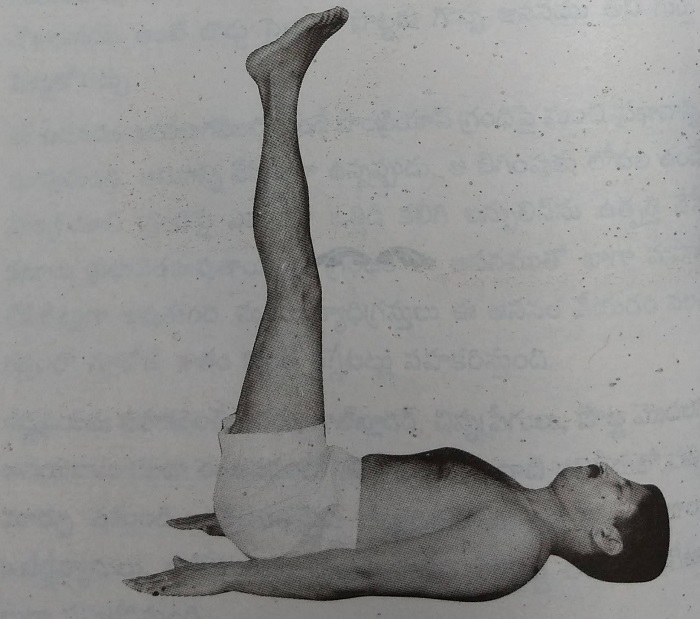
2. Next, bend the legs slightly and, in one smooth movement, lift the waist off the floor. Support the lower back with both palms so that the body does not fall backward.
At this stage, the knees will come close to the head or in front of the face.
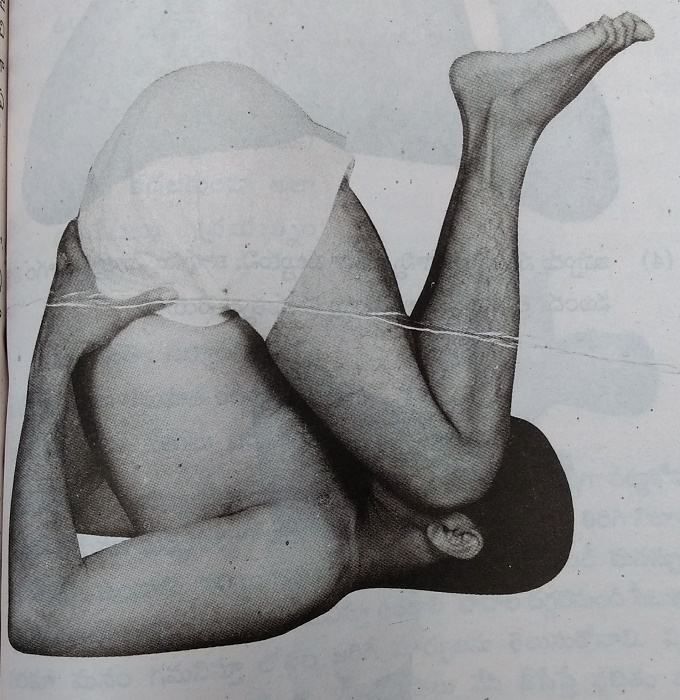
3. It is important to support the waist firmly with the hands. Otherwise, the body may lose its balance and fall.
As shown in the illustration, place the four fingers behind the waist, while the thumb rests along the side of the waist. This provides a firm and secure grip to support the body.
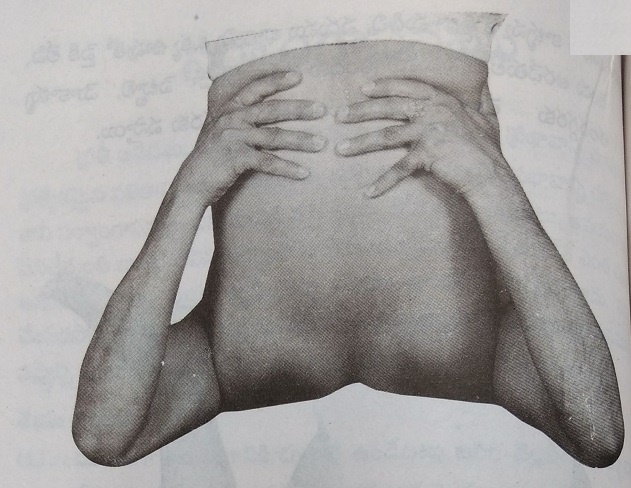
4. Holding the waist securely, gradually straighten the legs from the knees upward, bringing them into a vertical line.
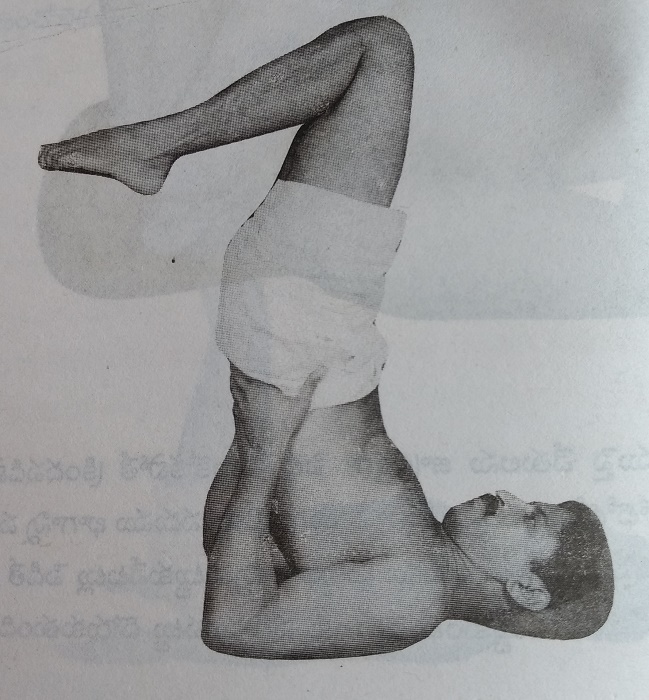
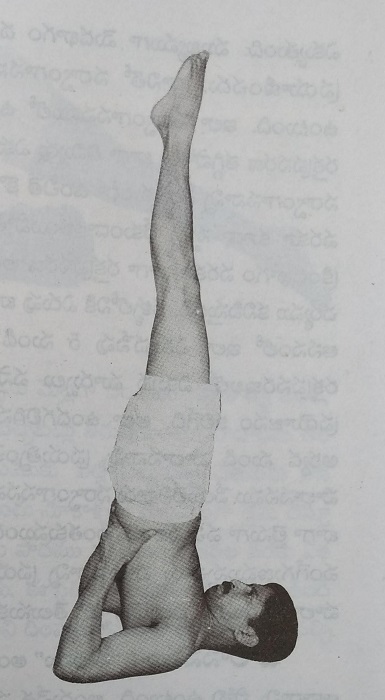
5. Continue adjusting the position until both the legs and the waist are fully aligned.
Ideally, the body should form a straight 90-degree line from the shoulders to the feet.
Stretch both feet upward toward the ceiling.
Close your eyes and remain in the posture, keeping the body as still as possible.
Asana Stage:
After coming into Sarvangasana, the body will not remain perfectly steady at first. The hands may gradually slip, so from time to time reposition them and support the waist firmly again.
Similarly, the waist may begin to bend slightly. Whenever this happens, gently straighten the body and restore the vertical alignment.
From the moment you enter the full posture, focus your attention on the changes taking place in the blood circulation. Observe the sensations throughout the body, beginning at the feet and moving upward to the hips, becoming aware of the internal changes as they occur.
Unlike most other asanas, Sarvangasana does not produce its full benefits if it is held for only one or two minutes. Remain in the posture for as long as you comfortably can.
After two or three minutes, you will begin to notice sensations such as tingling in the feet and a reduction in blood circulation to the legs.
At the same time, you may notice increased blood flow to the abdomen and chest, redness in the eyes, and similar changes.
While in Sarvangasana, the chest is unable to expand and contract fully. As a result, only a limited amount of air enters the lungs. In particular, because the neck is deeply bent, the passage of breath is somewhat restricted, making breathing feel shallow.
As you continue to hold the posture, blood circulation to the legs decreases further, causing increasing tingling and numbness.
If the posture is maintained for five to six minutes, the region from the thighs down to the feet may even become temporarily numb.
Meanwhile, the area from the throat to the lower abdomen receives a greatly increased blood supply. The skin in this region may appear flushed or take on a healthy pinkish-red colour. The eyes become noticeably red, and the face also becomes flushed.
If you are able to remain in Sarvangasana for five to ten minutes, these circulatory changes become more pronounced. It is through these changes that the posture provides its broad benefits to the entire body.
Remain in the posture for as long as you comfortably can.
When you feel it is time to come out of the posture, those who are able to practice Halasana should move directly into it from Sarvangasana.
Those who are not yet able to perform Halasana should come out of Sarvangasana slowly and carefully.
Practitioners who can maintain a good vertical alignment in Sarvangasana, who already have sufficient experience, and whose bodies are adequately flexible may proceed to Halasana.
Let us now see how to move from Sarvangasana into Halasana.
Halasana:
The word hala means plough. This posture is called Halasana because the body resembles the shape of a traditional plough.
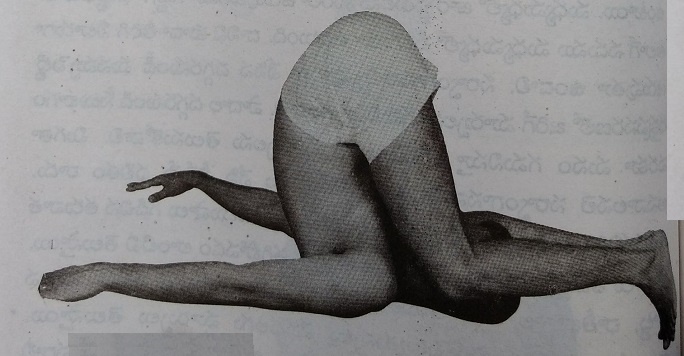
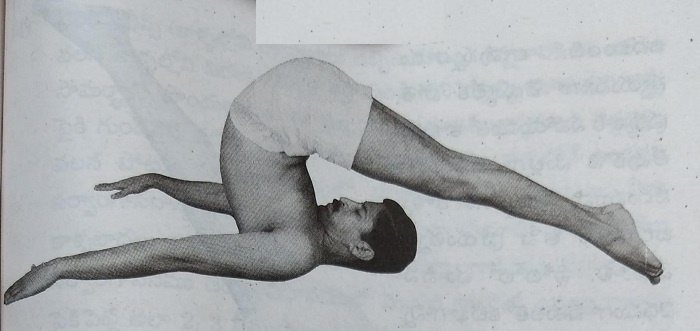
From Sarvangasana, slowly lower the legs. Bend the knees and bring them down on either side of the face, then gently lower the feet to the floor behind the head.
Next, release the hands from the waist and stretch the arms along the floor.
Then gradually straighten the knees, slowly moving the feet farther away from the head until the legs are completely straight. Finally, adjust the position so that the body forms a straight line from the feet to the buttocks.
Remain in this position for as long as you comfortably can.
To come out of the posture, slowly bend the knees, gradually lower the chest and the rest of the body, and gently return to the starting position, lying flat on your back.
After releasing Sarvangasana, the legs usually feel numb because of the altered blood circulation. Therefore, instead of resting immediately, practice Paschimottanasana (Seated Forward Bend). The numbness in the legs allows this forward bend to be performed more easily.
Only after completing Paschimottanasana should you proceed to the Relaxation Stage.
Similarly, those who move from Sarvangasana into Halasana should not rest immediately after releasing Halasana. They should first practice Paschimottanasana, and only then proceed to the Relaxation Stage.
Alternative Method:
For those who are significantly overweight, Sarvangasana can be quite difficult to perform. Those whose bodies allow some degree of movement may certainly attempt it.
Practitioners who are very overweight may not be able to bring the body into a completely vertical position. Even so, whatever position they are able to achieve will still provide benefits.
If they are unable to perform the posture independently, they may take the assistance of another person to raise the legs. Once the body has been lifted, they should support the waist with both hands and try to bear the weight of the legs.
As shown in the illustration, supporting the hip region with the hands provides a more stable and comfortable position.
Remain in the posture for as long as you comfortably can, then slowly and carefully return to the starting position.
There is very little possibility of performing Sarvangasana incorrectly. Even if the posture is not perfect, it still provides benefits in proportion to the position that is achieved.
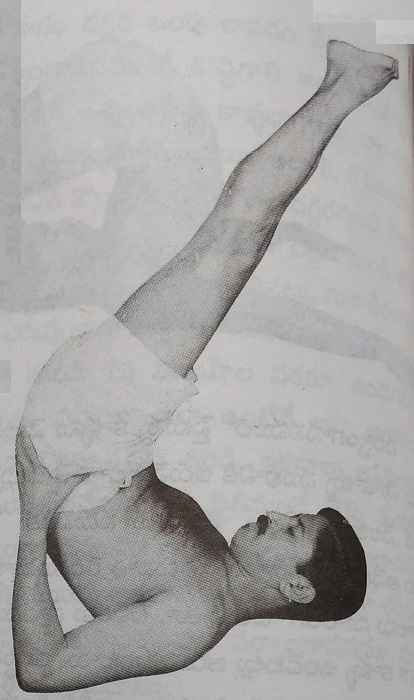
Benefits
1. This posture increases the flow of blood to the thyroid gland, helping to regulate the production of thyroid hormones.
As a result, many thyroid-related disorders may improve. Those who do not have thyroid problems can practice this posture as a preventive measure to help maintain healthy thyroid function.
2. Because the body is inverted in this posture, the pituitary gland and the pineal gland receive an increased blood supply, which enhances their functioning.
Since the pituitary gland regulates the production of hormones throughout the body, regular practice of Sarvangasana helps improve the functioning of all the endocrine glands.
3. In children whose physical growth has slowed or stopped prematurely, this posture may help stimulate the endocrine glands, increasing hormone production and supporting healthy growth and development.
4. This posture is especially beneficial for those with varicose veins.
It helps strengthen the veins in the legs and improves their ability to return blood toward the heart.
In people with varicose veins, blood does not flow efficiently from the legs back to the heart. Instead, it tends to remain in the legs for prolonged periods, leading to pain, a feeling of heaviness, and burning sensations.
Such individuals should practice Sarvangasana twice a day.
If the discomfort in the legs becomes particularly severe during the day, they need not perform the full posture. Instead, they may simply raise both legs as shown in the first illustration of the Method of Practice and hold them in that position for two to three minutes. This often provides considerable relief.
This simple variation may be practiced five or six times a day, if needed.
5. The feet and legs are the parts of the body farthest from the heart. Consequently, blood circulation to them is naturally slower than to many other parts of the body.
People who perform regular physical work generally receive adequate circulation to the legs through their daily activities. However, those who lead a sedentary lifestyle often develop poor circulation in the legs, resulting in symptoms such as tingling, burning sensations, and reduced sensation.
Medicines alone often do not provide satisfactory relief from these problems.
Such complaints are especially common after the age of 40 to 50 years.
Regular practice of Sarvangasana improves blood circulation to the legs and feet.
It also helps maintain healthy circulation in the small blood vessels of the toes, reducing the likelihood of blockages, narrowing, or impaired blood flow.
6. While practicing Sarvangasana, the brain receives an increased supply of blood. As a result, more oxygen reaches the brain, enabling it to function more efficiently.
Students who practice Sarvangasana regularly may experience improvements in memory, concentration, and thinking ability.
7. Throughout the posture, the weight of the entire body is supported by the shoulders and neck. This strengthens the neck and helps prevent neck-related problems and pain.
8. This posture greatly improves blood circulation to the throat. As a result, even people who speak for long periods are less likely to experience throat fatigue, hoarseness, or throat pain.
It also strengthens the muscles of the throat, enabling them to assist more effectively in promoting blood flow toward the head.
9. Regular practice of Sarvangasana helps bring the bones, muscles, nerves, and other structures of the body under better control, allowing them to function more efficiently.
It also improves the body's overall flexibility and ease of movement.
10. In people who perform heavy physical labour, the internal organs often receive relatively little movement despite the body's external activity.
Sarvangasana provides a unique benefit in this regard. In a way that few other asanas do, it promotes healthy movement of the internal organs, improves blood circulation, and enhances the flow of Prana (vital life energy) throughout the body. As a result, the organs become more active and are able to function more efficiently.
Note:
1. People with neck pain, lower back pain, heart disease, or high blood pressure should not practice Sarvangasana.
2. Beginners should first practice the other asanas regularly for one to two months. Only after gaining sufficient familiarity with them should they begin practicing Sarvangasana.
3. If you are significantly overweight and unable to perform the posture, set aside Sarvangasana for the time being and return to it after improving your physical condition.
4. Those who are over 60 years of age and find the posture difficult should discontinue its practice.
The word paschima means the back or the posterior part of the body. Since this posture stretches and bends the entire back of the body forward, it is called Paschimottanasana.
This posture is also known as Paschimatana Asana because it is said to direct Prana (vital life energy) through the Sushumna Nadi, the central subtle energy channel.
Method of Practice
1. Sit on the floor with both legs stretched straight in front of you. Keep the knees fully extended without bending them, and ensure that the backs of the legs remain in contact with the floor.
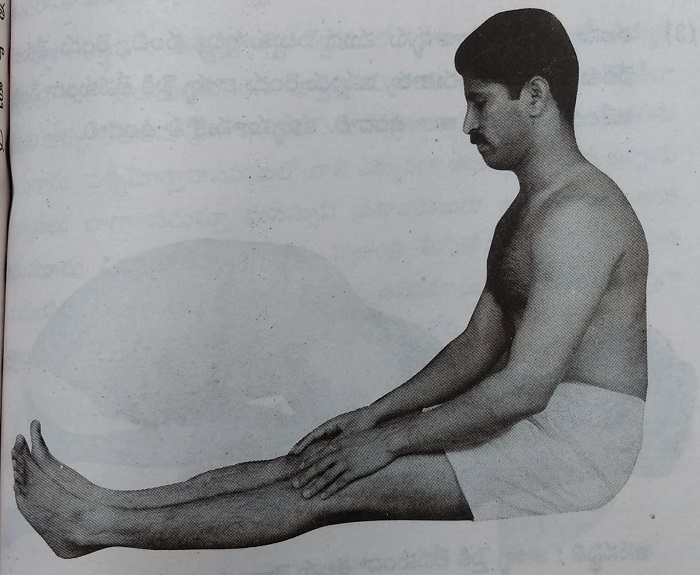
2. Bend forward from the waist and grasp the toes with both hands. Throughout the movement, keep the legs straight without bending the knees.
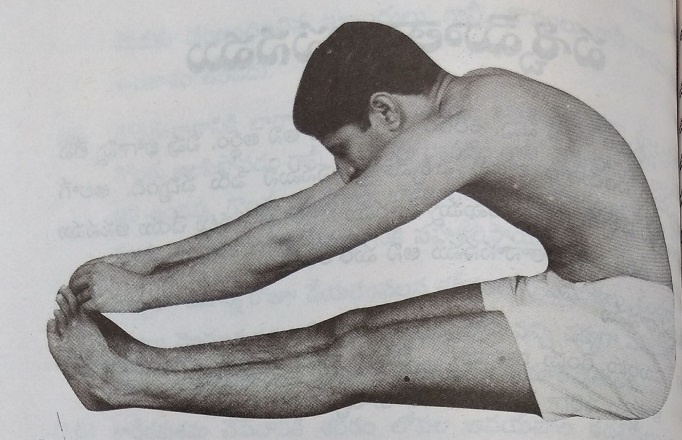
3. Slowly lower the head until it comes close to the knees, as though you are trying to kiss them.
Bend forward further until both arms rest on the floor.
Keep both legs pressed firmly against the floor so that they do not lift.
Close your eyes and remain in the posture.
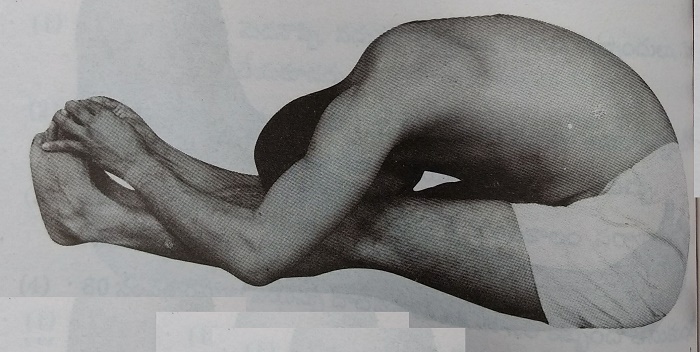
Asana Stage:
Keep the legs firmly on the floor without allowing them to lift, and keep the head resting against the knees.
Focus your attention on the area beneath the knees and along the thighs, and remain in the posture for as long as you comfortably can.
This position is quite difficult to maintain. The nerves and muscles along the backs of the legs are stretched intensely, producing a strong pulling sensation.
Bending the knees slightly reduces the effectiveness of the posture. Therefore, the full benefit is obtained only by keeping the legs straight and steady for as long as possible.
While holding the posture, you may experience cramping in the muscles of the abdomen and the sides of the waist. If this occurs, release the posture immediately and take rest.
During the Asana Stage, the diaphragm remains in a contracted position, allowing only a small amount of air to enter the lungs. As a result, breathing feels restricted, and you may experience fatigue or a sensation of not getting enough air.
Remain in the posture for as long as you comfortably can. When the discomfort becomes too great or you feel the need for more air, slowly raise the body back to an upright position.
As you come up, you will naturally take a deep breath without conscious effort, filling the lungs with a much greater amount of air.
When Paschimottanasana is practiced immediately after Sarvangasana, without taking rest in between, it produces considerable fatigue. Therefore, the body should be given adequate rest afterward.
Relaxation Stage:
Since Sarvangasana followed by Paschimottanasana causes considerable fatigue, lie flat on your back to allow the body to recover completely.
Keep both the arms and legs relaxed, focus your attention on the breath, and allow the mind to become calm.
Because breathing is somewhat restricted during Paschimottanasana, deep, natural breathing resumes during this relaxation period, bringing a sense of peace and refreshment.
Remain completely relaxed for two to three minutes.
The asanas that follow are physically demanding and require considerable effort. Therefore, unless you take sufficient rest at this stage, it will be difficult to perform the remaining asanas properly.
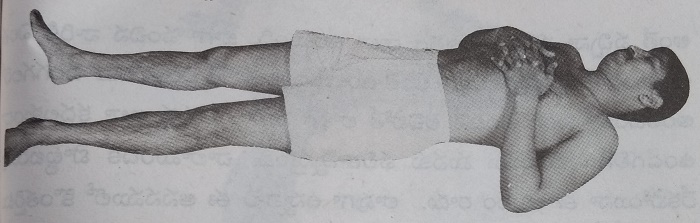
Alternative Method:
People with a large abdomen or those who are overweight may find it difficult to perform the full form of Paschimottanasana.
Many people become discouraged when they see the complete posture. They think, "My body will never bend like that. This posture is not for me," and gradually lose interest in practicing asanas.
What many people do not realize is that the posture is beneficial even if the full position cannot be achieved. Every practitioner receives benefits according to the extent to which their body is able to bend.
If you are overweight, do not become discouraged because you cannot bring your head to your knees. Simply bend forward as far as you comfortably can and remain there.
Make your best effort to keep the knees from lifting off the floor, and bend forward from the waist as much as your body allows.
Even if you can bend only as much as shown in the illustration, the posture will still provide considerable benefit. In principle, the benefits are the same as for someone who is able to bend much farther.
However, if you bend only as far as you can and immediately come back up, the benefit is negligible. It is remaining still in the posture for as long as you comfortably can that produces the real benefits.
Many people are unable to perform this posture fully even though they are not overweight. In fact, some overweight practitioners find it easier than very thin people.
Those with a slender body are often very stiff, and the waist does not bend forward easily.
Among all the asanas described in this book, Paschimottanasana is one of the most difficult, and it is the posture with which most practitioners struggle the most.
Whether you are thin or overweight, bend forward as far as you comfortably can, remain in the posture for as long as possible, and keep your mind focused on the practice. By doing so, you will receive excellent benefits.
After completing the posture, proceed to the Relaxation Stage.
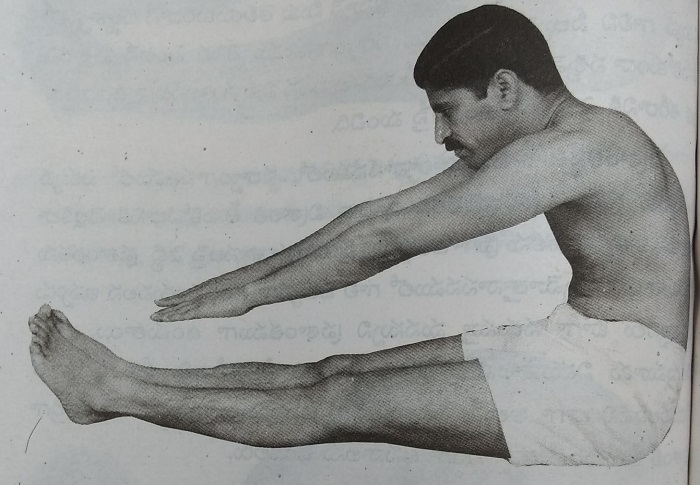
For some practitioners, bringing the head to both knees is especially difficult. Those who are unable to bend forward even a little may begin with an easier variation.
Practice the posture using one leg at a time for a few days. Once you become more flexible and are able to bend forward comfortably, you can gradually progress to the full posture with both legs extended.
Let us now learn the one-legged variation of Paschimottanasana.
1. Stretch one leg straight in front of you without bending the knee. Bend the other leg completely and place it as shown in the illustration.
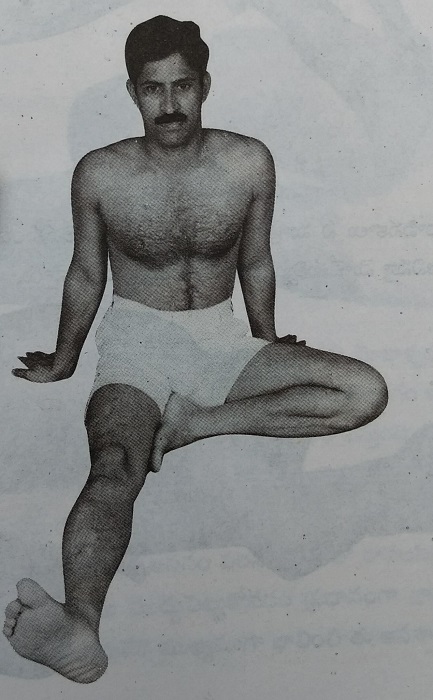
2. Bend forward from the waist and hold the foot of the extended leg with both hands. Take care not to allow the extended leg to lift off the floor.
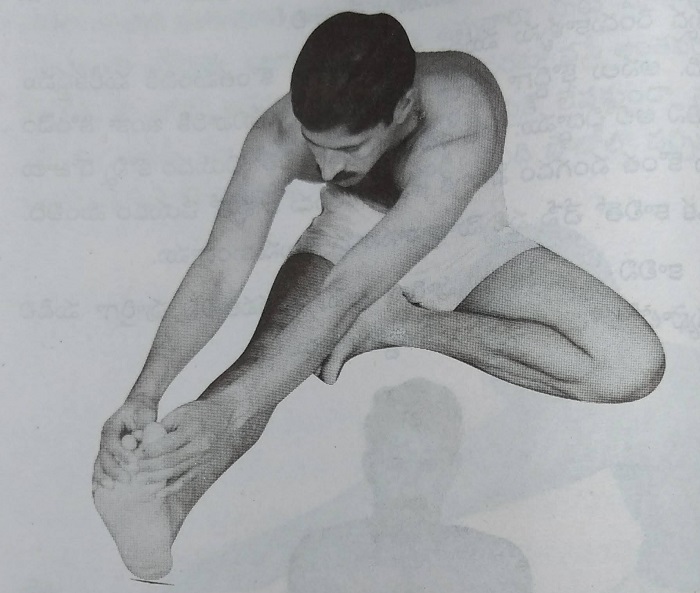
3. Keeping the extended leg firmly on the floor with the knee completely straight, lower the head toward the knee and try to bring both elbows to the floor.
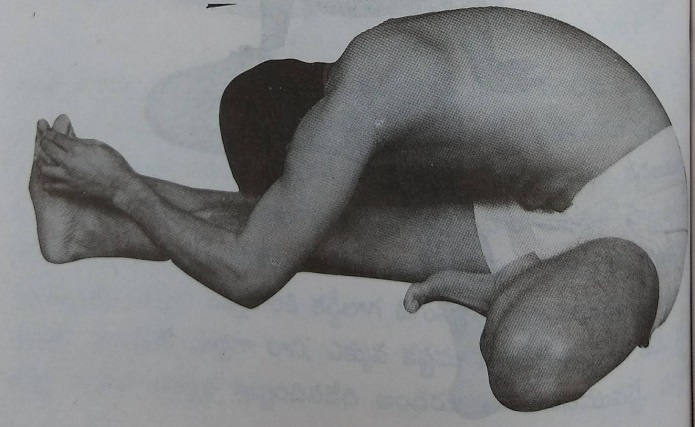
Bend forward only as far as you comfortably can while keeping the extended leg from lifting.
Remain in the posture for as long as you comfortably can.
When you are no longer able to hold the position, slowly release the posture, sit upright, and practice the Relaxation Stage in a seated position for about one minute.
Then bend the leg that was previously extended, straighten the other leg, and repeat the posture in the same manner.
Practice the posture separately on both sides, and after completing both, take complete rest in the Relaxation Stage.
Incorrect Posture:
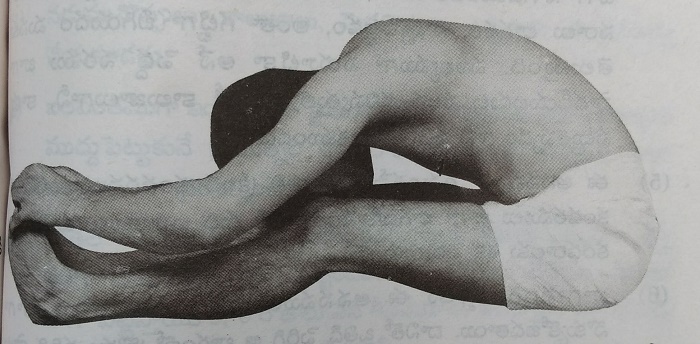
This is one of the asanas in which practitioners are most likely to make mistakes.
Many people become focused only on touching or kissing their knees with the head. They assume that if they can do this, they have mastered the posture.
The most common mistake occurs when they find it difficult to bend the head down to the knees. Instead of bending forward further from the waist, they lift the knees toward the head to make contact.
As shown in the illustration, it is incorrect for the knees to bend in this way.
In Paschimottanasana, you receive benefits no matter how far you are able to bend forward. However, if the legs are lifted or the knees are bent, the benefits are greatly reduced.
When the knees are bent, the nerves running from the spine into the legs are not stretched properly. The abdominal muscles also fail to contract fully. As a result, the physiological changes that this posture is intended to produce do not occur effectively.
Therefore, do not make touching the knees with the head your primary goal. The most important aspect of this posture is to keep the legs straight without bending the knees while bending forward as much as your body comfortably allows.
Benefits
1. In this posture, the spine is stretched to its maximum natural extent. Compared with its length in a normal sitting position, the spine can lengthen by as much as 20% during Paschimottanasana.
2. All the muscles along both sides of the spine are strengthened, and blood circulation to these muscles is greatly improved.
3. The nerves located between the lower back and the pelvic region become stronger. As a result, the organs supplied by these nerves are able to function more efficiently.
4. One of the principal effects of this posture is the deep stretch it provides to the nerves that run from the spine into the legs.
When the body is bent forward fully, you can feel the nerves and muscles in the thighs being stretched tightly.
In particular, the sciatic nerve is stretched thoroughly. Regular practice helps reduce the likelihood of developing sciatica, weakness in the legs, or instability while walking in the future.
5. While holding the posture, the muscles below the knees and those in the thighs are stretched and contracted intensely. This helps increase their strength.
6. When the body is bent forward deeply, the abdominal muscles are compressed firmly. This increases pressure in the abdominal region, helping to reduce excess fat around the abdomen and making the abdomen slimmer.
It also helps tighten a loose or protruding abdomen.
7. This posture is especially beneficial for people with diabetes.
When you bend forward, gentle pressure is applied to the pancreas, stimulating its tissues. This may help improve insulin production to some extent.
8. This posture applies firm pressure to the large intestine (colon) and the rectum.
While you remain in the posture, this pressure helps move retained stool forward through the intestine. It also strengthens the natural ability of the large intestine to propel its contents.
As a result, regular practice helps improve the functioning of the bowels, making it easier to relieve constipation and promoting smooth, complete bowel movements.
9. In this posture, the lungs, along with the muscles and nerves involved in breathing, develop a greater capacity to contract effectively.
This improvement helps increase the efficiency of breathing, allowing a greater volume of air to be taken in with each breath. As a result, the breathing rate gradually becomes slower.
10. Paschimottanasana provides healthy movement and improved blood circulation to the uterus, urinary bladder, liver, stomach, intestines, spleen, and other abdominal organs.
Note
1. People with lower back pain, sciatica, or neck pain should not practice Paschimottanasana.
2. Do not ask another person to force the body into the posture by pressing down firmly from above in an attempt to bring the head to the knees. Such forceful practice can cause injury and should be avoided.
3. During the first few days of learning this posture, practicing it excessively may cause enough soreness to make walking difficult. The muscles of the calves may become especially tight and painful.
Practice it moderately for the first five to six days. As the body gradually becomes accustomed to the posture, increase the duration for which you hold it.
4. When bending forward, do not become discouraged if you are unable to reach your feet with your hands, or if there is still a considerable gap between them.
For many people, it takes several months before Paschimottanasana can be performed well. With regular practice, flexibility improves little by little. Do not assume that you will never be able to perform the posture.
5. People with liver disorders, high blood pressure, or heart disease should avoid practicing this posture.
The word bhujanga means snake or cobra. In this posture, the body resembles a cobra raising its hood, which is why it is called Bhujangasana.
Just as a cobra can turn its body swiftly both upward and forward, regular practice of this posture makes the waist and spine more flexible, allowing the body to bend and turn with greater ease.
Method of Practice:
1. Lie face down on a mat or folded blanket, ensuring that the head rests on the blanket.
Place both palms on either side of the waist, near the level of the navel, as shown in the illustration. Only the fingers should rest on the floor, while the palms remain slightly raised.
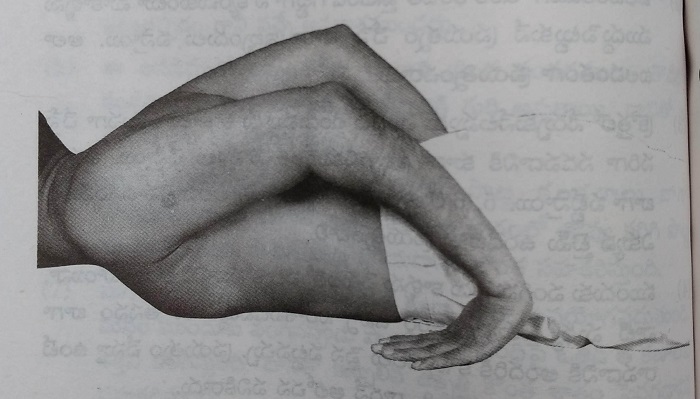
2. Draw both elbows inward toward the body and keep them aligned with the chest.
As you move into the full posture, make sure that the distance between the elbows remains the same and does not widen.
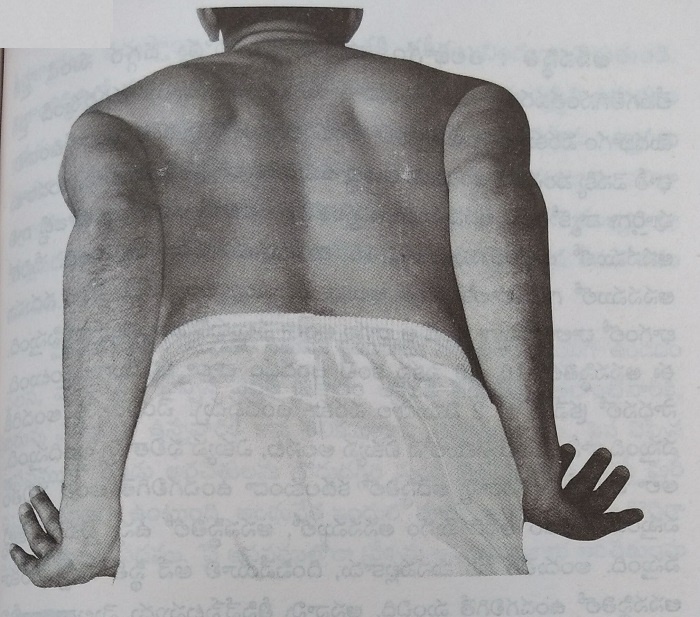
3. Keeping the elbows pressed inward and both feet together with the legs fully extended, slowly raise the head and chest from the level of the navel upward.
Bend the neck fully backward and keep the eyes closed.
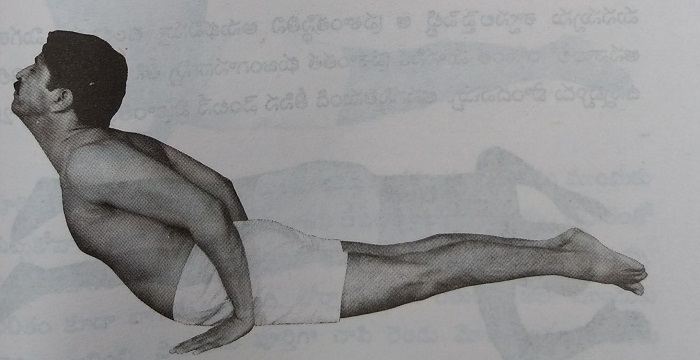
Asana Stage:
Raise the head and chest as high as you comfortably can, lifting from the level of the navel upward.
Then focus your attention on the area from the lower back up to the neck, and remain completely still in the posture for as long as you comfortably can.
As the chest is arched backward, the lungs, rib cage, and chest muscles remain fully expanded throughout the posture. Consequently, only about 10–15% of the normal volume of air moves in and out while you remain in the pose.
Because of this, breathing feels restricted, and you may experience a sense of fatigue or feel that you are not getting enough air.
You will also feel considerable strain in the back and lower back, as though the entire area is being firmly stretched and compressed.
Holding this posture for more than 10–20 seconds is difficult for most beginners. With regular practice, however, you may gradually increase the duration to one or two minutes.
Although Bhujangasana is easy for most people to learn, it produces considerable fatigue in a short time while also providing significant benefits.
The longer you are able to remain completely still in the posture, the greater the benefits you will receive. The benefits depend largely on the length of time you maintain the Asana Stage.
Therefore, remain in the posture until you genuinely feel that you can no longer continue comfortably.
To release the posture, slowly lower the chest back to the floor and lie face down again.
Do not open your eyes while coming out of the posture.
Relaxation Stage:
Lie face down, relax both the arms and legs, and turn the face to one side, as shown in the illustration.
Focus your attention on the breath and experience the sense of calm that follows.
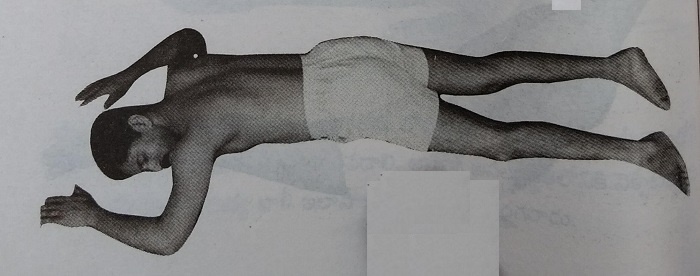
The mental tranquillity experienced during the Relaxation Stage after Bhujangasana is deeper than that produced by many other asanas.
Immediately after releasing the posture, the body naturally takes 20 to 25 deep breaths. During this time, Prana (vital life energy) is felt to flow throughout the body.
While resting, the mind becomes quiet, and for a time you may experience a state free from thoughts.
Remain in this peaceful state for two to three minutes.
Continue resting until your breathing returns to its normal rhythm.
If you do not take sufficient rest, you will find it difficult to hold the next posture for an adequate length of time.
In particular, after each of the four asanas performed in the prone position, it is beneficial to take a slightly longer period of rest.
Alternative Method:
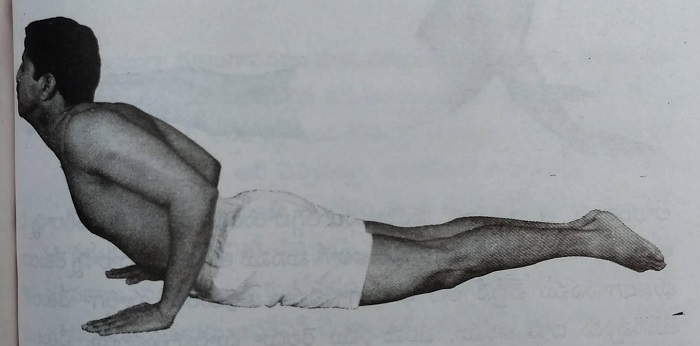
Some practitioners may not be able to perform Bhujangasana in the manner described above because the lower back muscles and the spine are not yet strong enough. This easier variation is also suitable for those who are overweight.
The main difference in this method is the position of the hands.
In the earlier method, only the fingers touched the floor while the palms remained raised near the level of the navel, making the posture more demanding.
In this variation, place both palms flat on the floor slightly in front of the navel.
With the hands positioned farther forward, they provide support while lifting the chest, making it easier to come into the posture. Even with this modification, the posture provides excellent benefits.
Lie face down and place the hands slightly forward as described. Stretch both legs fully, press both elbows inward toward the body, and slowly raise the head and chest, using the hands for gentle support as needed.
Come into the full position and remain there.
Keep the eyes closed.
Incorrect Posture:
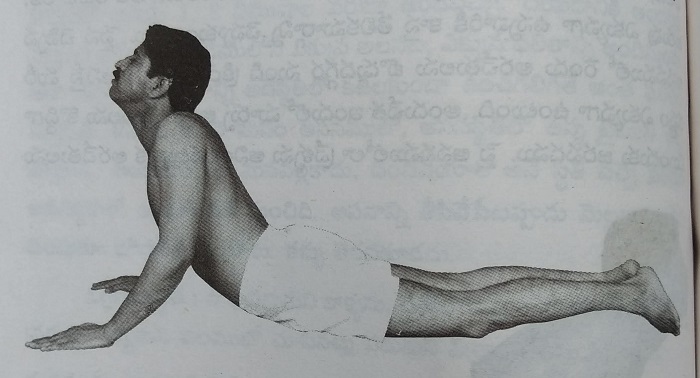
This is one of the asanas in which many practitioners make mistakes.
In Bhujangasana, the benefits depend greatly on the placement of the hands.
A common mistake is to place the hands too far forward, as shown in the illustration. When the hands are positioned this way, the entire weight of the body from the navel upward is lifted almost entirely by the arms. Once the body is raised, the arms continue to support nearly all of the weight, while the back and lower back do very little work.
If the arms bear the weight, the back receives much less benefit, and the effectiveness of the posture is greatly reduced.
A cobra raises its body without any external support. Likewise, Bhujangasana achieves its intended purpose only when the body is lifted primarily through the strength of the back, rather than by pushing up with the hands.
When the body is raised entirely by the arms, both the spirit and the purpose of the posture are altered.
If the hands are placed lower, near the navel, as described in the main method, they provide only about 10–15% of the support. The remaining 85% of the work is performed by the back and lower back, allowing them to receive the greatest benefit.
In the easier variation, where the hands are placed slightly farther forward, the arms provide approximately 30–40% of the support. Consequently, about 60–70% of the benefit still goes to the back and lower back.
However, when the hands are placed too far forward, as in the incorrect posture, the arms provide 80–85% of the support. In that case, the back and lower back receive no more than 15–20% of the intended benefit.
Adjust the position of the hands according to your strength and flexibility so that you receive the maximum benefit from the posture.
Those with severe lower back pain may initially practice with the hands placed farther forward, as shown in the incorrect posture, so that the movement is easier. As the discomfort gradually decreases, they should slowly move the hands farther back toward the correct position.
This posture is also effective in reducing body fat, particularly around the waist. Those who wish to obtain this benefit should place the hands as far back toward the chest as their ability allows.
Another important point is that, while lifting the chest, both elbows should be pressed inward toward the body. If the elbows are allowed to move outward, the body is more likely to be lifted by the arms, reducing the effectiveness of the posture.
Therefore, to obtain the greatest benefit, press both elbows inward while raising the lower back and chest.
Even if you are not yet able to place the hands in the ideal position, continue practicing. As your flexibility and strength improve, gradually move the hands farther back toward the recommended position.
Benefits
1. Bhujangasana is especially beneficial for people suffering from lower back pain, neck pain, sciatica, and other disorders related to the spine.
For those with such conditions, this posture can be of immense value.
While holding the posture, the neck and lower back are extended backward. This increases the space between the vertebrae, reducing pressure on the intervertebral discs. As a result, it helps prevent the nerves from being compressed or pinched between the vertebrae.
Many people who might otherwise require surgery for certain neck or lower back conditions have experienced significant relief through regular practice of this posture, avoiding the need for an operation.
Those with these problems should practice Bhujangasana twice a day.
Each session should consist of performing the posture once, resting until the fatigue subsides, then repeating it and resting again. Practicing it two or three times in the morning and two or three times in the evening is highly beneficial.
If you have lower back pain, you may first apply coconut oil to the affected area, followed by a hot compress, and then practice the posture.
Practicing in this manner twice a day often provides quicker relief.
2. Today, many people experience one or another problem related to the neck or lower back.
There are no medicines that can reliably prevent these conditions, and once they develop, medicines alone often do not provide a complete solution. Likewise, ordinary physical activity cannot fully protect against them.
According to the author, asanas are the most effective way to prevent these problems.
Rather than suffering from these painful conditions after they develop, it is better to practice these asanas regularly so that neck and lower back problems can be prevented.
3. Bhujangasana is one of the most effective asanas for reducing body weight.
Because the posture is physically demanding and difficult to hold, it requires considerable energy, thereby helping to burn more calories. Practicing it twice a day can assist in reducing body weight more quickly.
4. Excess body fat commonly accumulates around the waist.
In Bhujangasana, the region from below the neck to the waist, including both sides of the spine, receives deep compression and stretching. This makes it one of the most effective asanas for reducing excess fat in this area.
5. This posture applies healthy pressure to the kidneys, improving their blood circulation and helping to prevent circulatory disorders affecting them.
6. Bhujangasana helps train the lungs to adopt a pattern of deeper breathing throughout the day. As a result, the body receives more oxygen, leading to increased energy and vitality.
Note:
1. Since Bhujangasana is not difficult to learn, many beginners make the mistake of holding it for too long during the first few days of practice, leading to unnecessary discomfort.
For the first five to six days, practice the posture gently and release it without holding it for long. Advancing too quickly may cause pain in the neck and lower back.
2. People with a hernia should not practice Bhujangasana.
After assuming this posture, the body resembles a snake raising its hood. Sarpasana is very similar to Bhujangasana, the main difference being the position of the hands. Let us now learn this variation.
Method of Practice:
1. Lie face down on a mat or folded blanket, ensuring that the head rests on the blanket.
Keep both legs close together with the feet fully extended.
Using the fingers of both hands, firmly grasp the lower part of the buttocks, as shown in the illustration.
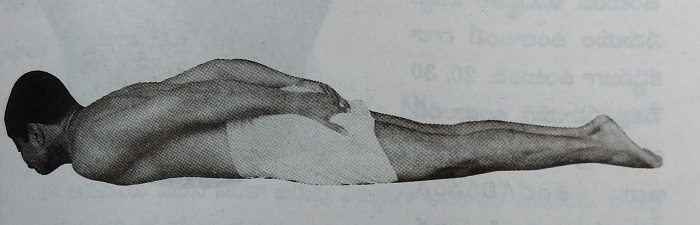
2. Pull firmly on the buttocks with the fingers, and at the same time lift the chest upward from the level of the navel.
Bend the head backward, raising the chest and neck as high as you comfortably can, and then hold the position.
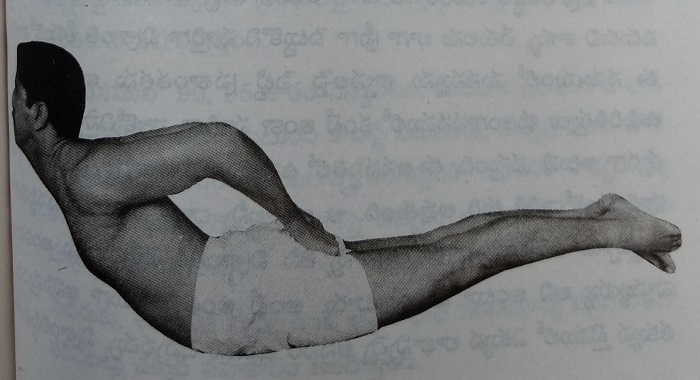
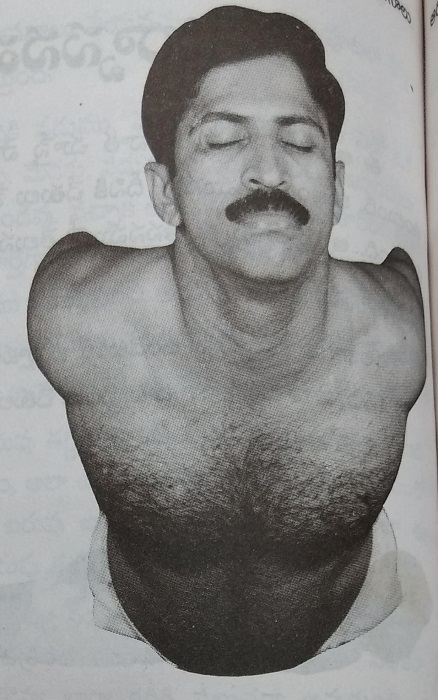
Asana Stage:
After lifting the front of the body from the level of the navel upward, remain in that position.
Focus your attention on the lower back and the neck, and remain completely still.
Since the hands do not rest on the floor in this posture, Sarpasana is considerably more difficult than Bhujangasana.
Holding the posture for any length of time requires significant effort. Even remaining in the position for 20 to 30 seconds demands considerable energy.
Stay in the posture for as long as you comfortably can. When you are no longer able to maintain it, slowly release the posture and lie face down.
Do not open your eyes while coming out of the posture.
Relaxation Stage:
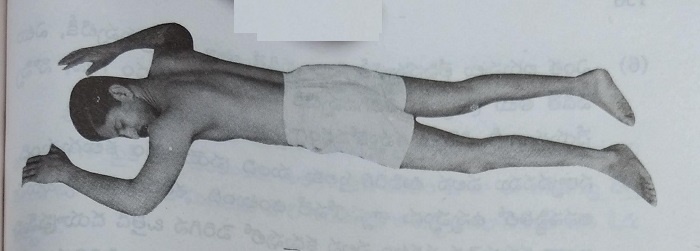
After releasing the posture, you will feel considerable fatigue.
Remain lying face down, relax both the arms and legs completely, and allow the body to rest fully.
During this time, focus your attention on the breath and experience the sense of calm that follows.
In Sarpasana, the lungs expand even more fully than in Bhujangasana, which is why the posture produces fatigue more quickly.
While holding the posture, the entire back and lower back are subjected to intense contraction. Consequently, these regions often feel quite strained during the Asana Stage.
Most practitioners instinctively let out a sigh of relief as soon as they release the posture and lie down to rest, which reflects how demanding the posture is.
Sarpasana may be regarded as one of the asanas that provides the greatest benefits in a relatively short period of practice.
During the Relaxation Stage, the body naturally takes long, deep breaths, allowing Prana (vital life energy) to flow throughout the body and helping to relieve fatigue.
Remain at rest until the body and breathing return to their normal state.
There is very little possibility of performing Sarpasana incorrectly. Regardless of the height to which you are able to raise the body, the posture provides benefits in proportion to your ability.
Benefits
1. All the benefits described for Bhujangasana also apply to Sarpasana. It is especially beneficial for those suffering from lower back and neck problems.
2. This posture can be even more effective in helping to reduce body weight. Therefore, those who wish to lose weight should include Sarpasana in their practice twice a day.
3. The intense contraction produced in the back during Sarpasana has a beneficial effect on the adrenal glands, which are located above the kidneys, and helps support their healthy functioning.
4. In Sarpasana, approximately 90–95% of the lifting of the chest is accomplished solely by the strength of the back and its muscles. As a result, it greatly strengthens the lower back, the vertebrae, and the muscles surrounding the spine.
Among the asanas that are within the reach of most practitioners, Sarpasana is one of the most effective for developing the strength of the back.
5. This posture helps improve the coordination and communication between the brain and the rest of the body, enabling them to function more harmoniously.
6. Regular practice helps protect the lower back from injury. Even when lifting heavy objects, sitting in awkward positions, or twisting the body suddenly, the likelihood of lower back strain, pain, or intervertebral disc problems is reduced.
7. Sarpasana provides significant benefits for the lungs.
While holding the posture, the breath remains naturally held within the lungs. At the same time, because much of the body's weight rests on the abdomen, the increased abdominal pressure pushes the diaphragm upward.
This increases the pressure within the chest, compressing the air inside the lungs. As a result, alveoli that may have remained partially collapsed or inactive are encouraged to reopen, increasing the volume of air the lungs can hold.
This improves the removal of carbon dioxide and allows more oxygen to be taken into the body.
The improved oxygenation also enhances blood circulation to the heart muscle, helping to strengthen the heart.
8. This posture applies healthy pressure to all the organs in the abdomen, helping to improve both digestion and bowel function.
9. Regular practice helps reduce excess fat around the waist, making the waist slimmer.
Note
1. During the first few days of practice, hold the posture for only five to six seconds before releasing it.
2. People with high blood pressure, heart disease, hernia, or stomach ulcers should not practice Sarpasana.
The word shalabha means locust. A locust has its front part lowered while its hind part is raised upward. In the same way, when this posture is performed, the back of the body is lifted high, giving it the appearance of a locust. Hence the name Shalabhasana.
Method of Practice
1. Lie face down on a mat or folded blanket, ensuring that the head rests on the blanket.
Close both hands into fists and place them beneath the thighs, as shown in the second illustration.
Keep both legs together with the feet fully extended.
Rest the chin on the floor and close your eyes.
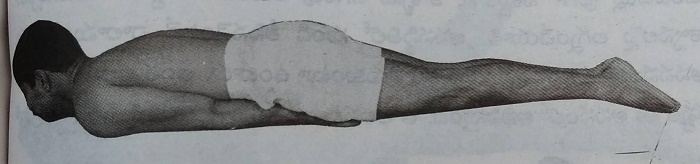
2. Tighten the lower back and the legs, then raise both legs together without bending the knees.
Lift the legs as high as you comfortably can and hold them at that height.
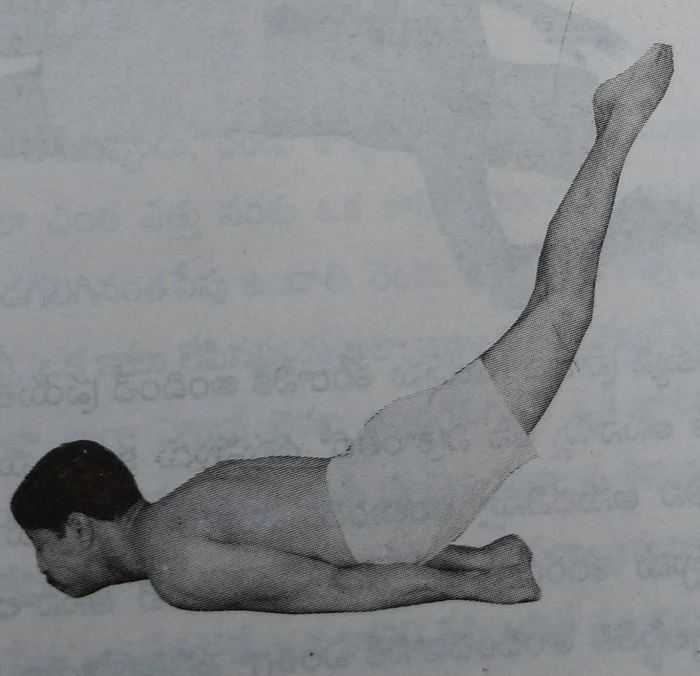
Asana Stage:
After raising the legs, keep them steady in that position.
Focus your attention on the buttocks and the lower part of the lower back, around the sacral region.
Throughout the posture, the legs should remain completely still. Do not allow them to move or gradually drop. Keep them at the height to which they were raised.
Some practitioners may notice a slight trembling in the legs while holding them up. Maintaining this position requires considerable strength.
The entire body, from the neck to the feet, remains firmly contracted. Only by tightening the body in this way is it possible to lift the legs.
During the posture, the lungs remain compressed to a large extent, allowing only shallow breathing. As a result, you will gradually begin to feel fatigued.
While holding Shalabhasana, the effort required is so great that the mind naturally becomes free from other thoughts.
Remain in the posture for as long as you comfortably can. When you feel that you can no longer maintain it, slowly lower the legs back to the floor.
Relaxation Stage:
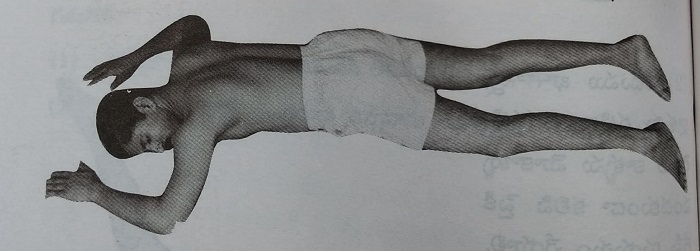
Without opening your eyes, remain lying face down.
Open your hands, relax both the arms and legs completely, and allow the body to rest comfortably without any tension.
Focus your attention on the breath.
Immediately after releasing the Asana Stage, many practitioners instinctively let out a sigh of relief. This posture can feel extremely demanding and produces considerable fatigue.
To overcome this fatigue, the lungs naturally begin taking deep breaths, supplying the body with a greater amount of oxygen.
During the Relaxation Stage, the mind also enters a state that is free from thoughts.
The mind, which ordinarily jumps from one thought to another like a restless monkey, now becomes quiet and still.
This clearly demonstrates how the practice of asanas can help bring the mind into a state of stillness and inner silence.
Remain in the Relaxation Stage until the body has completely returned to its normal state.
Keep your eyes closed throughout the entire period of relaxation.
Alternative Method:
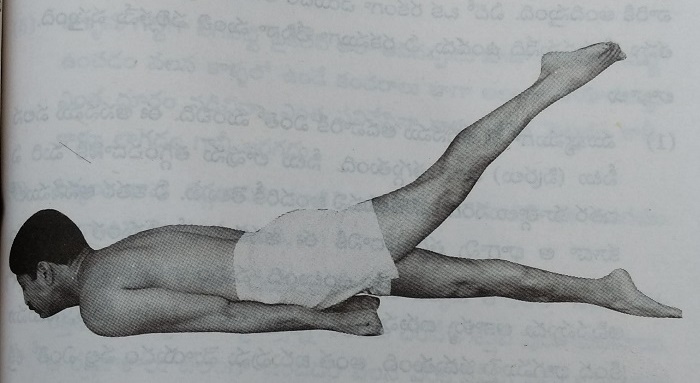
For people with heavier thighs and buttocks, Shalabhasana can be more difficult to perform. Lifting heavy legs requires considerable strength, particularly in the lower back, hips, and leg muscles. Those who have not yet developed sufficient strength may find that they cannot raise both legs even slightly.
Such practitioners need not be discouraged. They can begin with an easier variation and gradually work toward the full posture.
If you are unable to lift both legs together, practice by lifting one leg at a time. In fact, when only one leg is raised, it can usually be lifted much higher than when both legs are raised together.
Raise the leg as high as you comfortably can and hold it there.
Remain in the posture for as long as you comfortably can.
Although lifting both legs produces greater fatigue, lifting a single leg is much easier, allowing you to hold the posture for a longer time. Holding the posture longer enables you to receive worthwhile benefits even from this variation.
When you are no longer able to maintain the position, lower the leg, take complete rest, and then repeat the posture with the other leg.
People who suffer from severe sciatica and are unable to hold both legs up for long should also practice this one-legged variation. If one leg is more affected than the other, it is especially beneficial to raise and hold that leg.
With this variation, many practitioners are able to hold the leg raised for two to three minutes.
There is another variation that may also be helpful for some practitioners.
When both legs are raised without bending the knees, they may lift only a small distance from the floor. For those with very heavy thighs, even if the feet rise about one foot (30 cm), the thighs may still remain in contact with the floor, reducing the effectiveness of the posture.
In such cases, it is acceptable to bend the knees slightly while lifting the legs. This modification can still provide good benefits for practitioners who are overweight and unable to raise the legs properly.
The important thing is to practice the posture in whatever way your body allows.
There is no significant "incorrect" way of performing this asana. Whatever variation you are able to practice, you will still receive meaningful benefits.
Benefits
1. This posture is especially beneficial for women.
One of its principal benefits is that it helps reduce excess fat in the buttocks. Many people find that this is an area where other forms of exercise are not very effective. Among the asanas, Shalabhasana is particularly effective for toning and reducing excess fat in this region.
When the legs are lifted and held in the posture, their entire weight is borne by the buttocks and the lower part of the lower back. Supporting this weight requires considerable muscular effort and energy.
As these muscles work intensely, excess fat in the area is gradually reduced. The longer the posture is held, the greater this effect tends to be.
For those who do not have excess fat in this region, regular practice helps make the muscles of the buttocks firmer and stronger.
2. Shalabhasana is also an excellent posture for weight reduction.
Although it is easy to learn, it is difficult to hold. Because it demands considerable effort, it helps the body expend more energy. Practicing it twice a day can be very beneficial for those who wish to reduce body weight.
3. This posture is especially valuable for people suffering from sciatica.
Holding the leg in the raised position helps relieve pressure on the sciatic nerve where it emerges from the spine.
With regular practice twice a day, the condition of the lower spine gradually improves, and the symptoms of sciatica may be greatly reduced or relieved.
It also helps relieve the constant pulling sensation and heaviness that are commonly experienced in the affected leg.
4. Shalabhasana has a particularly beneficial effect on the vertebrae in the lower part of the spine.
Regular practice helps keep this region healthy and may help prevent many disorders affecting the lower end of the spine.
5. Holding the legs tightly contracted while they are raised strengthens the leg muscles considerably. As a result, even after walking long distances or doing strenuous physical work, the legs are less likely to become painful or develop a pulling sensation.
6. This posture is very effective in reducing excess fat in the calves and in increasing the strength of the calf muscles.
7. Regular practice of Shalabhasana helps strengthen the veins in the calves and thighs, enabling them to return deoxygenated blood to the heart more efficiently. Strong, healthy veins also help reduce the likelihood of developing varicose veins.
8. This posture has an excellent effect on both kidneys. While holding the posture, the pressure created by the raised legs extends to the kidney region, producing an effect similar to a gentle massage and promoting their healthy functioning.
9. People who experience pain in the middle part of the back can also practice this posture. Regular practice may help relieve lower back pain completely.
10. When the legs are raised and held, part of their weight is transmitted to the area below the navel, including the rectum. This stimulates the intestines, improving their ability to move waste forward. Consequently, Shalabhasana is highly beneficial for relieving constipation.
Note
1. During the initial days of practice, some people may experience a sudden cramp in the calf muscles. If this occurs, stop the posture and rest until the cramp subsides.
2. People with a hernia should not practice Shalabhasana.
3. When beginning this posture, it is advisable to practice it gently and without excessive effort.
This posture is called Dhanurasana because, when performed, the body resembles a drawn bow. The hands and legs, firmly holding each other, represent the bowstring, while the rest of the body forms the shape of the bow.
Dhanurasana is the complete combination of Bhujangasana and Shalabhasana, bringing together the essential features of both postures.
Method of Practice
1. Lie face down.
Keep the legs about one foot (30 cm) apart. Bend both knees, bringing the feet toward the buttocks.
Reach one hand back and hold the ankle of the corresponding leg. Then reach back with the other hand and hold the other ankle.
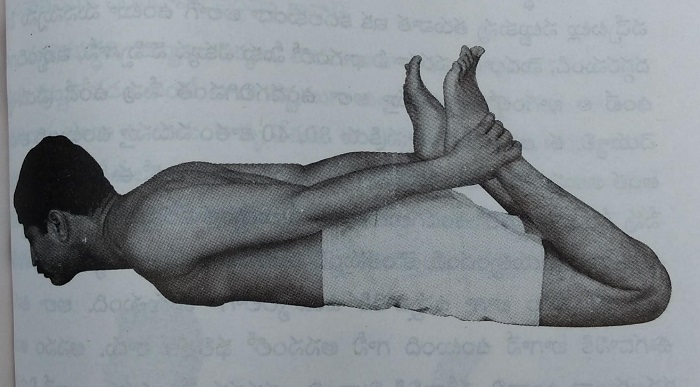
2. Hold both ankles firmly with the hands.
Kick both legs upward while simultaneously lifting the chest and neck.
Once the chest has been raised, keep it steady without moving. Hold the legs firmly so that they also remain still.
Close your eyes.
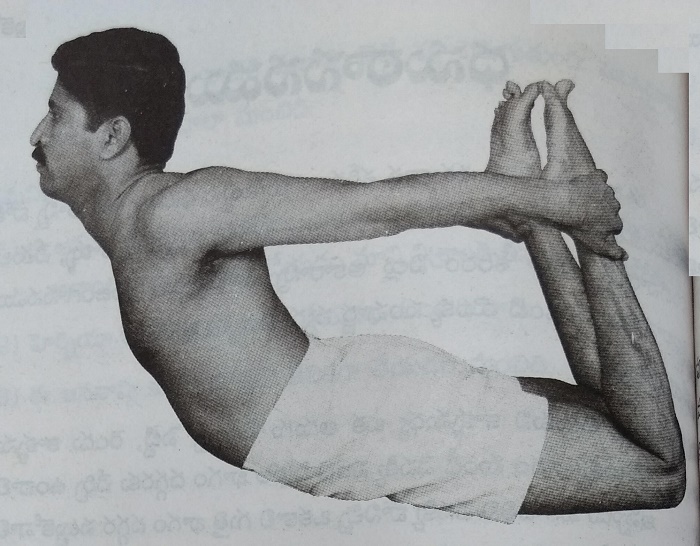
Asana Stage:
This posture is relatively easy to perform.
Once the body has assumed the shape of a bow, remain completely still.
Focus your attention on whichever part of the body, from the buttocks to the neck, experiences the greatest discomfort or stretch.
Remain in the posture for as long as you comfortably can.
During Dhanurasana, breathing continues at about 30–40% of its normal capacity. Consequently, this posture usually produces less fatigue than the other face-down postures.
Among the four asanas performed while lying face down, Dhanurasana is the one that can generally be held for the longest period.
Therefore, try to remain in the Asana Stage for as long as you comfortably can.
Some practitioners rock back and forth like a cradle while in this posture. This often happens in people with a larger abdomen. Although rocking may feel pleasant, it does not provide the intended benefits of the posture.
An asana should be held without movement.
Remain firmly in the posture until the body naturally requires rest.
Since this is the final posture among the face-down asanas, make a sincere effort to hold it for as long as your capacity allows.
Then slowly lower the legs, release the ankles, and return to lying face down.
Relaxation Stage:
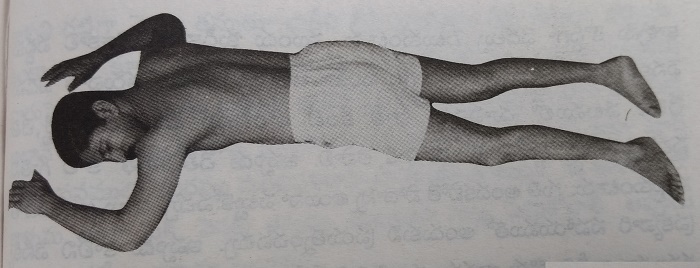
Release the hands and legs completely, allowing them to relax without any tension.
Remain lying face down, turn the head to one side, and focus your attention on the breath.
Since this posture is usually held for a relatively long time, you may experience greater fatigue. Therefore, it is advisable to remain in the Relaxation Stage for two to three minutes.
During this period, the breath naturally becomes deep, bringing the mind into a state of profound calm.
The sense of peace experienced after Dhanurasana is often deeper than that experienced after the other face-down asanas. Therefore, remain in this relaxed state for as long as possible and fully enjoy its calming effect.
Once the body has completely returned to its normal state, come out of the Relaxation Stage and prepare to practice Shavasana.
Alternative Method:
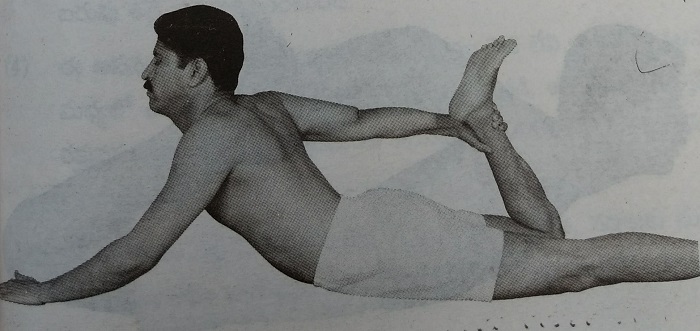
For people with a larger abdomen, buttocks, or thighs, reaching back and holding both ankles with the hands may be very difficult. Some practitioners may not be able to reach their feet at all.
If you cannot hold both ankles, do not give up the posture. Instead, practice the following variation, which also provides considerable benefit.
Lie face down and keep the legs slightly apart.
First, bend the right knee, bringing the foot toward the buttocks.
Place the left hand on the floor slightly in front of the chest, as shown in the illustration. Using the support of that hand, lift the chest and neck.
Now reach back with the right hand and hold the right ankle. If you cannot reach the ankle, hold the foot instead. If you are still unable to reach it, another person may assist you in bringing the foot within reach.
Then kick the leg backward while lifting the chest so that it rises from the navel upward.
Throughout the posture, keep the supporting hand and the raised leg firmly engaged.
If possible, gradually draw the supporting left hand farther back while maintaining the posture. Alternatively, you may place that hand closer to the shoulder from the beginning and use it to help lift the chest.
Remain completely still for as long as you comfortably can, and then move into the Relaxation Stage.
This variation is especially beneficial for people with a larger abdomen. The abdomen rests against the floor like a cushion, making it easier to bend the lower back more deeply.
After practicing on one side, take complete rest. Then repeat the posture on the other side in the same manner, followed once again by the Relaxation Stage.
Incorrect Posture:
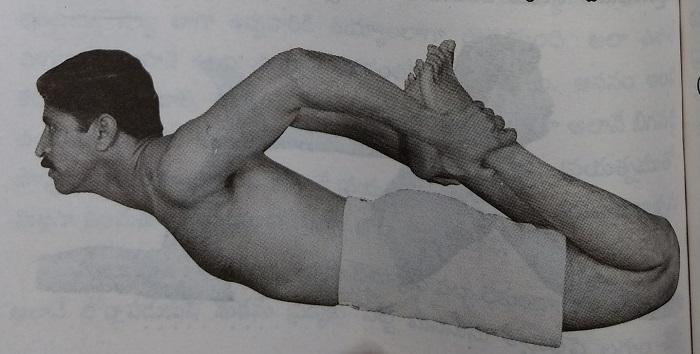
There is very little possibility of performing this posture incorrectly, although a few mistakes are common.
As shown in the illustration, some practitioners are able to hold the ankles correctly with the hands, but they are unable to kick the legs backward sufficiently, causing the chest to remain low.
If the chest is not lifted properly, the posture provides very little benefit.
To raise the chest effectively, keep the arms straight and firm, without bending the elbows. Hold the ankles securely and kick the legs strongly backward. This action will naturally help lift the chest higher.
If you are still unable to achieve the posture, another person may assist you by holding your legs and lifting them upward while you raise your chest. Once you are in the correct position, maintain a firm backward push with the legs and ask the helper to let go.
In this way, you will be able to experience the full benefits of Dhanurasana.
Remember that the most important action in this posture is to kick the legs strongly upward and backward. If this is done correctly, there is very little chance of performing the posture incorrectly.
Benefits
1. Dhanurasana is highly beneficial for people suffering from lower back pain or neck pain. It helps relieve pain in these areas and provides significant relief. To help prevent these problems from recurring, it is advisable to practice this posture regularly.
2. This posture is especially effective for people who have excess fat in the buttocks. While holding the posture, the buttocks are compressed, creating substantial pressure in that region. This helps reduce excess fat and makes the area firmer and slimmer.
For reducing excess fat in the buttocks, Dhanurasana is an excellent posture.
3. Those who wish to reduce their body weight should make Dhanurasana a regular part of their practice.
Although it is not as physically demanding as Sarpasana or Shalabhasana, this posture still requires considerable muscular effort and energy. As a result, it can contribute significantly to weight reduction.
4. In this posture, both the front and back of the body are lifted, placing considerable pressure on the waist in the middle. This stimulates healthy blood circulation in that region and helps make the waist slimmer.
5. Dhanurasana improves the coordination between the vertebrae, the lower back muscles, and the nerves. As a result, the lower back becomes stronger, more responsive, and more flexible, allowing it to bend freely in different directions.
6. While holding this posture, beneficial pressure is applied to the uterus and the urinary bladder.
Regular practice may help protect women from common uterine disorders and problems such as frequent urination.
Because this posture helps strengthen the uterus, supporting it and helping to prevent it from sagging or descending, Dhanurasana is considered especially beneficial for women.
Note
1. Practice Shavasana only after all fatigue has completely disappeared.
2. Beginners should practice this posture gently for the first two to three days. After that, they should gradually try to remain in the Asana Stage for as long as they comfortably can.
3. Before practicing any of the four asanas performed while lying face down, make sure that the urinary bladder is not full. If you feel even a moderate urge to urinate, empty the bladder before beginning your practice.
4. The four asanas practiced while lying face down should be regarded as some of the most important postures in the entire practice of asanas. Make it a point to practice them regularly and receive their many benefits.
Shavasana plays a vital role in allowing both the body and the mind to achieve complete relaxation after all the asanas have been practiced.
Ordinarily, we assume that simply lying still with our eyes closed, or even sleeping, is enough to provide rest. However, even when we appear to be lying quietly, many parts of the body continue to move unconsciously. As long as the muscles remain active in this way, the body does not experience complete relaxation.
True relaxation is essential for everyone.
Many people believe that sleep alone provides sufficient rest for the body and the mind. However, in today's tension-filled lives, people often go to bed physically exhausted, yet continue struggling with their worries and problems even during sleep. Instead of resting, the mind remains occupied, trying to resolve the day's concerns.
Such sleep does not provide genuine relaxation.
This is why many people wake up in the morning still feeling tired and lacking energy. That same sense of fatigue often continues throughout the day. By nightfall, they once again go to sleep with an exhausted body and a weary mind, only to wake up the next morning in much the same condition. Thus, the cycle continues day after day.
Sleep is certainly necessary for the body, but there are methods that can provide many times deeper relaxation than sleep alone.
Among the most important of these methods is the practice of asanas.
Regular practice of asanas brings the body and the mind into harmony, allowing both to experience profound relaxation.
The difference between a person's physical and mental condition before learning asanas and after becoming well established in their practice is often clearly noticeable.
Even if we practice asanas for only one hour a day, their influence extends far beyond that single hour. They help us remain balanced under all circumstances.
Whatever challenges or difficulties may arise, the body and the mind are able to remain calm and relaxed, free from tension and anxiety.
Yoga asanas, Pranayama, and meditation all work together to promote deep physical as well as mental relaxation.
Throughout the day, the muscles become tense as a result of our daily activities. The nerves also become fatigued. When mental stress is added to this physical strain, its effects are reflected throughout the body.
Mental stress causes the muscles to become tense. When the muscles remain in a state of tension, they require more energy to function.
As the body's demand for energy increases, the lungs and the heart must work harder to meet that demand. If they are repeatedly forced to work beyond their normal capacity, they may eventually become weakened, leading to ill health.
During emotions such as fear, anger, and anxiety, the adrenal glands become more active. This causes the muscles and blood vessels to contract, increasing the workload on the heart.
In today's world, almost everyone lives with one form of stress or another. As a result, the adrenal glands are often continually overactive. Over time, this may contribute to the development of various illnesses.
It can also reduce the body's natural immune resistance.
Many digestive ulcers are associated with prolonged mental stress.
To prevent such problems, overcome them, and enjoy a healthier and more fulfilling life, we must learn to give both the body and the mind adequate relaxation.
If we observe animals that live free from worldly worries, or watch young children while they sleep, we can begin to understand what true relaxation really is.
When children play, they play wholeheartedly. When they sleep, they sleep completely.
Adults, on the other hand, often work while their minds long for sleep, and when they sleep, their minds continue working. As a result, a great deal of energy is constantly consumed by thoughts.
To quiet this continuous stream of thinking, we should gently direct the mind toward the body and the breath. At the same time, the body should remain completely still and deeply relaxed.
Let us see what happens when we do this.
When we stop using the muscles, the nerves that carry signals from the muscles to the brain, as well as those that carry signals from the brain to the muscles, also become inactive. As a result, we gradually lose awareness of the body's movements.
The more completely we can relax the muscles without moving them, the more deeply we experience a feeling of lightness throughout the body.
The cells of the muscles, the nerve cells, and the cells of every organ are then able to rest completely, restoring and renewing their energy.
Since the brain is no longer occupied with directing physical activity, it too is able to experience deep rest.
When the mind is focused on the breath and on the various parts of the body, it temporarily lets go of the tension, worries, and problems that ordinarily occupy it, allowing it to experience genuine relaxation.
The depth of this relaxation depends largely on the sincerity and concentration with which we practice it.
When the mind remains focused on the body and the breath, the adrenal glands function in a balanced manner, allowing the body's normal physiological processes to proceed naturally.
It is Shavasana that brings together all the benefits described above.
Practicing Shavasana for just five minutes after completing all the asanas can provide even greater relaxation than an entire night's comfortable sleep after a tiring day.
Whether the fatigue is physical or mental, Shavasana is an extremely effective means of restoring freshness and relieving exhaustion.
You may remain in this posture for as long as you comfortably can. However, staying in Shavasana for five to ten minutes generally provides the greatest benefit.
Shavasana:
In this posture, the body lies motionless on the ground like a corpse, with no movement and no muscular tension. For this reason, it is called Shavasana ("Corpse Pose").
Method of Practice:
Lie flat on your back on a mat or folded blanket.
Keep the legs comfortably apart and fully extended.
Extend both arms straight, keeping them slightly away from the sides of the body. Turn the palms upward.
Close your eyes.
Now observe which parts of your body are in contact with the floor and which are not. This is an effective way to direct the attention of the mind toward the body.
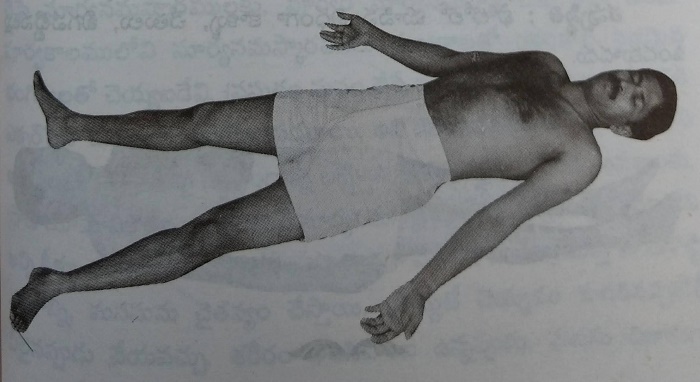
First, notice whether the buttocks are resting completely on the floor. If they are tightened, consciously relax them and allow their full weight to sink into the floor. Let them become completely relaxed.
Next, observe for a few seconds whether the right heel is resting fully on the floor.
Then observe the left heel in the same way.
Continue by bringing your attention to the right arm, right leg, left arm, left leg, back, both shoulders, and the back of the head.
Spend a few seconds observing each part, noticing whether it is resting completely on the floor.
Then become aware of the entire body resting on the ground.
Now notice the right leg becoming heavy, as though it is sinking into the floor and cannot be moved.
In the same way, observe the left leg becoming heavy.
Then bring the same awareness to the right arm, followed by the left arm, feeling each one becoming heavy and sinking gently into the floor.
If you notice that your hands have become clenched, gently open them and allow them to relax completely.
Keep the shoulders completely relaxed, without any sense of tightness or weight. People who are under stress often unconsciously keep their shoulders tense.
Do not wrinkle the forehead. A furrowed forehead is a sign of tension.
Relax the lower jaw and do not clench it. Keep the mouth closed naturally.
In this way, allow every muscle in the body to remain completely relaxed and free from all movement.
If thoughts arise during the practice, do not try to suppress them. Instead, gently bring the mind back to the different parts of the body or to the breath.
Remain in this state for five to ten minutes.
Then slowly open your eyes, bend the arms and legs, and gently come out of the posture.
Incorrect Posture:
As shown in the illustration, the arms and legs should not be held stiffly or under tension. Every part of the body should remain completely relaxed.
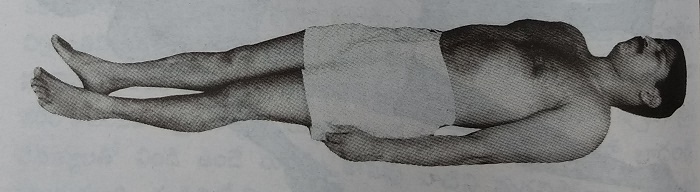
The Sun is the source of light and warmth for the world. Without the Sun, life on Earth could not exist. For this reason, human beings have worshipped the Sun since ancient times.
The practice of offering reverence to the Sun has been a tradition in many parts of the world since ancient times. Although the divine power itself cannot be seen, the Sun is visible to us every day. We directly experience its light and warmth. Since the Sun is the foundation of all life, it is only fitting that we express our respect and gratitude toward it.
The three stages of the Sun symbolize creation, preservation, and dissolution. Sunrise represents creation. The brilliance and power of the midday sun symbolize the preservation and sustenance of creation. Sunset represents its dissolution.
The Sun itself is eternal. Day after day, it rises and sets without fail. By dispelling darkness and bringing light to the world, it awakens all living beings from sleep, just as the light of knowledge dispels the darkness of ignorance.
Because of these profound associations, the practice of Surya Namaskara originated in ancient India.
The Rig Veda and the Yajur Veda describe how the Sun should be worshipped upon rising in the morning.
The Surya Namaskara practiced today, however, differs from the traditional form. In ancient times, it was performed with mantras and a series of distinct, steady postures.
The modern form of Surya Namaskara serves primarily as a complete physical exercise. Strictly speaking, it is not an asana. However, because of its close relationship to the practice of asanas, it is appropriate to include it here.
Practicing Surya Namaskara immediately after waking, before beginning asanas and Pranayama, helps loosen all the joints and muscles of the body, making them more supple and flexible.
It also dispels drowsiness and brings alertness and vitality to both the body and the mind.
Although it is best practiced in the morning, it may also be performed whenever it is convenient.
Whenever the body feels tired or the mind is restless, practicing Surya Namaskara acts almost like a medicine, quickly refreshing both the body and the mind.
It requires very little preparation.
Because Surya Namaskara moves the entire body through a wide range of motion, all the body's organs, muscles, and joints are exercised thoroughly. As a result, the body naturally develops the flexibility and ease required for everyday activities such as walking, sitting, and lying down.
Such are the many benefits of Surya Namaskara. Therefore, it is worthwhile to understand it thoroughly and practice it correctly.
1. Surya Namaskara consists of twelve postures. These twelve postures symbolize the twelve zodiac signs. Each posture represents one zodiac sign. According to traditional belief, the Sun remains in each zodiac sign for thirty days before moving on to the next one.
2. One of the distinctive features of Surya Namaskara is that the breath flows naturally and rhythmically throughout every posture, without conscious effort.
3. These twelve salutations are traditionally performed while chanting twelve mantras. Each stage of Surya Namaskara is associated with a specific mantra. When the words of these mantras are pronounced, their vibrations are believed to have a beneficial effect on both the mind and the body.
Chanting these bija (seed) mantras along with the practice of Surya Namaskara is said to strengthen the mind.
The twelve mantras corresponding to the twelve stages of Surya Namaskara are given below.
Before learning these mantras, you should first become proficient in performing the twelve stages of Surya Namaskara correctly.
Pay close attention to whether the breath is properly coordinated with each movement.
After that, practice chanting the appropriate mantra along with each stage of Surya Namaskara, making sure that the pronunciation is correct.
Ultimately, the movement, the breath, and the mantra should all become perfectly synchronized.
Chanting the mantras aloud produces the greatest benefit. If this is not possible, they may be repeated silently in the mind.
Completing all twelve stages of Surya Namaskara constitutes one round.
The number of rounds you practice depends on your capacity. You may perform anywhere from 2 or 3 rounds up to 12 rounds.
Those who are able to practice comfortably are encouraged to perform 12 rounds every morning for the greatest benefit.
Do not continue once you become fatigued.
Although Surya Namaskara is ideally practiced immediately after waking in the morning, it may also be practiced at other times of the day, provided that at least three hours have passed after a meal.
It can be practiced by both men and women of all ages.
Method of Practicing Surya Namaskara
1. Pranamasana:
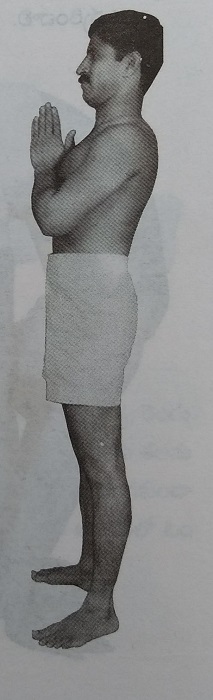
Stand upright with the feet slightly apart.
Join both palms together in front of the chest in the gesture of prayer, keeping the entire body erect and steady.
In this position, chant the first mantra aloud:
Om Mitrāya Namaḥ
2. Hasta Uttanasana:
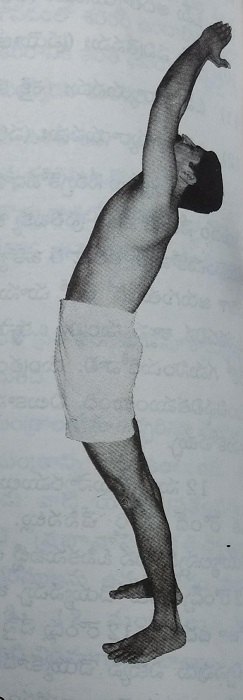
Keeping the palms joined together, raise both arms overhead.
Gently bend the waist and the neck backward, allowing the abdomen to arch slightly backward.
While performing this posture, chant:
Om Ravaye Namaḥ
3. Padahastasana:
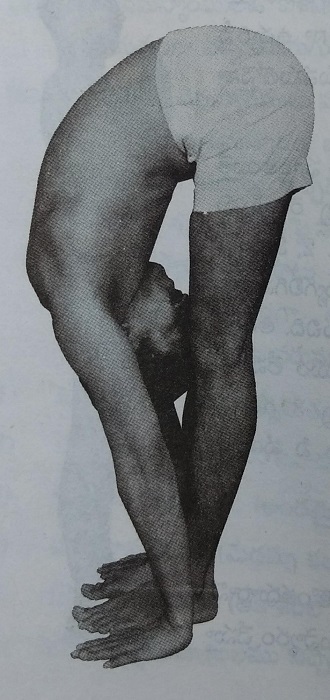
From the raised position, bend forward and place both hands on the floor.
Without bending the knees, bring the face close enough to the knees as though kissing them.
While performing this posture, chant:
Om Sūryāya Namaḥ
4. Ashwa Sanchalanasana:
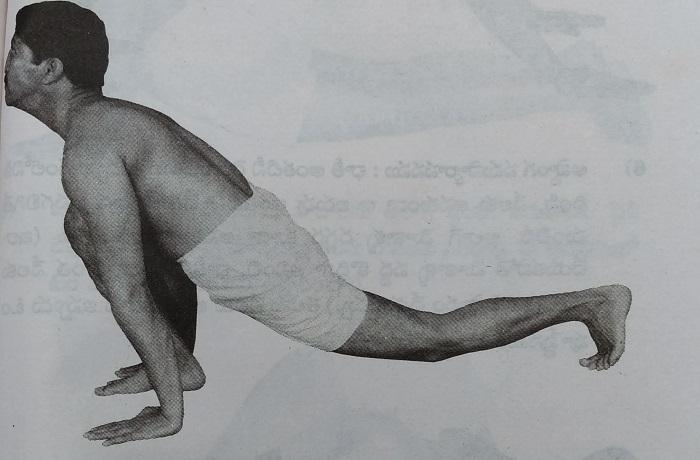
Stretch the left leg backward as far as it will comfortably go, resting on the toes.
Keep the left knee off the floor if possible.
Bend the right knee and place the right foot between the hands.
Support the weight of the chest on the right leg and both hands, then gently bend the neck backward.
While holding this posture, chant:
Om Bhānave Namaḥ
5. Parvatasana:
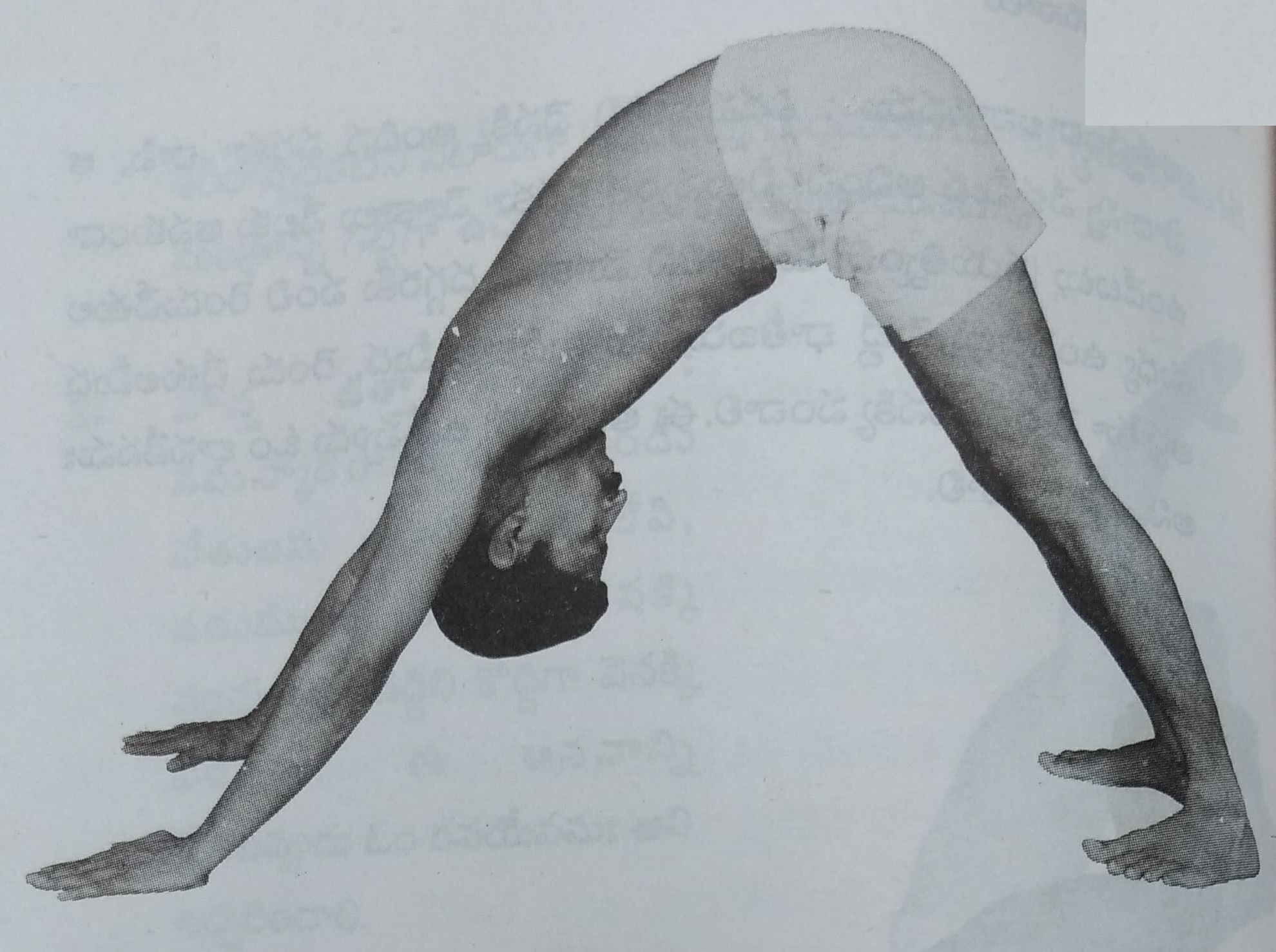
Now take the right leg back to join the left leg.
Place both feet firmly on the floor and press through the hands to lift the chest upward.
Tuck the head inward and direct your gaze toward the navel.
Keep both legs straight and assume the posture as shown in the illustration.
While holding this posture, chant:
Om Khagāya Namaḥ
6. Ashtanga Namaskarasana:
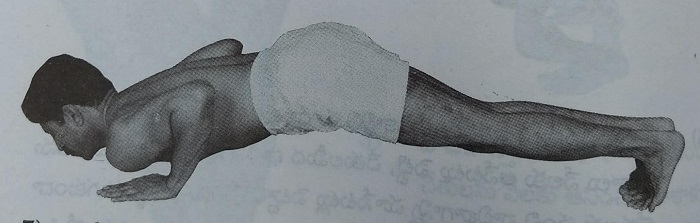
Lower the chest between the hands.
Ideally, keep the chest slightly above the floor, supporting the entire weight of the body on the hands. Likewise, try to keep the knees from touching the floor.
(If this is too difficult, you may lightly rest the knees and allow the chest to touch the floor slightly while performing the salutation.)
Keep the head from touching the floor.
While holding this posture, chant:
Om Pūṣṇe Namaḥ
7. Bhujangasana:
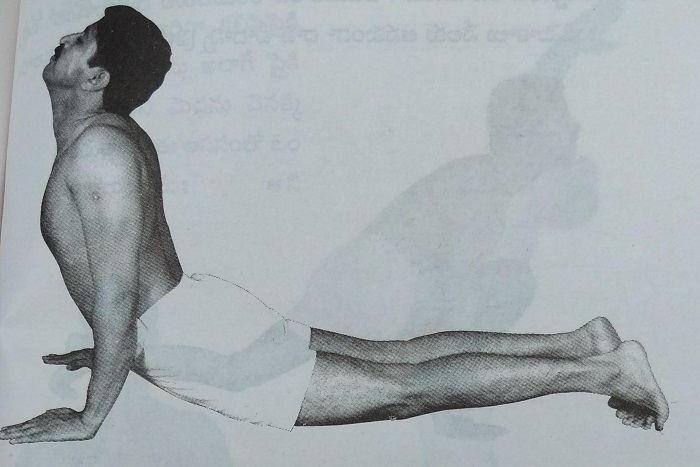
Keeping the legs in the same position, press through both hands and lift the chest upward.
Bend the neck fully backward.
Straighten the arms completely and arch the chest backward as much as possible.
While holding this posture, chant:
Om Hiraṇyagarbhāya Namaḥ
8. Parvatasana:
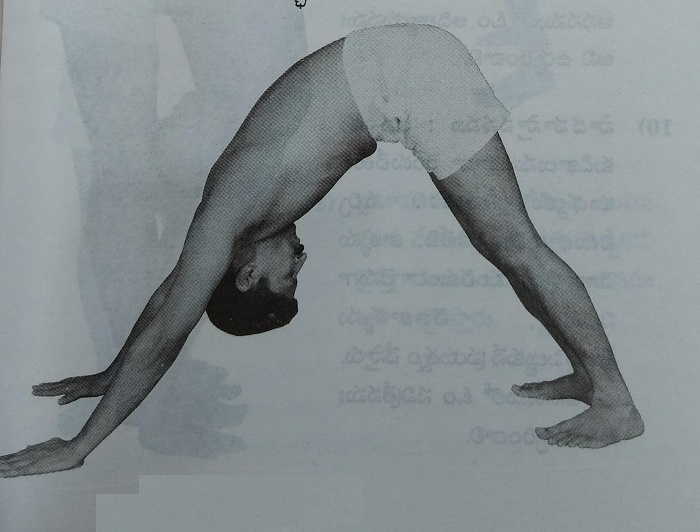
Keeping the hands and feet in the same position, lift the waist upward.
Tuck the head inward and direct your gaze toward the navel.
While holding this posture, chant:
Om Marīcaye Namaḥ
9. Ashwa Sanchalanasana:
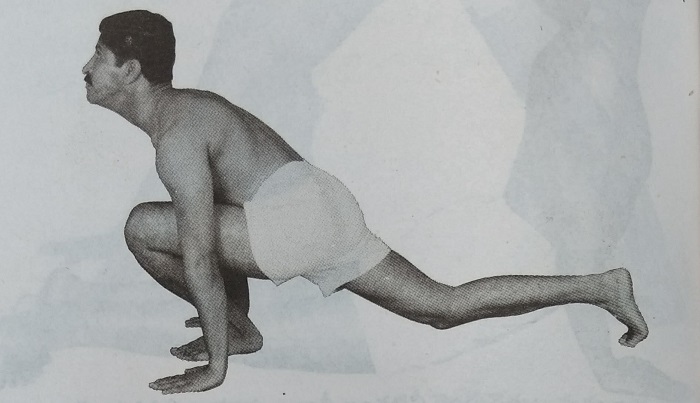
Bring the left foot forward and place it between the hands.
Stretch the right leg backward, keeping the right knee off the floor and resting on the toes.
Bend the neck backward while supporting the weight of the chest on both hands and the left leg.
While holding this posture, chant:
Om Ādityāya Namaḥ
10. Padahastasana:
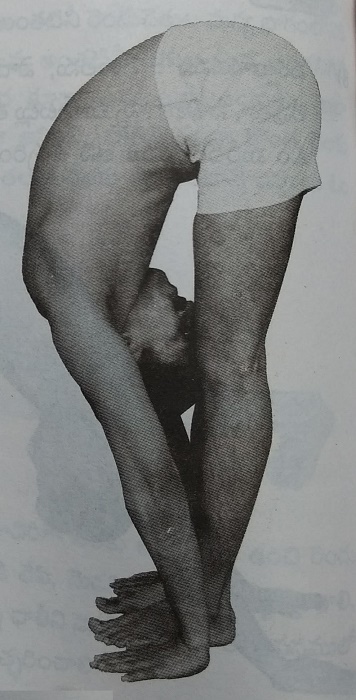
Now bring the right foot forward so that it comes between the hands.
Lift the hips upward and keep both legs straight without bending the knees.
Bring the face close to the knees, as though trying to kiss them.
While holding this posture, chant:
Om Savitre Namaḥ
11. Hasta Uttanasana:
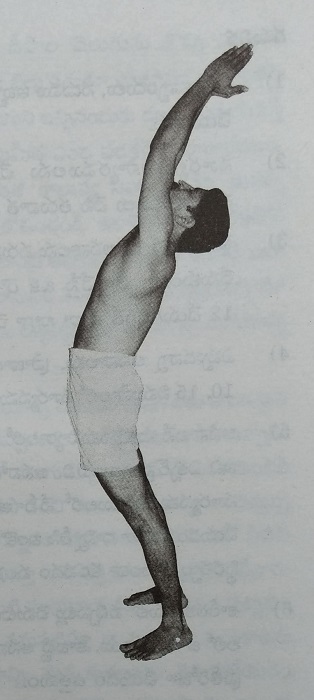
Keeping both hands joined together, rise to a standing position.
Raise the arms overhead and gently arch the chest and neck backward.
While holding this posture, chant:
Om Arkāya Namaḥ
12. Pranamasana:
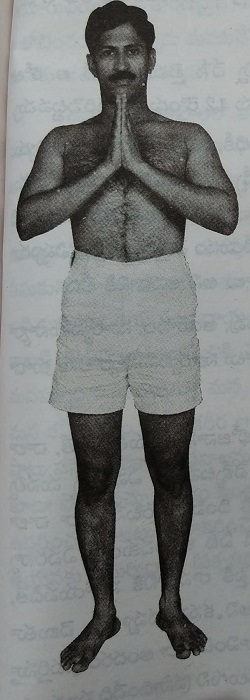
Bring the joined palms down in front of the chest and stand upright with the body erect.
While in this position, chant:
Om Bhāskarāya Namaḥ
Note
1. People with neck problems or lower back disorders should not practice Surya Namaskara.
2. Those who wish to practice Surya Namaskara should perform it before practicing Pranayama and asanas.
3. One complete round of Surya Namaskara consists of performing the twelve postures in sequence while chanting the corresponding twelve mantras continuously. Being able to complete twelve rounds in this manner is considered an excellent practice.
4. On days when you do not have enough time to practice asanas and Pranayama, you may instead perform twelve rounds of Surya Namaskara, which can usually be completed in about 10 to 15 minutes.
5. Although many of the postures used in Surya Namaskara are themselves asanas, practicing Surya Namaskara is not the same as practicing asanas. It is more like a form of physical exercise. The profound benefits that come from holding an asana steadily are not obtained here, because each posture is entered and released immediately before moving on to the next. Since there is no sustained, steady holding of the postures, Surya Namaskara is not regarded as a practice of asanas in the strict sense.
6. Like other forms of physical exercise, Surya Namaskara can produce perspiration, fatigue, and increased breathing. Therefore, it is ideal to practice Surya Namaskara regularly along with your daily practice of asanas.
Consider a simple example from everyday life.
If someone lovingly serves us a satisfying meal, we say, "Thank you very much."
If we are walking somewhere and someone kindly offers us a ride, we express our sincere gratitude as soon as we get down from the vehicle.
If someone helps us advance in our career or business without expecting anything in return, we often say, "I will remain indebted to you for the rest of my life," and we continue to express our gratitude whenever we meet them.
We do all this because we consider it our duty and a basic expression of good character.
Now think about the Sun.
Every day, it gives us twelve hours of daylight. When natural light is unavailable, we willingly pay our electricity bills for using artificial lighting for just a few hours.
If we had to pay for all the sunlight the Sun has provided us throughout our lives, could we ever afford it?
Consider another example. If the Earth were deprived of sunlight for only a few days, the environment and nature itself would become polluted and unhealthy. Reflect on how much money could possibly repay the Sun for continually protecting us by maintaining the balance of nature.
Likewise, without the Sun, no food could be produced on Earth. Think about what wealth could ever compensate the Sun for making it possible for the food we eat to grow.
The good that the Sun does for us cannot be measured or calculated.
Its service to all living beings is beyond price.
Have we ever paused to say "Thank you" to the Sun, which supports our very existence by helping us in so many ways?
Do we begin each day with a feeling of gratitude, recognizing that we are indebted to the Sun? Even if such gratitude arises, how many of us truly cultivate it every day?
In grateful recognition of the Sun, which bestows Prana (vital life energy) and sustains our lives, our ancestors followed a beautiful tradition. After bathing, they would offer water to the Sun with cupped hands while bowing in reverence, expressing their devotion and gratitude.
This is a cherished tradition of India.
Having been born into such a tradition, it is our basic duty to greet the Sun each day with folded hands, sincerely recite the twelve mantras, and express our devotion and gratitude.
For the sake of our health, we can combine the chanting of these twelve mantras with the twelve postures of Surya Namaskara, gaining not only physical well-being but also inner joy.
What more can we offer in return?
Therefore, let us practice Surya Namaskara, which helps uplift and strengthen our lives, and offer it with a spirit of devotion to the Sun.
May we live joyfully in harmony with Nature.
Even among the principal asanas described in this book, each posture offers its own unique benefits.
Those who wish to obtain the greatest benefit from a particular asana should give special attention to it by either practicing it an additional time during their routine or repeating it in the evening.
Let us now see which asanas are especially beneficial for different health conditions and physical problems.
1. For Neck Pain (Cervical Spondylosis)
The following asanas are especially beneficial for people suffering from neck pain (cervical spondylosis):
Those suffering from neck pain should temporarily set aside the other asanas and practice only the five listed above until the pain has completely subsided.
Practice these asanas twice a day for one to two months, or until the pain is completely relieved.
After the neck pain has disappeared, you may resume practicing all the other asanas except Sarvangasana, Halasana, Yogamudrasana, and Paschimottanasana.
Continue practicing in this way for another three to four months. If no discomfort remains, you may then practice all thirteen remaining asanas, continuing to omit only Sarvangasana and Halasana.
To obtain quicker relief from neck pain, the above five asanas should be practiced twice a day.
2. For Lower Back Pain (Intervertebral Disc Problems)
The following asanas are especially beneficial for people suffering from lower back pain caused by intervertebral disc problems:
People with lower back pain should practice only these four asanas twice a day.
Until the pain has completely subsided, it is especially beneficial to practice Ustrasana and Bhujangasana two to three times in the morning and again two to three times in the evening.
Once the pain has completely disappeared, you may practice all the other asanas except those that involve bending the spine forward, namely:
After the body, particularly the lower back, has become strong and fully under your control, you may gradually resume practicing the complete set of asanas described in this book.
3. For Sciatica
The following asanas are especially beneficial for people suffering from sciatica:
Practice only these five asanas twice a day, and temporarily discontinue all the other asanas.
Until the pain has completely subsided, it is especially beneficial to practice Ustrasana and Shalabhasana two to three times in the morning and again two to three times in the evening.
Once the sciatica has completely resolved, you may resume practicing all the asanas in the normal manner.
4. For Weight Loss:
People who are overweight and wish to make their bodies slimmer, healthier, and more attractive should practice asanas twice a day without fail.
In the morning, practice the complete set of fifteen asanas described in this book.
Practicing all of them again in the evening would take considerable time. Therefore, it is sufficient to practice only the following asanas:
In addition to these seven asanas:
If you wish to reduce excess fat in the upper arms, include Ustrasana.
If you wish to reduce excess fat around the sides of the waist, include Ardha Matsyendrasana.
If these asanas are practiced twice a day, holding each posture for a longer duration with full attention and care, you can confidently expect to lose 4–5 kilograms of body weight per month.
5. For Complete Health:
Those who wish to enjoy complete health should practice all fifteen asanas every day.
Only by practicing the entire set of asanas can every organ of the body receive their full benefit.
For people who do not engage in any other form of physical exercise or manual work, practicing these fifteen asanas is sufficient.
6. For Specific Benefits:
Some people feel discouraged by the thought of practicing all fifteen asanas and therefore never begin at all. Instead, they may spend their time doing activities such as walking and prefer to practice only one or two specific asanas.
Others may have excess fat or a particular problem affecting only one area of the body and wish to focus their practice on that area.
For such people, the following asanas are especially useful:
These asanas are not intended solely for weight loss.
For those who are not overweight, each asana provides its specific benefits to the corresponding part of the body. For those who are overweight, these benefits are gained along with a reduction in excess fat.
Likewise, anyone experiencing a health problem affecting any of the above body regions may give special attention to the corresponding asana and practice it with care and dedication to help improve that area.
7. Which Asanas to Practice When You Have Limited Time:
If you regularly practice all fifteen asanas, there may be days when you are traveling or occupied with other responsibilities and cannot spare enough time for your full routine. Rather than skipping your practice altogether, you may wonder which asanas will give you the greatest benefit in the limited time available.
On such days, you can complete your practice in 15–20 minutes by choosing asanas that provide benefits to the entire body while ensuring that all major regions receive adequate movement.
The recommended asanas are:
Whenever time is limited, practicing these seven asanas is sufficient.
Although the chapter explaining each asana already describes in detail which parts of the body it benefits, that information is spread across the individual asana descriptions and may be difficult to review as a whole. For that reason, the recommendations have been brought together in this chapter.
The fifteen asanas described in this book are all important. However, this chapter has been included to help those seeking specific benefits understand more clearly which asanas deserve special attention.
Today, a large number of people in society are troubled by excess body weight.
When a person is 10–15 kilograms above their ideal weight, the problem may not yet appear very serious outwardly. However, when the excess reaches 20–30 kilograms or more, a variety of difficulties begin to develop, including joint pain, ankle pain, the strain of carrying excess abdominal weight, shortness of breath, and fatigue.
People try many different methods to free themselves from these problems. Yet, despite their efforts, they are often unable to lose weight, and their discomfort continues. Many overweight people find themselves feeling frustrated and helpless.
Once the body has gained 20–30 kilograms of excess weight, the situation can feel like that of a fish trapped in a net.
The reason is that they seem to be caught in a vicious cycle. If they reduce their food intake to lose weight, they become weak and exhausted. If they eat a little more to regain their energy, they gain weight again. If they try to lose weight by walking, their pain often becomes worse. If they attempt strenuous exercise, their bodies may not be able to cope with the effort. If they try to work harder physically, they become fatigued. On the other hand, if they avoid all physical activity and remain seated to prevent pain, their weight continues to increase.
Unable to eat freely, unable to walk comfortably, and unable even to sit without difficulty, they often feel as though they are living through a kind of daily misery.
For such people, real relief comes only through a method that allows them to lose weight while minimizing physical strain and reducing their discomfort.
Is there such a method? Yes.
To reduce both excess weight and the problems associated with it, the best results are achieved by combining proper dietary discipline with the regular practice of asanas. Together, they provide an effective and balanced approach to restoring health.
Many people who want to lose weight choose activities such as walking, cycling, or other forms of exercise, but comparatively few take up the practice of asanas.
One reason is that when they look through books on yoga and see photographs of the postures — with their deep bends, twists, and stretches — they become discouraged even before they begin, thinking, "How could I ever do something like that?"
This way of thinking is mistaken.
For people who are overweight, asanas can provide remarkable support. They can stand by them just as faithfully as Hanuman stood by Lord Rama in times of adversity.
Yoga is a wonderful discipline that allows a person to practice gently while sitting or lying comfortably at home, without the need for strenuous movement. However, if yoga asanas are performed in the same manner as ordinary physical exercises, their benefits are greatly reduced. When they are practiced as true asanas, the results can be extraordinary.
With determination and consistent practice, it is possible to lose 30–40 kilograms of excess weight over a period of 8–10 months.
Many people, however, have doubts. They think, "That may be true, but first I have to learn how to do the asanas. My body must become flexible enough to bend and twist properly. Only then will I get the benefits. Won't I need to lose weight before I can perform these postures?"
Such questions are common among those who are overweight.
The answers to all these doubts lie within the practice of asanas themselves.
Because they do not understand one important principle of asana practice, many overweight people stay away from yoga altogether.
The principle is this: the benefit begins wherever your present ability ends. You only need to perform the posture to the extent that your body comfortably allows. The benefits begin from the very first day. They do not depend on performing the posture perfectly or becoming highly flexible.
A person who has mastered an asana may be able to hold it motionless for two minutes, while an overweight beginner may be able to remain in the same posture for only thirty seconds. Even so, both receive the benefits appropriate to their level of practice.
Let us understand this principle with an example by considering Paschimottanasana.
A practitioner performing the full Paschimottanasana posture after gaining proficiency
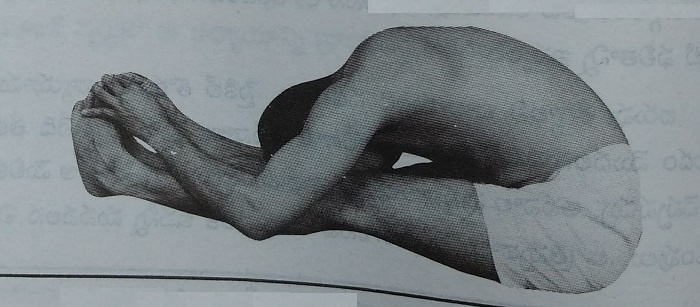
The posture as performed by a person who is significantly overweight and unable to bend fully
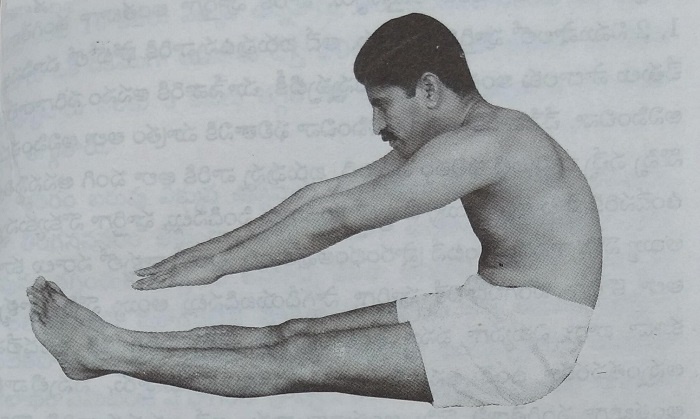
As shown above, Paschimottanasana is considered to be in its complete form when the head rests on the knees, both elbows touch the floor, and the posture can be held steadily without movement.
This is the full expression of the asana.
However, no one achieves this complete posture on the very first day of practice. It develops gradually over the course of several months through regular practice.
If the benefits of the asana were to begin only after this perfect posture had been attained — as described in the traditional definition — then all the time spent practicing beforehand would yield no benefit at all. In that case, one might conclude that asanas are of little value to people who are overweight.
But that is not how asanas work.
People who are significantly overweight should not compare themselves with experienced practitioners or with photographs of perfectly executed postures and wonder, "When will I ever be able to do that?"
Such comparisons are unnecessary.
Only if you were participating in asana competitions would it matter whether your posture had reached its perfect form. For the rest of us, our goal is to receive the benefits of the asana—not to perform it perfectly.
Whether you perform the posture fully, halfway, or even only a quarter of the way, the important thing is to practice it to the extent that your body comfortably allows, with sincerity and attention, and then remain in the posture for as long as you can comfortably tolerate the stretch.
Those who practice the asana in any of these three ways receive the same kind of benefit, appropriate to their level of practice.
This is one of the greatest strengths of asana practice.
How does this happen?
A person who can perform the asana in its complete form remains in the Asana Stage until the stretch becomes intense enough that it can no longer be comfortably tolerated. For someone who is flexible, it takes bending fully and holding the posture for one to two minutes before that level of stretch is reached.
Now consider a person who is overweight. As shown in the illustration, their hands may still be far from their feet. To an observer, it may appear that the asana has not been performed correctly, and the practitioner may even feel the same way. However, from the standpoint of the benefits, that is not the case.
The benefits depend on the internal stretch experienced by the body, not on how perfect the posture looks.
In an overweight person, even a partial forward bend causes the abdomen to compress against the thighs. The abdominal muscles are squeezed and pressed firmly, and the sensation of stretch begins almost immediately.
At the same time, the muscles and nerves in the legs are stretched sufficiently, so the practitioner experiences a strong stretch there as well, even though the forward bend is only partial.
The practitioner remains in the posture until the stretch becomes as intense as can be comfortably tolerated, and then comes out of the asana.
A person with a slimmer, more flexible body must bend much farther before experiencing a stretch of the same intensity.
Thus, even though an overweight person bends only a little, the internal effects — the stretching of the tissues, the temporary reduction in blood flow caused by compression, and the other physiological changes produced by the posture — occur to a similar degree.
These internal changes are what matter. They are what produce the benefits of the asana. How far the body bends is not the most important factor.
Since the same beneficial changes occur within the body, both practitioners receive the same essential benefits.
As practice continues over several months, the body of an overweight person gradually becomes more flexible, allowing the forward bend to deepen until the complete posture is eventually achieved.
At that stage, however, simply bending to the level that once produced results is no longer enough. When the practitioner was new to the asana, bending only partway created the necessary stretch and therefore produced the benefits. As flexibility improves, the body must bend farther to create that same level of stretch. If the practitioner continues to stop at the earlier position, the body will no longer receive the same benefit.
Therefore, those who can bend deeply should not judge those who cannot, and beginners should not compare themselves with experienced practitioners. Each person receives the appropriate benefit at the level that matches their present ability.
People who are overweight generally experience a stronger stretch in a shorter period of time. A stronger stretch indicates that the body is working harder internally. Where the body has to work harder, the potential for improvement is greater.
For this reason, people with a greater amount of excess weight often have the potential to lose weight more rapidly.
For example, suppose two people practice the same asanas with equal sincerity. One is 10 kilograms above their ideal weight, while the other is 30 kilograms above it. If the first person loses about 5 kilograms in a month, the second may lose 10 kilograms during the same period.
People who are significantly overweight need not become discouraged or search endlessly for different solutions. They can practice asanas comfortably at home and gradually reduce their excess weight.
To receive the full benefits, it is important to understand and practice all three stages of every asana correctly: The Entry Stage, the Asana Stage, and the Relaxation Stage.
When these are practiced properly, the asana produces its benefits even if the complete posture cannot yet be achieved.
Another great advantage of asanas for people who are overweight is that they allow you to focus on specific parts of the body. If you wish to reduce excess fat in a particular area, there are asanas designed to benefit that region. Likewise, if you want to make a certain part of the body slimmer, more shapely, and healthier, there are suitable asanas for that purpose.
For example, some people are overweight throughout the body but have an especially prominent abdomen. There are specific asanas that help reduce excess abdominal fat.
On the other hand, some women may have a generally slender body but find that their thighs are disproportionately large and troublesome. There are also specific asanas intended to help reduce excess fat in the thighs.
In this way, asanas provide a means of improving the appearance, balance, and health of individual parts of the body according to each person's needs.
All that remains is for us to make use of this valuable practice and enjoy its benefits.
If asanas are practiced in the proper manner and each posture is held for the appropriate length of time, the results are often greater than you might expect.
Those who wish to improve their health as well as reduce excess weight should also follow appropriate dietary guidelines. Those whose primary goal is to lose weight as quickly as possible will achieve even faster results by combining proper dietary discipline with regular asana practice.
By guiding people to follow suitable dietary rules and practice asanas twice a day, I have seen many individuals lose 5–6 kilograms per month with relative ease.
Over the years, I have personally observed hundreds of such cases.
To understand how effective asanas are for weight reduction, I conducted practical observations with both men and women who came to me seeking help with weight loss.
Initially, I instructed them to follow a simple diet for one to two months, eating vegetables prepared without salt or oil, together with chapatis. Along with these dietary changes, I also advised them to follow the other principles of the Nature Cure way of life.
Those who followed these guidelines for one to two months typically lost 10–15 kilograms.
After this initial period, I taught them the asanas and instructed them to practice them twice a day.
Those who continued with the asanas went on to lose about 5 kilograms per month over the next three to four months.
Some others, however, chose to follow only the dietary guidelines without practicing asanas. In these cases, weight loss generally continued for only the first two to three months. After that, it stopped. Their weight remained stable without increasing further, but it did not continue to decrease.
For such people, after five to six months, I supervised periods of complete fasting. During the fasts, they lost some additional weight. Afterwards, they continued following the same dietary guidelines for another five to six months.
However, even after fasting, I observed that weight loss eventually came to a standstill in those who relied on dietary regulation alone.
I then selected several of these individuals whose weight loss had plateaued and asked them to practice the principal asanas twice a day, spending about one hour in each session and following five different asana routines.
I observed that these practitioners once again began losing about 5 kilograms every month, and this continued until they reached their ideal body weight.
In other words, the weight loss that had stopped despite following dietary rules alone resumed rapidly once asanas were introduced. This greatly impressed me.
Unlike dieting by itself—which often produces weight loss for the first two or three months before reaching a plateau—asana practice continued to produce steady weight loss month after month. It was then that I fully realized the remarkable power of asanas.
With patience, determination, and regular practice, it is possible to shed even a large amount of excess weight through asanas.
People who are overweight require more Prana (vital life energy) to support their bodies. Their lungs are often unable to supply sufficient oxygen to meet the needs of the entire body.
In such a condition, if they attempt to lose weight through strenuous exercise or hard physical work, the body's increased demand for oxygen causes them to breathe much more rapidly. This is why overweight people often become short of breath even after walking a short distance or doing a small amount of work. Their heart also has to beat faster, causing further discomfort and fatigue.
As a result, they often find physical exercise difficult and exhausting.
With asanas, however, the situation is different. They can be practiced comfortably while sitting or lying down, without strenuous movement. The heart is not forced to beat faster, and deep, controlled breathing naturally occurs, allowing more oxygen to be supplied efficiently throughout the body.
Thus, asanas help reduce excess weight while increasing strength and vitality, all without placing unnecessary strain on the body.
People who are overweight also often experience a decline in their mental well-being. Through the regular practice of asanas, they can gain a deep sense of mental calmness and peace as well.
From now on, make an effort to practice these wonderful asanas, which offer so many valuable benefits.
With the specific needs of overweight people in mind, each asana in this book has been explained separately to show how it can be practiced effectively for them. The chapter describing the individual asanas also includes special guidance and practical suggestions for those who are overweight.
Study those instructions carefully, follow the recommended dietary guidelines, and with regular practice, may you soon free yourself completely from the excess weight that you have been carrying with you day and night.
The primary purpose of learning and practicing asanas is to develop a body that is healthy, strong, and full of vitality.
Through the practice of asanas, healthy blood circulation is established throughout the body, enabling every organ to regain the strength needed to function efficiently.
However, the organs can function properly only when the blood supplies them with adequate nutrients. It is through eating foods that are rich in these nutrients that the body receives the nourishment and energy it needs.
If we neglect to eat wholesome, nourishing food, what benefit can we expect from practicing asanas alone?
Let us now understand what kind of food we should eat in order to obtain the full benefits of asana practice.
The food we eat should be easy to digest and provide all the essential nutrients required by the body.
In general, the foods we consume can be grouped into the following categories:
These essential nutrients are needed by the body every day. Only when they are supplied in the proper proportions does the body receive the nourishment and energy required to maintain good health.
Nature provides these nutrients abundantly in foods such as grains, pulses, nuts, leafy vegetables, fruits, and other natural foods.
However, when these wholesome, nature-given foods are boiled, overcooked, or deep-fried, much of their nutritional value is lost.
In addition, the salt, chili, oil, and spices commonly added during cooking further diminish the natural value of the food.
Therefore, let us understand in detail how these foods can be eaten in a way that preserves their nutritional value as much as possible.
1. Eating Natural Uncooked Foods
If we ensure that about 50% of our daily diet consists of uncooked natural foods — such as fruits, vegetables, nuts, seeds, and coconut — it provides tremendous benefits for our health.
Natural uncooked foods are rich in carbohydrates that provide quick energy, as well as vitamins and minerals.
Eating uncooked natural foods every day makes digestion much easier. It also promotes smooth and regular bowel movements and helps strengthen the body's immune system.
2. Eating Cooked Foods
Cooking food reduces some of its natural nutritional value. Certain vitamins are lost during the cooking process.
If food is simply cooked without adding other ingredients, some nutrients are lost, but the loss is comparatively limited. However, when salt, oil, chili, and spices are added during cooking, digestion becomes more difficult.
This leads to the production of more waste materials, which tend to accumulate in the body.
Some people cook vegetables until they are heavily fried or overcooked. This destroys much of their nutritional value. What finally enters the body is compared to little more than charred residue, with very little nourishment remaining.
Regularly eating food prepared in this way weakens the body's cells. As the cells lose their vitality, the health of the entire body gradually declines.
Many people today depend almost entirely on this type of cooked food. In addition, they often eat pickles with every meal.
As a result, even though they eat until their stomachs are full three times a day, they continue to struggle with poor health and become afflicted by one illness after another.
3. Healthy Methods of Cooking:
Since most of us are accustomed to eating cooked food, we should prepare it in a way that preserves as much of its nutritional value as possible.
Let us now see what changes and precautions can help us achieve this.
1. Do not use polished rice or refined wheat.
2. When cooking vegetables, use very little water and cook them slowly over a low flame, allowing them to cook mainly in their own steam.
3. When leafy vegetables are boiled, much of their nutritious liquid is released into the cooking water. Do not throw this water away. Instead, use it in some other way as part of the meal. Also, avoid deep-frying foods in oil altogether.
4. Avoid adding salt, oil, souring agents, spices, sugar, and excessive chili to your cooking. Instead, use natural alternatives:
By replacing processed ingredients with these fresh, natural alternatives, your food will not only remain tasty, but will also help preserve and promote good health.
Milk and curd (yogurt) may be consumed freely.
It is beneficial if only about 50% of your daily diet consists of cooked food prepared in this healthy manner, with the remaining portion coming from natural uncooked foods.
Along with food, water plays an essential role in ensuring that all the body's vital functions are carried out properly. Drinking an adequate amount of water at regular intervals throughout the day is therefore very important.
For good health, it is recommended to drink at least 5 litres of water a day.
So far, our discussion has been limited to a vegetarian diet.
Many people in society are accustomed to eating meat, and they may wonder whether they can still practice yoga asanas while continuing to eat a non-vegetarian diet.
Meat may contain proteins, fats, and vitamins that contribute to physical strength. However, according to the author, its disadvantages outweigh its benefits. Since vegetarian foods can provide nutrients that are equally nourishing — or even more beneficial — there is no need to depend on meat.
A vegetarian diet, it is said, is better able to promote both physical strength and mental peace.
So far, we have learned what kinds of foods to eat and how they should be prepared.
Let us now understand which foods should be avoided.
Completely avoiding the above foods is considered beneficial.
Preparing food with care is one aspect of healthy eating. Eating it mindfully and correctly is equally important. Therefore, it is essential to follow a few simple rules while eating.
By practicing asanas for one hour every day, healthy blood circulation is promoted throughout the body. This helps remove waste materials from the organs, allowing them to regain fresh strength and vitality.
However, if we then eat whatever we please, much of the energy gained through asana practice is wasted in digesting unsuitable foods and eliminating the additional waste they produce.
The strength and vitality developed through asanas should be used to preserve good health and to lead our lives along a higher path, not merely to satisfy our taste for rich or unhealthy foods.
The benefits gained during that one hour of asana practice need not remain limited to that period alone. By following proper dietary guidelines, those benefits can be extended throughout the entire day.
Following the dietary principles described above also helps the breath become slower, deeper, and more relaxed, which in turn promotes mental peace and calmness.
Some people believe that those who practice asanas can digest anything they eat. As a result, even some teachers and practitioners become overconfident, thinking, "If I practice asanas every day, I can eat whatever I like. I will never fall ill, lose my strength, or shorten my lifespan."
Because of this mistaken belief, many people neglect proper eating habits. Consequently, even though they practice asanas, they do not remain healthy into their nineties or beyond.
It is well known in the yogic tradition that yogis who combined asana practice with proper dietary discipline were said to have lived for two or even three hundred years.
Therefore, readers should understand that following appropriate dietary guidelines is essential for obtaining the lasting benefits of asana practice.
I hope that, by practicing asanas together with these dietary principles, you will enjoy their full and lasting benefits.
1. Can women practise asanas during menstruation?
Answer: Asanas should not be practised during those four days. However, one may sit in Vajrasana and practise pranayama, or yogic breathing exercises. It is also good to practise Shavasana twice a day and take sufficient rest.
During menstruation, the uterus is very sensitive. Practising asanas may increase pressure on the uterus and lead to heavier bleeding. This can cause weakness. Therefore, it is better to rest during those four days.
2. After coming out of an asana, can the same asana be repeated two or three times? If so, how many times should it be practised?
Answer: There is nothing wrong with repeating certain asanas. Each asana provides a particular benefit. Therefore, when we want a specific part of the body to receive greater benefit from an asana, we may repeat it.
For example, people with lower-back pain should not practise every asana. They may feel more comfortable after practising the asanas that are suitable for relieving their pain. When they wish to reduce the pain more quickly, they may practise particular asanas for the lower back two or three times.
However, repeating an asana two or three times does not mean that one should enter the posture and come out of it immediately. Each time, one should remain in the posture for as long as one can comfortably hold it and then come out of it. After taking sufficient rest, the same asana may be practised again.
There are also certain asanas that are especially helpful for people who want to lose weight. Such people may repeat some of those asanas two or three times.
3. Should Surya Namaskars be practised before or after the asanas?
Answer: Some people practise them before the asanas, while others practise them afterwards. There is no harm in either method, but the benefits may differ.
The benefit obtained from Surya Namaskars remains the same whether they are practised before or after the asanas. Changing their position in the routine does not change their effect. However, to gain greater benefit from the asanas, it is better to practise Surya Namaskars first.
Asanas generally offer greater benefits than Surya Namaskars. Therefore, the practice should be arranged in a way that helps us gain the maximum benefit from the asanas.
Surya Namaskars work like physical exercises for the body. Exercise loosens the body and helps the muscles, bones and joints move more freely. When Surya Namaskars make the body flexible and relaxed, it becomes better prepared for practising asanas.
When Surya Namaskars are practised first and the asanas are performed afterwards, it becomes easier to enter the postures correctly. They also help us remain in each posture for a longer time. Therefore, practising Surya Namaskars before the asanas is beneficial in every way.
4. Should people who practice asanas also do exercises such as walking or other workouts? Or are asanas alone sufficient?
Answer: People who practice asanas may also do other forms of exercise, such as walking or conventional workouts. There is no harm in doing so. However, they are not necessary.
The reason is that when asanas are practiced correctly, there is no need for additional physical exercise. Asanas alone provide the body with the full range of benefits that all the organs require.
If that is the case, why spend extra time on other activities?
If you have additional time available, it is more beneficial to spend it practicing a few more asanas rather than other forms of exercise.
Those who currently depend on walking or exercise routines would do well to learn asanas, because those activities alone cannot provide the body with the same complete range of benefits.
Therefore, those who practice asanas properly need not spend their time on other forms of physical exercise.
5. Can people with heart disease or high blood pressure practice asanas?
Answer: People with heart disease can practice asanas, but they should perform only selected postures. Certain asanas should be avoided.
Since heart disease can occur in many different forms, the appropriate asanas depend on the individual's specific condition. Therefore, such practitioners should consult a qualified yoga instructor to learn which asanas are suitable and which should be avoided, rather than attempting to practice every posture.
As for those with high blood pressure (hypertension), the author advises that they should not begin practicing asanas immediately. Instead, they should first follow appropriate dietary guidelines. Once their blood pressure has improved to some extent, they may begin practicing suitable asanas.
Those whose blood pressure is only slightly elevated may generally practice the regular asanas. However, they should monitor their blood pressure periodically and continue practicing with an awareness of their condition.
6. Should asanas be practiced during acute illnesses, or should they be stopped?
Answer: When you have a fever, it is better to stop practicing asanas. During a fever, the entire body feels heavy and achy. At such times, giving the body adequate rest allows it to focus its energy on recovering and reducing the fever.
If you have a common cold or nasal congestion, there is no need to stop practicing asanas. However, because congestion makes it difficult to breathe properly, you may become tired and fatigued more quickly while practicing. Even so, it is better to continue the practice rather than discontinue it.
Similarly, if you have a cough, you may continue practicing asanas. In fact, some postures help loosen and mobilize phlegm (mucus). However, when you have a cough or excess phlegm, you may not be able to remain in the asana for as long as you normally would, and you may feel somewhat weak while practicing.
Therefore, the presence of a cough or phlegm alone is not a reason to stop practicing. However, if you feel sufficiently uncomfortable that your body clearly needs rest, then you should rest instead of practicing.
If you have a headache, your mind is generally not calm. Since a peaceful and focused mind is important for obtaining the full benefits of asanas, practicing while mentally disturbed is of little value. Therefore, it is better to rest until the headache has completely subsided.
7. How many days does it take to learn asanas?
Answer: There is a difference between learning how to perform an asana and attaining perfection in it.
Reaching the complete or ideal form of each asana may take several months or even longer. There are hundreds of different asanas, but learning the essential postures presented here requires only a few days.
Under the guidance of a yoga teacher, you learn the fundamentals of each asana—how to enter the posture, how to come out of it, the correct sequence, the relaxation phase, and the general rules of practice. Once you understand these principles, you can continue practicing regularly at home. With steady practice, you will gradually attain the complete form of each asana over time.
It generally takes about a week to ten days to learn the proper method of practicing the asanas. After that, the important thing is to remember the key points and continue practicing consistently, taking care to avoid mistakes.
If, however, your goal is to master every asana under the continuous supervision of a teacher, then you should expect to undergo daily training for several months.
8. Some people say that all diseases can be cured through asanas alone. How true is this?
Answer: That is not correct.
If an illness is caused solely by a lack of physical activity, then asanas can correct that deficiency, and the resulting health problems may be completely resolved.
However, diseases arise from many different causes. Therefore, it is a mistake to believe that all illnesses can be cured by asanas alone.
If that were true, then people who spend the entire day doing strenuous physical labor under the hot sun—working until their clothes are soaked with sweat—should never fall ill. But that is clearly not the case.
Likewise, if a health problem is caused by poor nutrition, it must be corrected through proper food, not through asanas. In the same way, deficiencies that are corrected through asanas cannot be corrected by food alone.
The human body is a combination of many interconnected systems. It requires all the necessary elements—proper nutrition, physical activity, rest, and other healthy habits—to remain healthy. Only when all these needs are met can true health be achieved.
Therefore, it is incorrect to think that asanas alone are the complete answer. Some people make such claims simply to attract attention.
If, through our own experience, we come to understand the genuine benefits that asanas provide, then we are indeed fortunate.
9. Can people with low blood levels (anemia) practice asanas?
Answer: Those whose blood test shows a hemoglobin level of 7–8 g/dL or lower are advised not to practice asanas until their condition improves.
When the blood level is very low, the body cannot transport oxygen efficiently. As a result, such individuals often feel tired and short of breath even during ordinary activities.
In this condition, practicing asanas causes fatigue to develop very quickly, leading to weakness. Even if they attempt the postures, they are unlikely to perform them properly, and the benefits will be limited.
On the other hand, those with a hemoglobin level between 8 and 10 g/dL can usually practice some of the gentler asanas. At the same time, they should improve their diet, which will help raise their hemoglobin level.
For people with low blood levels, Pranayama is considered especially beneficial.
10. Can I practice other asanas in addition to the ones you have described?
Answer: The asanas presented here are the most important ones, but they are by no means the only asanas a person can practice. There are many more.
If I were to describe every asana I know, many people might feel overwhelmed and think, "How could we ever learn all of these?" They might become discouraged and end up practicing none at all. That is why I have limited this book to a selected group of essential postures.
Even if you practice only these, they are sufficient to provide significant benefits.
However, if you have the interest, dedication, and time, it is certainly beneficial to learn and practice as many additional asanas as you are able. There is no harm in doing more; on the contrary, every additional asana practiced correctly can provide further benefit.
There is no rule that says you should limit yourself to only a certain number of asanas each day.
If you have already learned other asanas before reading this book, you may certainly include them along with the ones described here. Practicing them regularly will provide even greater overall benefit.
11. For people with joint pain, is walking better, or are asanas better?
Answer: According to the author, people with joint pain should avoid walking as a form of exercise.
Walking places additional weight and stress on already damaged joints. As a result, worn joints may become even more painful. For those whose joint pain is associated with excess body weight, walking may actually increase their discomfort.
For such individuals, asanas can be far more beneficial.
Many people hear the word asana and immediately think only of postures such as Padmasana (Lotus Pose) or Vajrasana (Thunderbolt Pose). They assume, "My joints don't bend that way, so yoga is not for me." This is a misunderstanding.
There are different asanas suited to different people and different physical conditions. Some are performed while lying on the back, while others are done lying on the stomach. These postures can provide significant benefits without placing additional strain on painful joints.
Therefore, people with joint pain can learn and practice those asanas that benefit the rest of the body without aggravating their joints.
For such individuals, asanas are beneficial in every respect.
12. If I want to go for a walk, should I do it before practicing asanas or afterward?
Answer: Many people are accustomed to walking regularly. Some even say that if they miss a day of walking, they feel as though something is missing from their day. They experience good results from walking and therefore do not wish to give it up.
There is no need to stop walking.
However, it is better to complete your walk first and then practice asanas.
Walking warms up the body, produces a light sweat, and relaxes the muscles, making them more flexible. Once the body has reached this state, practicing asanas becomes easier.
The postures will feel much more comfortable, and during the practice, breathing also becomes deeper and more efficient, allowing more air to enter the lungs.
13. Why are asanas nowadays often taught like exercises?
Answer: The human mind is constantly active and restless. It tends to keep moving from one thought to another and rarely remains steady.
An asana, by definition, is a posture in which one remains still and stable. The practitioner should stay in the posture without movement for a period of time.
Nowadays, however, many people find it very difficult to remain completely still. When such people attempt to practice asanas, their restless minds do not allow them to stay motionless.
For this reason, some instructors have developed the habit of introducing continuous movements into asana practice. Instead of holding the posture, they have practitioners move back and forth while counting, such as "one, two, three."
Once movement is introduced, however, the practice becomes exercise, not an asana.
If there is movement, it is exercise.
If the posture is held without movement, it is an asana.
Some people also believe that adding movement helps them learn the postures more quickly or makes the practice more effective. Others assume that continuous movement benefits the body more because it resembles conventional exercise.
According to the author, however, the distinctive benefits of asanas cannot be obtained when they are practiced in this way. The unique effects of an asana arise from remaining steady and motionless in the posture, not from repeatedly moving through it.
14. Why do my calf or abdominal muscles cramp while practicing certain asanas?
Answer: During the practice of asanas, the muscles are stretched. In some postures, depending on the nature of the asana, certain muscles are stretched much more than they are in everyday life.
When muscles that are usually not stretched very much are suddenly lengthened, they may feel as though they are cramping or tightening. This is common when you are first learning the asanas. Once your body becomes accustomed to the practice, these cramps generally disappear.
For example:
In Paschimottanasana (the seated forward bend in which you try to touch your knees with your forehead), some people experience cramping in the abdominal muscles.
In Shalabhasana (Locust Pose), raising the legs may cause the calf muscles to cramp.
These problems usually disappear after a week to ten days of regular practice.
15. Should asanas be learned only under the guidance of a teacher?
Answer: Yes.
When you learn under the supervision of a qualified teacher, you can practice without fear. Otherwise, you may constantly wonder whether you are performing the postures correctly or incorrectly, and that uncertainty itself becomes an obstacle.
Learning asanas from a book alone is quite difficult.
Yoga teachers have typically practiced for many years, and through their experience they understand the subtle adjustments and refinements required for each posture. They can explain these details clearly and help you practice correctly.
While you are learning, a teacher can identify and correct your mistakes. When practicing solely from a book, however, you may not even realize that you are making mistakes. If you continue practicing incorrectly for several days, those errors can become habits, and this may even lead to undesirable effects.
If you have already learned asanas from a teacher at some point in the past and have some practical experience, you can certainly use this book to continue and refine your practice. In that case, there is no need to seek further instruction unless you wish to.
If you have no previous experience with asanas, first read this book carefully from beginning to end.
If you have the opportunity to learn from a yoga teacher nearby, attend classes for 10 to 20 days and practice the asanas as instructed. This will give you practical experience and help remove any fear or hesitation. Afterward, you can combine that experience with the additional guidance and refinements described in this book.
If, however, you do not have the time to attend classes or cannot find a yoga teacher, then read the book thoroughly, understand all the important points, and make sure your doubts are resolved. Begin by practicing only the simpler asanas at home.
After gaining some experience over a period of days, gradually learn the remaining postures as well. Whenever questions arise, ask someone knowledgeable, or seek clarification from a qualified instructor.
The author also notes that this book has been written in sufficient detail so that careful readers can practice safely at home while avoiding common mistakes.
Ultimately, each person should practice according to the opportunities available to them. However, learning under the direct guidance of a qualified teacher remains the best approach.
16. At what age can a person begin practicing asanas?
Answer: There is no age restriction for practicing asanas. They may be practiced by children from about five years of age all the way through to older adults.
When parents practice asanas at home, children naturally observe them and begin to learn. If children are introduced to asanas at a young age and develop the habit of practicing them daily, it can greatly benefit them throughout their lives.
When practiced in a systematic manner, asanas bring about positive mental transformation. Children who practice regularly tend to perform better in their studies as well as in games and other activities.
Similarly, retired people can benefit greatly by practicing asanas for one to two hours each day. Regular practice helps maintain their strength, improves their health, and reduces the decline in physical vitality that often accompanies advancing age. With asanas as part of their daily routine, their later years can become healthier and more enjoyable.
In short, regardless of age, not practicing asanas means missing out on many valuable benefits in life.
17. If someone practices asanas for a few months and then stops, will they gain even more weight?
Answer: No. This is not a problem with asanas.
Even if you practice asanas for many years and later stop, they do not, by themselves, cause weight gain.
One reason is that asanas do not create excessive hunger. People generally continue eating about the same amount of food after beginning asana practice as they did before. Asana practice does not usually cause a dramatic increase in appetite.
This is different from vigorous physical exercise.
When people perform strenuous exercises that produce considerable fatigue, the body uses up more of its stored nutrients. To replace this energy, appetite increases. As a result, they often begin eating significantly more than they did before starting their exercise routine.
While they continue exercising, the extra food is burned for energy rather than stored as fat.
However, after some time, many people stop exercising but continue eating the same larger quantity of food they had become accustomed to. Since they are no longer burning the extra calories, the excess food is stored as fat, leading to weight gain.
For example, if someone becomes accustomed to eating five or six idlis a day while exercising, it is often difficult to reduce that intake back to two or three idlis after they stop exercising. Because they continue eating the larger amount without the corresponding physical activity, they may become heavier than before.
Many people worry that the same thing might happen if they stop practicing asanas.
According to the author, this concern is unfounded. Asanas do not overstretch or weaken the muscles. On the contrary, they make the body firmer and better conditioned.
If you stop practicing asanas for a long period, you simply stop receiving their ongoing benefits. However, stopping the practice does not itself cause any harm or lead to increased weight gain.
18. If I do not sweat while practicing asanas, does that mean I am not receiving any benefit?
Answer: It is normal for asanas to produce very little sweating. During the summer, you may sweat more because of the heat. In other seasons, you may simply feel warmth being generated within the body. Some people perspire, while others do not.
Many people assume that sweating is a sign of effective exercise. This is often true for conventional physical exercise, where vigorous movement causes the body to sweat quickly.
Asanas are different.
During asana practice, there is very little external movement. Instead, the changes occur internally—the organs are affected, blood circulation improves, and various physiological changes take place within the body. Because of this, sweating is not necessarily immediate or significant.
Therefore, not sweating does not mean that you are practicing incorrectly, nor does it mean that the asanas are ineffective.
The benefits of asanas are experienced through the internal changes they produce, not by the amount of perspiration.
Those who practice asanas should not expect or seek sweating. If you practice the postures correctly, the necessary changes will naturally take place within your body.
19. Do people who perform physical labor still need to practice asanas?
Answer: The benefits of physical labor and the benefits of asanas are not the same.
Physical work produces fatigue and may leave a person feeling exhausted. In contrast, practicing asanas helps increase energy rather than deplete it.
One of the principal benefits of asanas is that they help the body make better use of oxygen (Prana). They also promote mental calmness, improve awareness and control of the body, and cultivate greater physical balance.
No matter how much physical labor a person performs, if there is an opportunity to practice asanas even once a day, it is highly beneficial.
Regular asana practice enables a person to perform their physical work with greater energy and enthusiasm.
Another important benefit is that asanas train the mind to remain connected with the body. As a result, when you are engaged in any activity, your mind is more likely to remain focused on the task at hand rather than wandering elsewhere.
By gaining these valuable benefits through asanas, the physical work you perform during the day becomes easier, more efficient, and less tiring.
20. If I practice both asanas and Pranayama every day, which should I do first?
Answer: It is better to practice Pranayama first and then perform the asanas.
Some people practice the asanas first and then do Pranayama. While this does not cause any harm, the benefits of the asanas are comparatively less. If Pranayama is practiced first, the benefits of the subsequent asanas are enhanced.
Whether Pranayama is practiced before or after the asanas does not significantly affect the benefits of Pranayama itself. The difference lies in the additional advantage it provides to the asanas when it is practiced beforehand.
Let us understand why.
Through Pranayama, the body becomes well supplied with Prana (vital life energy carried through the breath). As a result, the breathing naturally becomes deep and steady. By the time Pranayama is completed, the number of breaths per minute has generally decreased, indicating a calmer and more efficient breathing pattern.
Pranayama also prepares the mind. It becomes peaceful, clear, and free from unnecessary thoughts. In this way, Pranayama creates an ideal mental state before beginning the asanas.
At the same time, the lungs undergo thorough expansion and contraction during Pranayama, improving their functioning.
This combination of physical and mental preparation contributes an additional 20–30% benefit to the practice of asanas.
Because the body has a greater reserve of Prana, it becomes easier to remain in the asana for a longer period. Even when holding a posture for an extended time, fatigue and breathlessness develop more slowly.
During the asana stage, the mind is able to remain free from distracting thoughts. Instead, it stays focused on the posture itself and on the sensations within the body. This allows the practitioner to observe the internal changes taking place while holding the asana with greater awareness.
During the relaxation stage, if the mind remains calm, the nervous system also gains greater strength.
Another advantage is that, after Pranayama, deep breathing naturally continues during the asanas.
Pranayama also warms the body thoroughly and helps mobilize accumulated waste products. The asanas that follow provide an opportunity for these waste materials to be eliminated more effectively.
Thus, practicing Pranayama before asanas benefits both the body and the mind. The physical and mental changes produced by Pranayama create an ideal foundation for asana practice and significantly enhance its overall effectiveness.
My name is Vishala, and I am 33 years old.
In one way or another, I have been interested in asanas since childhood. Back then, I only knew them as various physical poses. I thought they looked impressive, and I wished I could perform them too.
The first time I learned a few asanas was when I was in the eighth grade. I practiced them for a short time and then stopped.
About five or six years ago, I came across a book on asanas. Following its instructions, I practiced for a few days, but once again I discontinued the practice.
Why did I stop?
Because no one had properly explained to me how valuable asanas are, or how essential they are for both the body and the mind. I also did not know that, while practicing an asana, one should focus attention on the specific parts of the body involved and practice with a concentrated mind.
As far as I knew, the only thing that mattered was whether I could achieve the outward posture exactly as it had been demonstrated.
After I got married, I still could not develop a consistent interest in practicing asanas.
Although I was following the dietary guidelines completely, I realized that I was still not in perfect health. If I did a little more work than usual, I would become tired and weak. I also experienced sciatic nerve pain from time to time.
I wanted to overcome all these problems and become completely healthy, just like my husband, Dr. Mantena Satyanarayana Raju.
Moreover, I am a doctor by profession. I felt that if I myself lacked energy and vitality, how could I confidently advise my patients?
I came to believe that if I practiced asanas every day, I could attain complete health. With that conviction, I began learning them seriously.
Even while I was learning, I experienced a deep sense of satisfaction. Every time I practiced an asana, even if only for a few minutes, both my body and mind experienced a kind of joy I had never known before.
After I had become accustomed to practicing the complete sequence of asanas, I began to understand their true greatness.
The real joy of an asana is experienced after completing the posture and entering the relaxation stage.
Without any conscious effort on our part, the lungs fill completely with air and then release it naturally. The parts of the body that had been under tension during the posture receive a fresh supply of blood and feel wonderfully relaxed. The mind becomes completely still and peaceful.
Many people who teach asanas simply ask students to perform each posture and then move on to the next. They do not emphasize the importance of relaxing after each posture.
One of the most remarkable aspects of the method taught by Dr. Mantena is that each asana is practiced with the eyes closed, followed by a period of complete relaxation. I feel that these two features are the very reasons why his method produces such excellent results.
Throughout the practice of the asanas, the mind remains calm and joyful.
My daily routine begins with Pranayama, followed by meditation, and then asanas. Altogether, this takes about two hours.
If a person spends two hours every day disciplining and calming the mind in this way, how wonderful the results will be!
The effects continue throughout the entire day. The peace of mind and the sense of physical freshness and vitality remain with me from morning until night.
I feel that the benefits which asanas provide to the human body are truly beyond description.
The joy I experience through practicing asanas has become one of the greatest experiences of my life.
By the third week after beginning regular practice, all the weakness and fatigue I used to experience had disappeared. I am now able to perform all my daily activities with energy and enthusiasm. My sciatic pain has also completely disappeared.
Unlike many others, Dr. Mantena has selected those asanas that are especially beneficial to the body and has taught them in a simple and practical manner. Anyone can learn and practice them with ease.
I offer my heartfelt salutations to Dr. Mantena Satyanarayana Raju, who tirelessly works for the welfare of society by inspiring people to adopt Natural Living, promoting good health, and teaching asanas and Pranayama in a simple and accessible way.
Dr. Mantena Vishala,
Hyderabad.
My respectful greetings to everyone.
My name is Uma, and I am 46 years old.
My health problems began about 20 years ago. From that time until 1996, when I had the good fortune of meeting Dr. Mantena Satyanarayana Raju, I endured years of suffering from various illnesses. Along with my health problems, I also gained a significant amount of weight.
By the time I met Dr. Mantena, I weighed 75 kilograms.
Under his guidance, I observed an 18-day fasting program, during which I lost 5 kilograms. After completing the fast, I continued following the prescribed dietary guidelines, and my health gradually began to improve.
The allergies, joint pain, breathlessness, burning sensations, and water retention that I had previously suffered from all gradually subsided. However, although my health improved, my weight did not decrease very much.
At that point, Dr. Mantena explained that practicing asanas would produce excellent results. He taught me all the important asanas in a simple manner that I could perform comfortably.
From then on, I practiced asanas faithfully for one hour every morning and one hour every evening, without missing a day.
As a result of this regular practice, my weight dropped from 75 kilograms to 53 kilograms within five months. I was losing approximately 3 to 4 kilograms each month.
Before that, my abdomen had been loose, and my body lacked firmness. Through the practice of asanas, my body became firm, my abdomen tightened, and my waist gradually returned to a normal shape.
I was truly amazed and delighted that asanas could help me lose so much weight in such a short time—far beyond anything I had imagined.
From that time until today, I have not missed a single day of practicing asanas.
That is why, for the past five years, my weight has remained stable. It has stayed exactly where it should be.
Today, my weight is ideal for my height and age, and I enjoy complete health and a happy life.
Having personally benefited in every way from Dr. Mantena's Natural Living system, I have been inspired to introduce this way of life to many others. I also teach asanas to those who are interested.
I consider it my good fortune to share with others the happiness and well-being that I myself have experienced.
I sincerely hope that all of you will not only follow the dietary guidelines, but also understand the value of asanas, put them into practice, and enjoy a life of health and happiness.
S. Uma,
Wife of Surya Narayana Raju
Amalapuram
I, M. Malla Reddy, am employed as a Stenographer in the Secretariat, Hyderabad.
I had the good fortune of becoming acquainted with Dr. Mantena Satyanarayana Raju in August 1999, through my colleague Mr. R. Bhujanga Raju.
Dr. Mantena has presented the principles of Natural Living in such a clear and detailed manner that they can be understood equally well by both scholars and ordinary people. His teachings have been published in the form of four books, written with remarkable simplicity and clarity.
Through Dr. Mantena's lectures, I came to understand in detail how changes in our food and drinking habits can profoundly improve our health, and also how the foods we consume merely for taste can seriously harm the body.
Before that, if I felt that the curry did not contain enough salt, I would add as much as one teaspoon of salt before eating. I loved salt so much that I could not imagine a meal without it.
When I learned from Dr. Mantena how the salt added to food simply for taste can create numerous health problems, it was a real awakening for me.
As a result, beginning on 2 September 1999, I started eating one meal with salt and one meal without salt each day.
Then, from 24 December 1999 onward, I began following Dr. Mantena's recommendations completely by eating salt-free meals twice a day. At the same time, I also learned how to practice asanas.
After making these changes, I soon began to notice remarkable improvements in my health.
After changing my diet, I lost 2 kilograms. After I began practicing asanas, I lost another 3 kilograms, and in addition, my waist circumference reduced by 3 inches.
I noticed that I became more energetic, and the glow on my face also improved noticeably.
Even after changing my diet, I had previously been able to pass stools only once a day. However, after I started practicing asanas, my bowel movements became smooth and regular three times a day.
Another change I observed was that my blood had earlier seemed thick and sluggish, whereas now it appeared thinner and healthier, with a richer red color.
Not only has my mind become calm and peaceful, but I also remain active and energetic throughout the day.
After witnessing all these changes, I realized that changing one's eating habits alone is not enough. Practicing asanas along with proper dietary habits provides tremendous additional benefits for maintaining good health.
The asanas taught by Dr. Mantena are simple enough for anyone to practice. Although I currently perform only nine of the asanas he recommends, I have already experienced excellent results.
From my own personal experience, I have come to understand that the asanas taught by Dr. Mantena work like a divine medicine, helping to relieve problems affecting each specific part of the body.
I sincerely hope that you too will change your mindset, adopt this way of living, put it into practice, and enjoy a healthy and happy life.
M. Malla Reddy
K.P.H.B. Colony
Hyderabad
I am 65 years old. I have been practicing asanas and meditation regularly for the past 30 years.
Since childhood, I have always been very careful about my health. Whenever I came across sound advice on health, I made it a point to follow it.
Through the good fortune of becoming acquainted with Dr. Pratap Kumar, I developed an interest in the Natural Living principles taught by Sri Satyanarayana Raju. For the past three years, both my wife, who is 60 years old, and I have been following this way of life and have been enjoying good health.
Although I did not have any major illness to begin with, I adopted this lifestyle with a view toward preserving my future health and maintaining my well-being as I grow older.
Today, in the name of civilization and modern living, people have forgotten the wholesome foods provided by nature and have become accustomed to artificial and processed foods, leading to poor health.
Along with proper food, adequate physical activity, sufficient rest, and mental peace are all essential for maintaining good health.
In today's fast-paced, modern world, many people neither engage in enough physical activity nor find peace of mind amidst the pressures of daily life. As a result, they end up developing a variety of illnesses.
To overcome these shortcomings, one can practice yogasanas, pranayama, and meditation, thereby attaining and preserving good health.
For countless generations, many teachers have described numerous beneficial yogasanas. However, in today's fast-paced world, it is difficult for most people to practice all of them. As a result, many stay away from yoga altogether and miss out on the health benefits it offers.
Keeping this reality in mind, Sri Satyanarayana Raju has simplified the practice by selecting only a limited number of highly effective yogasanas. He teaches a set of asanas that can be practiced comfortably by everyone within a reasonable amount of time.
There has long been a common belief that yogasanas, pranayama, and meditation are meant only for renunciates and sages who have given up worldly life, and not for ordinary householders. Sri Satyanarayana Raju has shown that this belief is incorrect. He emphasizes that yogasanas are meant for everyone and that there is no distinction based on one's way of life.
Accordingly, he recommends simple, practical asanas that anyone can practice, including Matsyasana, Vakrasana, Yogamudrasana, Gomukhasana, Supta Vajrasana, Ustrasana, Paschimottanasana, Pranasana, Bhujangasana, Sarpasana, Shalabhasana, Dhanurasana, and others.
I have been in the habit of practicing asanas for many years. In addition to the asanas taught by Sri Satyanarayana Raju, I include a few others and practice them every day.
If, for some reason, I do not practice yogasanas on a particular day, I feel dull, heavy, and lacking in enthusiasm throughout the day.
My wife, who is 60 years old, also practices yogasanas along with me. Through this regular practice, we both enjoy good health, comfort, and well-being.
We are forever grateful to Sri Satyanarayana Raju for helping us attain this health and sense of well-being.
B. V. Satyanarayana Raju,
Advocate,
Kuppanapudi,
Akiveedu Mandal, West Godavari District
My name is Lakshmikanthamma, and I am 43 years old. I work in a bank. For the past two years, I have been following Dr. Mantena Satyanarayana Raju's Natural Living principles, and through this approach I have been freed from the health problems that troubled me for many years. Today, I am living comfortably and in good health.
In 1995, I developed severe pain in my right leg. The pain began in the hip region and extended all the way down to my heel. It was so intense that I could hardly bear it. I was unable to sit or stand comfortably and suffered tremendously.
When medications failed to provide any relief, I underwent a laminectomy within two months of the pain beginning.
After the surgery, I remained pain-free for about six months. However, the pain gradually returned with the same intensity as before. Eventually, my condition became so severe that I could hardly move.
When I consulted my doctor again, I was told that an infection had developed at the site of the surgery. Despite trying many different medications, nothing helped. I consulted orthopedic specialists wherever I could find them, but after examining me, most of them said that the condition might never improve completely.
In that state, I was unable to continue working. I took a full year of leave from my job and remained confined to bed.
Fortunately, in 1999, I came into contact with Dr. Mantena.
After following his dietary guidelines for a few days, my pain was still quite severe. On his advice, I began a course of therapeutic fasting.
Within one month of beginning the fasts, I experienced some relief from the pain.
However, because I had already been on leave for a long time, I had no choice but to return to work. So I resumed my job while continuing the fasting program.
My fasting program lasted 95 days, and I was able to complete it without any major difficulty.
Although the fasting reduced my pain to some extent, it did not eliminate it completely.
About three months after completing the fasting program, Dr. Mantena taught me asanas. He assured me that they would produce excellent results, so I began practicing them every day according to his instructions.
Within two months of starting the asanas, I noticed an unexpected improvement in my leg pain. The pain had diminished dramatically.
Previously, I had also suffered from neck pain, so severe that I could not even hold objects comfortably in my hand. Today, that neck pain has also disappeared completely.
At present, I enjoy complete health. I am able to perform all my daily activities and carry out my job without any difficulty. In fact, I have completely forgotten the leg pain that once dominated my life.
Dr. Mantena has given me a new life.
I remember him with gratitude every single day. When I was suffering, he gave me courage, encouraged me, and inspired me to follow this way of living.
I can never repay the debt I owe him.
I sincerely pray that God bless him with perfect health and a long life.
Lakshmikanthamma,
Hanuman Tekdi, 4-1-77,
Troop Bazaar, Hyderabad
I believe it was August 1999.
At that time, my co-father-in-law, Dr. G. V. S. R. Krishna, and co-mother-in-law, Vimala Krishna, were undergoing a course of therapeutic fasting under the guidance of Dr. Mantena Satyanarayana Raju at the Jubilee Hills Nature Cure Ashram.
My wife and I visited the ashram to see them. It was on that very day that I had the opportunity to meet Dr. Mantena for the first time.
As I learned more about the principles of Natural Living, I realized how truly remarkable this way of life is. That day, I firmly resolved to follow in Dr. Mantena's footsteps.
For approximately six months, I ate salt-free food. After that, under Dr. Mantena Satyanarayana Raju's guidance, I underwent 30 days of therapeutic fasting at the Jubilee Hills Nature Cure Ashram.
Following the fasting program, my health improved significantly.
Dr. Mantena also taught me yogasanas and pranayama.
Earlier, I had learned pranayama and yogasanas from Sri Suri Raghava Dikshitulu. However, I set aside that earlier approach and adopted Dr. Mantena's method instead.
The reason was that I was deeply impressed by the scientific reasoning and the conviction with which Dr. Mantena explained pranayama and asanas.
The method he teaches is truly a special technique.
After completing the sessions of pranayama and yogasanas, I perspire profusely, and my mind becomes deeply peaceful. The feeling is so profound that it is difficult to express in words.
He taught us ten yogasanas. They are simple enough for people of all ages to practice, yet they provide equally beneficial results for everyone.
Since I began practicing these yogasanas, I have felt extremely energetic.
Every day, I wake up at 3:00 a.m. to practice pranayama and yogasanas. Afterward, I sit for meditation.
I have found that pranayama greatly enhances the quality of my meditation.
Whenever I see Dr. Mantena, I am reminded of Ramana Maharshi.
In the past, countless devotees burdened with the complexities and troubles of life would approach Ramana Maharshi seeking guidance. With a gentle smile, he would simply say, "First, know who you truly are. Once you do, all your problems will disappear." Those devotees would leave feeling greatly relieved, breathing freely again, and returning home with joy and peace.
I feel the same way about Dr. Mantena.
People come to him suffering from severe, long-standing illnesses. Whatever the disease may be, however chronic or stubborn it is, Dr. Mantena's answer is always the same.
"It will get better—it will certainly get better. Your illnesses will disappear completely," he says with a reassuring smile.
When people ask, "How can such stubborn diseases disappear?" his reply is simple:
"Drink water the way I tell you. Eat food the way I tell you."
Such a simple formula—an amazingly simple one.
There are no expensive treatments, and he does not even charge a consultation fee.
I often feel that if everyone in society were to adopt Dr. Mantena's Natural Living principles, there would be no physical illnesses—and, likewise, no mental illnesses.
The ideal society that Mahatma Gandhi dreamed of could become a reality.
People would become pure in both body and mind, like pearls that have been freshly polished, and they would lead exemplary lives.
I firmly believe that this day will surely come.
From the depths of my heart, I pray that Lord Krishna bless Dr. Mantena Satyanarayana Raju and Dr. Vishala with boundless strength so that they may continue their efforts toward the renewal and well-being of society.
M. Vishnu Prasad,
8-3-430/1/4,
Yellareddyguda,
Hyderabad
My name is Kamala, and I am 27 years old. I am a doctor by profession.
From the time I was 15 years old, my weight began to increase gradually. About five months ago, I weighed 91 kilograms.
I tried many different methods to lose weight, but none of them produced satisfactory results.
After becoming acquainted with Dr. Mantena Satyanarayana Raju, I gained confidence that I could reduce my weight through his Natural Living program. I joined the Nature Cure Ashram at Jubilee Hills, where I followed the prescribed diet and also learned to practice asanas.
During the one week I spent at the ashram, I lost 2 kilograms.
Later, under Dr. Mantena's supervision, I underwent 20 days of therapeutic fasting. By the time I completed the fasting program, I had lost 8 kilograms. My body felt much lighter, and I became far more energetic and active.
Since then, I have continued to follow the prescribed dietary guidelines. Along with that, I practice asanas every morning for one hour without fail, and I also practice pranayama. Whenever time permits, I practice asanas again in the evening.
At present, I weigh 76 kilograms.
Following this program, I lost 15 kilograms in three months, averaging about 5 kilograms per month.
I now have complete confidence that I can continue reducing my weight further.
Through Dr. Mantena's lectures and the books he has written, I learned many things that I had not known, despite being a medical doctor.
I believe that this way of living is an ideal lifestyle for everyone. It is practical to follow, promotes good health, and deserves to be adopted by the public at large.
My family and I are deeply indebted to Dr. Mantena for the guidance he has given us with such selflessness and compassion.
Along with me, the members of my family have also adopted this way of living.
My sister-in-law followed the dietary guidelines and practiced asanas, and she was able to lose 5 kilograms in just one month.
Through his lectures, Dr. Mantena is rendering an invaluable service to humanity.
I sincerely hope that his work and teachings become accessible to even more people.
Dr. Kamala,
G-2, Doomez Apartments,
Shivapuri, Malkajgiri,
Hyderabad
My name is Mantena Surya Narayana Raju, and I am 50 years old.
I first developed lower back pain when I was about 20 years old. About ten years later, I developed asthma. After that, I also began suffering from mouth ulcers.
In December 1996, I started experiencing pain near the buttock region. As the pain became increasingly severe, I consulted doctors at NIMS Hospital. They advised me to take complete bed rest and prescribed medications.
Despite following their advice, the pain did not improve.
As a result, I underwent back surgery in 1997.
About two months after the operation, I began experiencing a number of side effects.
I was unable to sit properly at all and suffered from severe pain. Gradually, my left arm began to feel stiff and pull painfully. The same happened to my left leg, and I also developed intense neck pain.
When I consulted the doctors at NIMS again, they prescribed various medications and advised me to perform several types of exercises.
However, even after following their recommendations, my condition did not improve.
The suffering became so unbearable that, after some time, I was forced to leave my job.
One of our relatives suggested that I try Nature Cure treatment, so I visited the Nature Cure Ashram at Jubilee Hills.
On 20 February 2000, I attended one of Dr. Mantena's lectures. From that very day, I began drinking 5 liters of water every day and completely gave up tea and coffee.
I also purchased the four books written by Dr. Mantena, read them carefully, and began following the Natural Living method in its entirety.
Before adopting this lifestyle, I used to have a bowel movement only once every two or three days. Now, I have two or three smooth bowel movements every day.
Within a few days of following the dietary guidelines, my pain gradually began to subside.
Dr. Mantena explained that practicing asanas and pranayama would provide even greater benefits. Accordingly, from 27 June 2000, I began practicing both asanas and pranayama regularly without missing a day.
After I started practicing asanas, I experienced the greatest improvement.
Previously, I could not sit on the floor at all. Now, I am able to sit comfortably on the floor and even perform my daily prayers.
The leg pain that had developed after my surgery has reduced considerably.
I had resigned from my job because I could no longer bear the pain. Now, I am able to move about normally and even undertake journeys.
Although my arm pain and neck pain have not disappeared completely, they have improved enough that they no longer cause me significant difficulty.
With the goal of eliminating the remaining pain and achieving complete health, I underwent another period of therapeutic fasting under Dr. Mantena's supervision from 29 March 2001 to 18 April 2001.
After completing the fasting program, my appetite improved greatly. My body felt lighter, I became more cheerful and energetic, and I regained the confidence that I could work again.
As a result of following the Natural Living program, my back pain has improved by about 80%, my asthma by about 90%, and the stiffness and pulling sensation in my arm and leg by about 60%.
From the day I first met Dr. Satyanarayana Raju until today, I have followed his dietary guidelines, asanas, and pranayama exactly as he instructed, without any deviation.
When I was suffering from so many hardships, this way of living gave me renewed courage and hope.
For that, I shall always remain grateful to Dr. Mantena.
The help he has given me is something I will never forget for the rest of my life.
I offer him my heartfelt respects.
M. V. S. N. Raju,
H. No. 124, K. V. K. Raju Nagar
BHEL, Hyderabad
My greetings to everyone.
My name is Alluri Venkatapathi Raju. I completed my M.S. in General Surgery and have been practicing as a surgeon in Amalapuram since 1975.
I have never had any bad habits. I do not suffer from high blood pressure, diabetes, or high cholesterol. Physically, I have always been in good health.
However, I had one major problem—I had a short temper.
It was my habit to take even the smallest matters very seriously and worry about them excessively. If my patients did not take their medicines properly, failed to follow my instructions, or came without their previous prescriptions, I would become very angry.
I first learned asanas in 1958, when I was a child. I continued practicing them until 1965, when I joined medical school to pursue my M.B.B.S. After that, I stopped practicing regularly and, from 1975 onward, I practiced only occasionally whenever I found the time.
In February 1992, I suffered a severe heart attack.
I survived because I received immediate treatment from Dr. Raghavendra Rao.
On March 1, I underwent angioplasty performed by Dr. Somaraju.
After the procedure, I was advised to take slow walks for 15 minutes every morning and another 15 minutes every evening. I followed those instructions faithfully and also took my medications regularly.
However, I completely stopped practicing asanas.
In October 1996, I had the opportunity to meet Dr. Satyanarayana Raju.
He advised me to adopt Nature Cure. Instead, I requested him to teach me asanas.
One day, he taught me several important asanas. From that day until now, I have practiced them regularly without interruption.
I also watched the asana programs on GTV, learned the practices that were suitable for me, and incorporated them into my daily routine.
In March 1999, I read Dr. Satyanarayana Raju's book on therapeutic fasting.
After reading it, I developed complete faith in Nature Cure.
The very next day after finishing the book, I began a fasting program on my own. I fasted for 60 days, and from that time onward, I have continued to follow the principles of Nature Cure.
Let me describe my daily routine.
I wake up at 4:00 a.m. Every night, I keep 1.25 liters of water in a copper vessel. As soon as I wake up, I drink this water. By the time I finish washing my face and brushing my teeth, I have a bowel movement.
At 4:20 a.m., I begin my practice with 20 minutes of pranayama, followed by ten asanas.
Afterward, I drink more than 1.5 liters of water, which results in another complete and comfortable bowel movement. I then take a head bath.
Next, I drink 400 ml of fresh raw vegetable juice mixed with honey. I eat sprouted green gram and chickpeas, followed by a breakfast prepared without salt or oil.
For lunch, I eat boiled vegetables of various kinds, along with unpolished rice, dal, and curd.
Between 6:00 and 6:30 p.m., I have a light meal consisting of boiled vegetables with curd, followed by some fruit.
I also drink one liter of water each at 10:00 a.m., 12:00 noon, and 4:00 p.m.
I go to bed at 9:00 p.m.
Today, I enjoy sound and restful sleep. (Previously, I would rarely experience a good night's sleep.)
My anger has reduced by 70–80 percent.
Earlier, I used to think seriously about every little matter. Now, I am able to take even serious situations in a calm and balanced manner.
Previously, I suffered from colds and sneezing for nearly 330 days a year. Those problems have now disappeared completely.
My mind remains completely peaceful.
Earlier, I used to take 14 tablets every day. Now, I take only one Aten 25 mg tablet.
I can comfortably walk 6 to 7 kilometers at a speed of 4 to 5 kilometers per hour without any difficulty or fatigue.
Whenever circumstances require me to eat ordinary food, I do so, and then I observe one day of fasting afterward.
By following Dr. Satyanarayana Raju's advice and practicing asanas every day, I have attained excellent health.
For this, I remain deeply grateful to Dr. Satyanarayana Raju.
Alluri Venkatapathi Raju,M.S.
Annapurna Nursing Home
Amalapuram
In these times, many people misunderstand Yoga, assuming that it is nothing more than a form of physical exercise. In reality, Yoga is a profound science developed by our great sages and seers.
These enlightened masters lived in close harmony with nature. They carefully observed how other living beings coexisted effortlessly with the natural world—living healthy, joyful lives without medicines. Drawing upon their deep observation, wisdom, and vast experience, they gifted humanity the invaluable science of Yoga.
Today, Dr. Mantena Satyanarayana Raju, a dedicated promoter of Natural Living, is making sincere efforts to awaken people once again to the true essence of this great science, sharing it through his own personal experience and understanding.
Dr. Raju explains in a detailed and scientific manner what asanas, pranayama, and meditation truly are, as well as the correct methods of practicing them.
When one understands these practices thoroughly and follows them in a systematic way, the resulting joy is unique, and the experience is beyond description.
However, this can be realized only by learning the science properly and practicing it every day with understanding, determination, regularity, and discipline.
In fact, Yoga is the cultivation of a disciplined way of life.
To illustrate this, let me share an incident from my own life.
I have been practicing Yoga for about nine years.
On 16 March 2000, while making arrangements for a yoga conference, I was riding my scooter in Hyderabad on an errand. As I was approaching the main gate of Public Gardens, a jeep came speeding from behind, struck both my scooter and me, knocked me to the ground, and drove away.
In that accident, I suffered a fracture in my right leg.
I sustained a chip fracture in the bone below my right knee, and the ligament on the left side of my right kneecap was also injured.
A severe blow to the upper calf of my right leg caused the entire area to swell, and blood clotted beneath the tissues.
Six people had to lift me and carry me into the hospital.
After taking X-rays, Dr. Vijay Kumar applied a large plaster cast extending from my foot up to my thigh.
As soon as I arrived at the hospital, I was advised to take an injection. However, I felt it was unnecessary, so I declined it.
The doctor prescribed two pages of medications, but I did not purchase or take even a single one.
He told me that it would take seven to eight months for the fractured area to return to normal and that I would need to remain on complete bed rest for two months.
However, because blood circulation around my calf had already been severely restricted, the plaster cast applied tightly above that area caused the blood flow to become even more obstructed. Within four or five days of the cast being applied, I began experiencing excruciating, unbearable pain.
Once again, I had to be carried to the hospital.
After listening to my account of what had happened, the doctors removed the plaster cast and wrapped my leg with a crepe bandage.
By that time, I had already begun fasting and was not taking any food. Dr. Vijay Kumar, the orthopedic surgeon, became upset with me and prescribed several more medications.
However, beginning the very next day after returning home, I removed the crepe bandage myself. I continued treating the injury with finger massage and alternating hot and cold water compresses.
At the same time, I practiced only those asanas that were suitable for my condition, including Paschimottanasana, Padottanasana, Bhujangasana, finger movement exercises, Nadi Sadhanam, pranayama, and deep breathing while in Shavasana.
Along with these practices, I continued my 22-day fast.
Throughout that entire month, I did not take a single tablet, capsule, injection, or even apply an ointment to my injured right elbow.
Using only Yoga and the principles of Natural Living, I was able to restore both my injured leg and my injured arm to normal condition.
After about one month, I returned to see Dr. Vijay Kumar.
After examining me, he was astonished by how quickly I had recovered.
He immediately called in all of his assistant doctors, explained my case to them, and expressed his amazement. He became so impressed that he and his colleagues expressed a keen interest in learning the methods of Yoga themselves.
This experience gave me tremendous confidence.
By the second month, I had already resumed my regular routine. I would practice Yoga early every morning and then travel to conduct training sessions at the ten yoga camps under our guidance.
There is no doubt that Yoga bestows both physical and mental health, instills unwavering courage, and guides a person toward a noble spiritual path.
At a remarkably young age, Dr. Mantena Satyanarayana Raju acquired profound knowledge and rich practical experience. More importantly, he has selflessly shared that knowledge with others and has been tirelessly working to bring about a positive transformation in society through the promotion of Natural Living.
There is no doubt that his efforts have become a guiding light, particularly for the people of Andhra Pradesh, elevating the practice and promotion of Yoga in India to a much higher level.
His unwavering courage, relentless hard work, determination, and effective teaching methods stand as shining examples of his commitment to this noble mission.
Praying to the Almighty to bless Dr. Satyanarayana Raju with complete success in his endeavors...
Yogacharya P. Ravikishore,
President, Twin Cities Yoga Forum
Hyderabad
My name is Naresh Reddy, and I am 42 years old. I have been working as a Bank Manager for the past 15 years.
Since I was employed in a rural bank, my job required me to travel about 50 kilometers every day on a scooter. Owing to the stress of work and the constant travel, I began experiencing lower back pain in 1994.
In August 1999, I was transferred to another branch, which required me to commute daily by bus. As a result, my back pain became much worse. I also began suffering from fever and a burning sensation in both legs.
In that condition, I consulted a doctor and took medication. When there was no improvement, I was advised to undergo an MRI scan.
According to the MRI report, there was a problem involving the discs of the five lumbar vertebrae in my lower back. The doctors also informed me that surgery was not a feasible option.
Following the doctor's advice, I remained completely bedridden, without moving at all, from September 1 to September 15, 1999.
Since my condition did not improve in the slightest, I had to continue on bed rest throughout October as well. The pain subsided only very slightly, and I was still in no condition to return to work.
On the recommendation of a few friends, I underwent three courses of Ayurvedic oil massage therapy at the Verana Ayurvedic Clinic during the months of November, December, and February.
The treatment provided some relief from the pain, and I was finally able to rejoin my job in March.
Meanwhile, in April 2000, I visited the ashram of Yogacharya Boddu Bhimayya. During my visit, I came across a book written by Dr. Mantena Satyanarayana Raju titled Natural Living for Perfect Health. I read the book there, and through it I was introduced to Dr. Raju's Natural Living philosophy.
I then obtained his other books and studied them thoroughly. I repeatedly read the testimonials of various patients included in those books — some of them two or three times. As a result, I developed a deep interest in the Natural Living approach.
Within 15 to 20 days, I had made it a habit to drink five liters of water daily and eat sprouts regularly.
From July 1, 2000, I also began following a salt-free diet. From that day onward, I have not touched salt at all.
After following these dietary principles for three months, my lower back pain had reduced by about 50%.
In November, I learned asanas directly from Dr. Raju.
He explained in detail the changes that asanas bring about in the body and how they improve blood circulation to every organ. I was particularly impressed by the scientific reasoning behind his explanations. His method of teaching gave me great confidence and satisfaction.
Dr. Raju taught me eight asanas, all of which were specifically intended for the spine. They were:
Since then, I have been practicing these asanas every morning in the prescribed sequence. I wake up at 4:30 a.m. and practice them for one hour every day.
About two months after beginning the asanas, I noticed significant improvement.
While my dietary changes had reduced my pain by 50%, practicing the asanas brought an additional 30% improvement.
Before starting the asanas, I found it very difficult to lie flat on my back. After I began practicing them, I was able to lie down comfortably.
For many years, I had also suffered from poor sleep. After adopting this lifestyle — and especially after beginning the asanas—I started enjoying three to four hours of deep, peaceful, and refreshing sleep.
I can now walk briskly for long distances without difficulty.
Because of my profession, I sometimes have to walk across farm embankments. On many occasions, the people accompanying me become tired and stop to rest, whereas I am able to continue walking for as long as necessary without any discomfort.
Before adopting this method, I had completely stopped riding my motorcycle for nearly a year because of my condition. Now, however, I travel on it just as I used to before my illness.
I am able to attend work regularly without needing to take even a single day's leave.
At present, I am undergoing supervised fasting at the Nature Ashram in Jubilee Hills under the guidance of Dr. Raju. As of 18 June 2001, I am on the 40th day of my fast.
Within 20 days of beginning the fast, the burning sensation in my legs disappeared completely.
So far, I have recovered from about 80% of my problems, and I have complete confidence that the remaining 20% will also disappear, enabling me to regain full health.
Earlier, I had learned and practiced asanas, but instead of relieving my pain, they actually made it slightly worse. The reason was that I did not know which asanas were appropriate for my condition or how they should be practiced. Because of this lack of proper guidance, I suffered unnecessarily for a long time.
Now I often feel that if I had met Dr. Raju earlier, I would not have had to endure so much suffering.
Since adopting this way of life, my tension has decreased, my patience has increased, and I have become much more forgiving.
Dr. Raju's Natural Living method has truly been a blessing for people like me who suffer from back pain.
I can confidently say that even people who are not suffering from any illness would make their lives heaven-like if they followed this excellent way of living.
From my own experience of practicing it for the past eleven months, I can say with conviction that heaven is not somewhere else — it lies in living according to the principles of Natural Living.
My 65-year-old mother is also following this lifestyle and is living in good health.
With all sincerity, I hope that people of every age will follow these dietary principles, practice asanas, and transform their lives into something truly heaven-like.
Natural Living Salutations.
G. Naresh Reddy,
Branch Manager,
Sri Rama Grameena Bank,
Nizamabad
My name is Nerella Ramarosayya, and I am 47 years old. For the past year, I have been serving as the President of the Patanjali Yoga Health Center in Akividu.
For the last four years, I have been practicing pranayama and asanas every day and have enjoyed good health as a result.
Inspired by Dr. Mantena Satyanarayana Raju's Natural Living philosophy, I resolved to make this way of life accessible to everyone. With that goal in mind, we have been organizing Dr. Raju's lectures in Akividu every month since 1998.
Since then, many people have adopted this lifestyle, overcome their illnesses with ease, and begun living healthier and happier lives. It would not be an exaggeration to say that the results have been remarkable.
Last year, Dr. Raju conducted a series of five or six classes on pranayama and asanas, explaining the principles in detail and demonstrating them practically.
We noticed a significant difference between the methods we had previously learned and the method taught by Dr. Raju.
In the approach we had learned earlier, we simply practiced one asana after another without realizing the importance of resting after each posture.
We also did not know that remaining in each asana for as long as one can comfortably hold it produces greater benefits. We came to understand this only after Dr. Raju explained it.
Keeping these two principles in mind, we began practicing the asanas while focusing our attention on the respective parts of the body.
Soon afterward, we observed noticeable changes in our health.
After adopting this method, everyone practicing at our Patanjali Yoga Health Center began experiencing better results.
Each participant has expressed great satisfaction with this approach.
Personally, I too feel that my body is now lighter and more energetic than before.
Even after working hard throughout the day or traveling long distances, I no longer experience fatigue.
After practicing pranayama and asanas according to Dr. Raju's method and then meditating, my mind remains deeply calm and peaceful.
With the aim of making everyone aware that pranayama and asanas, along with proper dietary discipline, are essential for perfect health, we have also been organizing Yoga training classes in nearby villages under the guidance of Yoga teacher Kandula Satyanarayana, striving to inspire and educate more people.
It is my sincere wish that, through this book, the work being carried out by Dr. Mantena Satyanarayana Raju becomes known throughout the state, enabling everyone to practice these principles and attain complete health.
I also pray that Dr. Raju's services may reach more and more people and continue to expand for the benefit of society.
Nerella Ramarosayya,
Akividu
West Godavari District
"Every living being strives for sustenance. Human beings strive not only for sustenance but also for liberation. Yet, many obstacles arise in the pursuit of this noble goal.".
My name is Kandula Satyanarayana, and I am 48 years old.
For the past 20 years, I have been serving as a Yoga teacher, providing instruction in Yoga asanas to many people through the Patanjali Yoga Health Center in Akividu.
In 1998, I had the good fortune of meeting Dr. Mantena Satyanarayana Raju. After reading the books he had written and regularly attending his monthly lectures, I began practicing the healthy lifestyle that he advocated.
For nearly two years after teaching us about dietary discipline, Dr. Raju did not speak to us about Yoga asanas or pranayama.
Later, in 2000, he began delivering lectures on Yoga asanas and demonstrated them practically.
His explanations about Yoga asanas deeply touched me.
One statement in particular made a lasting impression on me: even if you perform an asana only to the extent that your body currently allows, you will still receive its benefits.
I especially appreciated the way he demonstrated how people who cannot bend easily or who are overweight could still practice the asanas effectively.
I recorded Dr. Raju's asana classes on video and watched them continuously for ten consecutive days. Like Ekalavya, I learned by careful observation until I thoroughly understood his method.
After that, I began practicing the 14 asanas that he taught, without fail, and carefully observed the results.
Although I had been practicing Yoga asanas for many years, I experienced far better results after adopting Dr. Raju's method.
Previously, I felt that my practice gave me about 50% of the possible benefits. After following his method, I felt that the results increased to about 90%.
From that time onward, we introduced the five pranayama techniques and the fourteen asanas taught by Dr. Raju into the training program at our Yoga Training Center.
Every day, around 60 to 70 people attend our center.
All of them have experienced encouraging results by practicing asanas and pranayama according to this method.
Being able to achieve greater benefits with fewer asanas has been truly remarkable.
Many people who were overweight have successfully reduced their weight.
Those suffering from diabetes have also experienced noticeable improvement.
We have observed significant mental and emotional changes in the participants as well.
Compared to earlier years, many more people are now attending our Yoga classes, learning with great enthusiasm and dedication.
My life's ambition is to teach Yoga asanas to everyone and help people become healthy.
I spend four to five hours each day attending to my business, and I devote the rest of my time to speaking about Yoga asanas.
It is my sincere hope that if I continue to learn them thoroughly and teach as many people as I can, one day everyone will learn and benefit from them.
I also conduct Yoga asana training for people in the villages around Akividu, introducing them to the principles of Natural Living and doing my part to help improve their health.
From my own experience, I tell everyone that it is highly beneficial to wake up at 4:00 a.m., drink one to one-and-a-half liters of water, attend to the morning's natural functions, take a head bath using two buckets of cold water, and then practice pranayama and Yoga asanas.
I am truly delighted that Dr. Mantena Satyanarayana Raju, through his own research, not only developed and shared these dietary principles with the public but also introduced an innovative and practical method of practicing asanas and pranayama.
I sincerely appreciate and congratulate him for his dedicated efforts, and I hope that everyone will follow in his footsteps.
Kandula Satyanarayana,
Patanjali Yoga Health Center
Akividu
My heartfelt congratulations to all of you who have read this Asanas book from beginning to end.
Reading my other books is one thing; reading this book on Asanas is quite another. Most people do not have a proper understanding of Asanas. I hope that, by now, you have realized that the benefits obtained from other forms of exercise are comparatively limited.
If, after reading this book, you find yourself wondering, "Why did I not start practicing Asanas all these years?", then I will consider my efforts to have been worthwhile.
If this book has given you a proper understanding of Asanas and inspired you to make them an essential part of your life from now on, then I can truly say that you are fortunate.
To begin with, read the chapter titled "Description of Asanas" two or three times with special attention.
From the 15 asanas described in this book, first learn a few that are suitable for you and that you can perform comfortably. Begin practicing those regularly.
After 20 to 30 days, gradually learn and practice all the asanas.
Continue this disciplined practice once or twice a day for three to four months.
Observe the changes in your physical health. At the same time, pay close attention to the changes in your mental state.
If, after practicing exactly as described in this book, you do not experience the benefits I have explained, then you may return to whichever form of exercise you prefer.
On the other hand, if you personally experience the unique benefits that Asanas offer, you may then choose to give up other forms of exercise, such as walking and similar activities.
For many years, we have missed out on the immense value of Asanas simply because we did not understand their greatness.
Now that you have discovered this remarkable secret, I hope each one of you will make every effort to make up for that lost time.
Practicing Asanas every day requires patience, perseverance, and determination.
I sincerely pray that each of you may be blessed with these qualities.
Through disciplined dietary habits and the regular practice of Asanas, may you gain mastery over your body and mind and make your life truly meaningful.
With this heartfelt wish, I hope that everyone will begin this journey with complete sincerity in thought, word, and deed.
"Sarve Janāḥ Sukhino Bhavantu" - May all beings be happy.
With respectful regards,
Yours
Mantena Satyanarayana Raju